
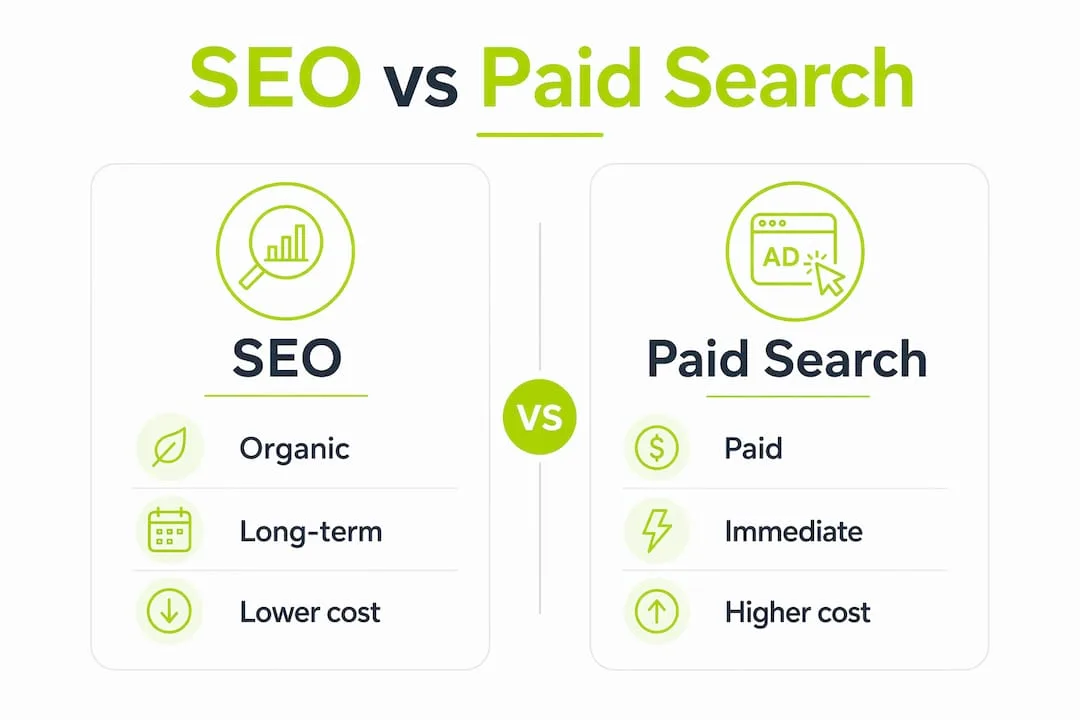
SEO builds compounding organic visibility over months and years; paid search buys immediate, controllable traffic the moment a campaign goes live. If you need leads this week, paid search is the faster path. If you want to reduce your cost-per-lead over the next two years, SEO is the smarter investment. The smartest move for most businesses is running both: use paid to test which keywords and messages actually convert, then feed those winners into your SEO content. Thewebteam works with trades, B2B companies, and niche businesses on exactly this sequence, starting with a fast WordPress foundation and building organic authority on top of it. One benchmark worth keeping in mind: SEO leads typically cost around $31 each, while PPC leads average about $181 each, which frames the long-term case for organic investment clearly.
Table of Contents
- How SEO differs from paid search: the core mechanics
- What paid search actually is and how it works
- What are the real advantages and disadvantages of each?
- SEO vs. paid search: side-by-side comparison
- When should you prioritize SEO or paid search?
- How do you measure success for each channel?
- How to run SEO and paid search together effectively
- A practical implementation checklist for WordPress sites
- Key Takeaways
- The channel debate misses the real question
- Thewebteam builds the WordPress foundation your SEO and paid campaigns need
- Useful sources and further reading
How SEO differs from paid search: the core mechanics
SEO, or search engine optimization, is the practice of improving your website so search engines rank it higher in organic (unpaid) results. It is not a single tactic. It is a system of four interconnected disciplines that compound over time.
Content strategy means publishing pages that match what your audience searches for at every stage of the buying cycle. Technical SEO covers site speed, crawlability, mobile performance, and structured data. Information architecture shapes how pages link together so search engines can understand your site's depth. Authority building earns backlinks and brand mentions that signal credibility to Google and Bing.
Core SEO components:
- Content strategy and topical depth
- Technical health: speed, crawlability, schema markup, mobile
- On-page signals: titles, headings, internal links, structured data
- Information architecture and site structure
- Backlinks and domain authority
One thing that has shifted recently: AI Overviews and SERP features are changing click behavior. Ranking well no longer guarantees the same traffic volume it once did. Strong SEO foundations, authoritative content, and clean technical structure are increasingly what AI systems draw on when generating answers, so the value of SEO is expanding beyond traditional blue links.
Timeline reality: Most sites see meaningful ranking movement between 3 and 6 months. Competitive terms in established industries can take 9–12 months or longer. Early milestones to watch are crawl coverage, indexed pages, and impressions in Google Search Console, not just rankings.
Pro Tip: Set up Google Search Console on day one. Impressions growth is the earliest signal that your content is entering Google's consideration set, weeks before rankings move.
What paid search actually is and how it works
Paid search, also called PPC (pay-per-click) or SEM (search engine marketing), places your ads at the top of search results in exchange for a bid. You pay when someone clicks. The ad appears almost immediately after a campaign is approved.

The mechanics are auction-based. Platforms like Google Ads and Microsoft Advertising (Bing Ads) factor in your bid, your Quality Score (a measure of ad relevance and landing page experience), and expected click-through rate to determine where your ad ranks. A higher Quality Score can let you outrank a competitor who bids more. Paid ads can appear in standard search results, Google Shopping, local map packs, and display networks.
What you are paying for and what you get quickly:
- Clicks on your ad, charged per click at your bid rate
- Immediate data on which keywords, headlines, and offers drive conversions
- Precise targeting by keyword, location, device, audience, and time of day
- Full budget control: pause, scale, or redirect spend in real time
PPC delivers immediate traffic and fast experiments. A campaign can generate conversion data within days, which is genuinely useful when you are entering a new market or testing a new offer. The tradeoff is that the traffic stops the moment the budget does.
Pro Tip: Before you launch a paid campaign, build a dedicated landing page for each ad group. Sending paid traffic to a generic homepage is one of the fastest ways to waste budget. A partner like TradePilot shows what a focused lead-capture page looks like in practice.
What are the real advantages and disadvantages of each?
Neither channel is universally better. The right choice depends on your timeline, budget, and how much risk you can absorb.
SEO strengths and weaknesses
Strengths:
- Traffic compounds over time without paying per click
- Higher trust signals: organic listings carry no "Sponsored" label
- Feeds AI visibility as search shifts toward AI-generated answers
- Lower cost-per-lead at scale (roughly $31 per lead in aggregate benchmarks)
Weaknesses:
- Results take 3–12 months, sometimes longer in competitive verticals
- Algorithm updates and AI Overviews can reduce click volume even when rankings hold
- Requires consistent content investment and technical maintenance
Paid search strengths and weaknesses
Strengths:
- Immediate visibility, often within hours of launch
- Precise audience and keyword targeting
- Every click, impression, and conversion is trackable
- Easy to test messaging, offers, and landing pages quickly
Weaknesses:
- Traffic stops when spend stops: no residual value
- CPCs in competitive industries can make cost-per-acquisition unsustainable long-term
- Ad fatigue and "ad blindness" reduce click-through rates over time
The cost gap is significant. At roughly $31 per SEO lead versus $181 per PPC lead, the math favors SEO at scale. But that gap only materializes after months of investment, which is why most growing businesses need paid search to bridge the gap while SEO builds.

SEO vs. paid search: side-by-side comparison
| Dimension | SEO | Paid Search (PPC) |
|---|---|---|
| Time to results | 3–12 months (sometimes longer) | Near-immediate (hours to days) |
| Cost model | Upfront investment; lower long-term cost per click | Ongoing spend per click; costs scale with volume |
| Scalability & control | Scales with content and authority; less direct control | Full budget and targeting control; scales with spend |
| Longevity | Compounds; pages can rank for years | Stops when budget stops |
| Intent match | Broad to high-intent depending on content type | Highly targeted by keyword, audience, and device |
| Typical KPIs | Organic sessions, keyword rankings, cost per lead over time | CPC, CTR, CPA, ROAS |
| Best use cases | Long-term brand visibility, authority, AI inclusion | Product launches, seasonal promos, fast lead generation |
A few axis clarifications worth noting:
- Small business context: A local trades company might see paid search generate leads within the first week, while SEO builds a foundation that reduces their Google Ads dependency over 12–18 months.
- Mid-market B2B: Longer B2B buying cycles mean SEO content that targets early-stage research queries can influence deals that close months later. Paid search handles bottom-funnel, high-intent queries where the buyer is ready to act now.
- ROAS benchmarks vary widely by industry, but paid search campaigns typically need a ROAS above 3:1 to justify ongoing spend in most B2B categories.
When should you prioritize SEO or paid search?
The answer almost always comes down to three variables: how fast you need results, how much budget you have, and how competitive your market is.
Use cases where paid search should lead
- Product or service launch with no existing organic presence
- Seasonal promotions where timing is fixed and you cannot wait for rankings
- New geographic market where your domain has no local authority
- High-intent, bottom-funnel queries where buyers are ready to purchase now
- Rapid message testing before committing to a long-form content strategy
Use cases where SEO should be primary
- High CPCs make paid acquisition unsustainable (common in legal, finance, and insurance)
- Long-term brand building where credibility and trust matter more than speed
- Informational and research-heavy queries that attract buyers early in the decision cycle
- Budget constraints that cannot sustain ongoing ad spend
Budget and timeline guidelines
- Starter paid budget: Even $500–$1,000/month on Google Ads can generate enough data to validate 5–10 keyword clusters in 30–60 days.
- SEO investment horizon: Expect 6–9 months before organic leads meaningfully offset paid spend in most competitive markets.
- Crossover point: When CPCs are high, a combined approach typically reaches a crossover where SEO outperforms PPC on cost-per-lead within 6–18 months, depending on competition and investment level.
- Reallocation signal: When organic sessions consistently cover 40–50% of your lead volume, it is usually time to reduce paid spend on those keyword clusters and redirect budget to new markets or untested queries.
Practical checkpoint: If your paid campaigns have been running for 60+ days and you have not used that conversion data to inform your content calendar, you are leaving the most valuable part of PPC on the table.
How do you measure success for each channel?
Measurement is where most teams get this wrong, and the mistake almost always involves last-click attribution.
SEO KPIs to track
- Organic sessions (Google Analytics 4, segmented by landing page)
- Keyword ranking movement (Google Search Console, Ahrefs, or Semrush)
- Assisted conversions: how often organic touchpoints appear in the path before a paid or direct conversion
- Cost per lead over time: divide your total SEO investment by leads generated each quarter; this number should fall as authority builds
Paid search KPIs to track
- Impressions and CTR: signal whether your ad copy is resonating
- CPC (cost per click): benchmark against your industry average
- CPA (cost per acquisition): the number that determines whether the channel is profitable
- ROAS (return on ad spend): revenue generated per dollar spent
Attribution tips
SEO often appears undervalued in last-click reports because it influences earlier stages of the buyer journey. A buyer might find your blog post through organic search, leave, and then convert on a retargeted paid ad. Last-click gives all credit to the ad. Multi-touch attribution, or at minimum reviewing assisted conversions in GA4, gives a more accurate picture of what SEO is actually contributing.
Common pitfalls:
- Stopping SEO investment because it "doesn't show up in conversions" when it is driving assisted conversions
- Comparing SEO and PPC on the same 30-day window (SEO compounds; PPC is immediate)
- Ignoring impression share data in paid campaigns, which reveals how much of the available market you are actually capturing
Pro Tip: In GA4, set up a custom exploration report that shows organic as an assisted conversion source. Most teams are shocked by how often SEO appears two or three touchpoints before the final paid click.
How to run SEO and paid search together effectively
The question "SEO or PPC?" is outdated. The real question is how to sequence them so each channel makes the other more effective.
The feedback loop playbook
- Run paid campaigns first on your highest-value keyword clusters. Collect 30–60 days of conversion data.
- Identify the top-converting keywords and ad copy from paid. These are your validated content priorities for SEO.
- Build long-form content around those validated topics. Use long-form content templates to structure pages that target decision-stage queries.
- Retarget organic visitors with paid ads. Someone who read your blog post but did not convert is a warm audience. A retargeting campaign with a specific offer closes that gap efficiently.
- Use paid to seed new content. When you publish a high-value page, run a small paid campaign to drive early traffic. That initial engagement can generate the external references and signals that support longer-term organic performance.
Experiment checklist
- Test 3–5 headline variants in paid ads before writing your SEO title tags
- Test landing page CTAs in paid before committing them to organic pages
- Use paid audience data (demographics, device, time of day) to inform your SEO content calendar
- Monitor which paid keywords trigger AI Overviews; those queries may need a different organic content approach
Budgeting phases
- Test phase (months 1–3): 70% paid, 30% SEO. Goal: validate keywords and messaging.
- Scale phase (months 4–9): 50/50 split. Goal: build organic assets on proven topics while maintaining paid volume.
- Maintain phase (month 10+): Shift toward 30% paid, 70% SEO as organic gains compound. Paid stays active for high-CPC terms and new campaign tests.
Paid search provides clean, fast learnings that materially reduce the risk of investing in longer-term SEO content around high-value queries. That is the practical case for running both channels from day one.
A practical implementation checklist for WordPress sites
For WordPress-based businesses, the path from paid insights to lasting organic assets follows a predictable sequence. Here is how Thewebteam approaches it with B2B and trades clients.
WordPress technical health (weeks 1–4)
- Confirm Core Web Vitals pass in Google Search Console (LCP under 2.5 seconds, CLS under 0.1)
- Compress images and implement lazy loading; use a caching plugin (WP Rocket or W3 Total Cache)
- Add schema markup for your business type (LocalBusiness, Service, or FAQPage)
- Audit your plugin stack; remove anything unused that adds load time
- Check crawl coverage: submit an XML sitemap and confirm no important pages are blocked in robots.txt
These technical quick wins often deliver outsized SEO improvements in 4–12 weeks on WordPress sites, making it faster to convert paid-test winners into organic winners.
Content and on-page (weeks 4–8)
- Map your top 10 paid keywords to existing or planned pages
- Write or update title tags and meta descriptions using your best-performing paid ad copy as a starting point
- Add internal links from high-traffic pages to conversion-focused pages
- Publish one case study or proof page per service line; case studies build topical authority and support AI visibility
Link building starters (months 2–6)
- Submit to relevant industry directories and local citations
- Reach out to suppliers, partners, and trade associations for backlinks
- Repurpose paid ad landing pages as linkable resources by adding data, FAQs, or how-to content
Sample timeline and expected signals
| Phase | Activity | Expected signal |
|---|---|---|
| Month 1 | Technical fixes, GSC setup, paid campaigns live | Crawl coverage improves; paid data starts flowing |
| Month 2–3 | Content publishing, on-page optimization | Impressions rise; first ranking movements |
| Month 4–6 | Link building, retargeting campaigns | Organic sessions grow; CPA begins to fall |
| Month 9–12 | SEO compounds; paid budget reallocated | Organic leads offset paid spend on core terms |
Pro Tip: Use site architecture planning before you publish new content. A clear silo structure helps search engines understand your topical authority faster than publishing isolated pages.
Key Takeaways
SEO and paid search serve different jobs on the same buyer journey: paid search captures immediate demand while SEO builds the compounding authority that lowers your cost-per-lead over time.
| Point | Details |
|---|---|
| Core difference | SEO builds long-term organic visibility; paid search delivers immediate, controllable traffic that stops when spend stops. |
| Cost-per-lead gap | SEO leads average roughly $31 each versus approximately $181 for PPC, a gap that widens as organic authority compounds. |
| Recommended sequence | Run paid first to validate keywords, then build SEO content around proven converters to reduce long-term acquisition costs. |
| Measurement priority | Use multi-touch or assisted-conversion reports; last-click attribution consistently undervalues SEO's role in the buyer journey. |
| Thewebteam approach | Thewebteam builds fast WordPress foundations and manages Google Ads alongside SEO, helping trades and B2B clients reach the paid-to-organic crossover point faster. |
The channel debate misses the real question
Most of the "SEO vs. paid search" content online frames this as a binary choice, and that framing leads teams to make a decision they should not be making at all. The real question is sequencing, not selection.
Paid search is a learning machine. It tells you, within weeks, which keywords convert and which messages resonate. That information is genuinely expensive to acquire through SEO alone, where you might invest six months in content before discovering the topic does not convert. Teams that skip paid entirely and go straight to SEO are essentially betting on their instincts rather than data.
The other common mistake runs in the opposite direction: teams that run paid indefinitely without building organic assets are renting their traffic. Every month they pay for clicks that a well-ranked organic page would deliver for free. The crossover point, where SEO cost-per-lead drops below paid, typically arrives within 6–18 months for most competitive markets. Stopping SEO investment at month four because rankings have not moved yet is the single most expensive mistake in digital marketing.
One more thing worth saying plainly: last-click attribution makes SEO look worse than it is. A buyer who reads three of your blog posts over two months before clicking a retargeted ad looks like a paid conversion in most dashboards. Fix the measurement before you make budget decisions, or you will keep defunding the channel that is actually warming up your pipeline.
Thewebteam builds the WordPress foundation your SEO and paid campaigns need
Running SEO and paid search together only works when your website can actually convert the traffic both channels send. Slow load times, broken mobile layouts, and weak landing pages waste paid budget and suppress organic rankings at the same time.
Thewebteam builds fast, conversion-ready WordPress sites for trades, B2B companies, and niche industries, and manages Google Ads and SEO as ongoing services. Clients get a site that goes live within days, not weeks, with hosting included for the first year and no hidden costs. From there, the team handles technical maintenance, on-page optimization, and paid campaign management so you can focus on running your business.
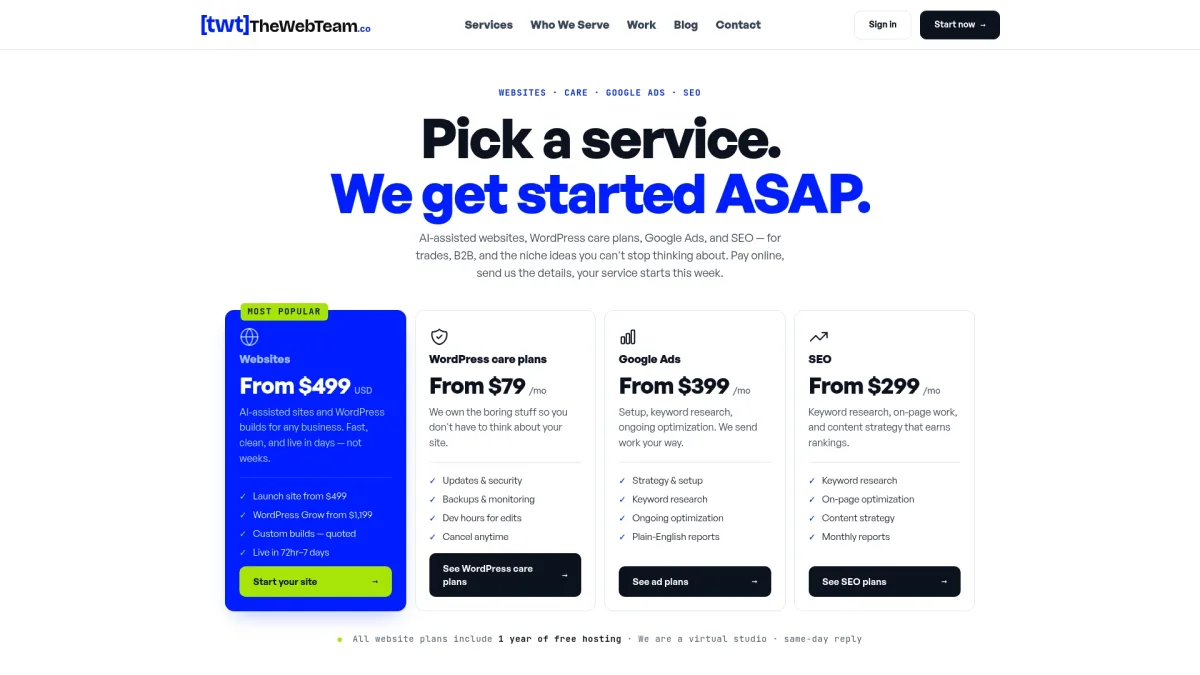
If you want to see what that looks like in practice, the services and pricing page covers the full offering. Or browse the portfolio to see results from clients in similar industries. Ready to get started? Reach out to Thewebteam for a quick site review and a clear picture of where your paid and organic strategy should go next.
Useful sources and further reading
These resources cover the core concepts in this guide and are worth bookmarking for ongoing reference.
- SEO vs. PPC: Understanding the Difference (Google) — Google's own explanation of how paid ads and organic search interact; useful for understanding Quality Score and how the two channels coexist in the same SERP.
- SEO Vs. PPC Strategy: What's Right For Your Business? (Search Engine Journal) — Detailed breakdown of when each channel wins, with practical guidance on blending the two; one of the more balanced treatments of the topic.
- SEO ROI Statistics (Resourcera) — Aggregated data on SEO cost-per-lead, ROI benchmarks, and break-even timelines; the source for the $31 vs. $181 cost-per-lead figures cited in this guide.
- SEO vs Paid Search: What Actually Works and When (Factors.ai) — Strong on attribution: explains why last-click reporting undervalues SEO and how to set up multi-touch measurement properly.
- Why the SEO vs. PPC Debate Is Finally Over (Search Engine Land) — Makes the case for treating SEO and paid search as a single integrated system, with useful context on AI Overviews and changing SERP dynamics.
- Technical SEO Checklist for B2B Websites (Thewebteam) — Step-by-step WordPress and B2B technical checklist; practical starting point for any site audit.
- How B2B Buying Cycles Affect SEO (Thewebteam) — Explains how long sales cycles change the way you should structure and measure SEO content; especially useful for trades and industrial businesses.
- The Role of Case Studies in SEO (Thewebteam) — Covers how proof-based content builds topical authority and supports AI visibility for B2B sites.