
On-page SEO elements for B2B sites are the specific webpage components you control directly to improve search visibility and attract decision-makers who are actively researching vendors. These elements include title tags, meta descriptions, headings, body content, internal links, structured data, and image alt text. 57% of US B2B decision-makers still start their research on traditional search engines, and most complete 61–70% of their vendor evaluation before ever contacting sales. That means your website must do the selling before a human ever does.
1. Which on-page SEO elements drive B2B rankings and leads?
The on-page SEO elements with the greatest impact on B2B sites are title tags, meta descriptions, heading structure, body content, internal links, image optimization, and structured data. Each one serves a distinct role in helping search engines understand your page and helping buyers trust your brand.
Title tags
Your title tag is the first signal Google reads to determine page relevance. For B2B sites, write titles that reflect buyer intent rather than product features. "Enterprise Inventory Software for Manufacturers" outperforms "InventoryPro Software" every time. Keep titles under 60 characters and place the primary keyword near the front.

Meta descriptions
Meta descriptions do not directly affect rankings, but they control whether a buyer clicks. Write them as a one-sentence value proposition aimed at a specific decision-maker. A well-crafted meta description raises click-through rates and signals content relevance to Google's quality systems.
Heading structure (H1, H2, H3)
Use one H1 per page that contains your primary keyword and states the page's core purpose. H2 and H3 headings should map to the questions your buyers actually ask. This structure helps search engines index your content and helps busy executives scan for the answer they need.
Body content aligned to buyer stages
Content depth separates B2B SEO from general SEO. Buyers complete 70% of their journey before contacting a vendor, so your pages must educate, validate, and build trust without a sales rep in the room. Case studies, benchmarks, and technical documentation belong on your site, not just in sales decks.
Internal linking
Internal links distribute authority across your site and guide buyers deeper into your content. Link from high-traffic blog posts to product or service pages. Link from service pages to supporting case studies. A deliberate internal linking structure keeps buyers on your site longer and signals topical authority to Google.
Image optimization and alt text
Every image on a B2B site needs a descriptive alt text that includes relevant keywords where natural. Alt text serves two purposes: it helps visually impaired users and it gives search engines additional context. Compress images to reduce load time without sacrificing quality.
Structured data markup (schema)
Schema markup tells search engines exactly what your content means. FAQ schema, HowTo schema, and Product schema are all relevant to B2B pages. Structured data is critical AI infrastructure, not just optional SEO. AI tools pull from schema to generate answers and recommendations in search results.
Pro Tip: Add FAQ schema to any page that answers a specific buyer question. This increases your chances of appearing in AI-generated answer summaries and featured snippets.
2. How content strategy and keyword targeting differ for B2B sites
B2B keyword strategy is not about chasing high-volume terms. It is about matching the exact language your decision-makers use when they are mid-research and comparing vendors.
-
Target decision-maker personas. A CFO searches differently than a plant manager. Build separate keyword clusters for each persona and create dedicated pages for each. Use Thewebteam's guide on targeting decision makers to map persona-specific intent.
-
Prioritize long-tail, problem-solving keywords. "How to reduce downtime in CNC manufacturing" converts better than "manufacturing software." Long-tail keywords signal specific intent and attract buyers who are closer to a decision.
-
Build content depth for complex buying cycles. B2B purchases involve multiple stakeholders and months of evaluation. A single 500-word page will not satisfy a procurement team. Long-form content that covers a topic from multiple angles earns more backlinks, more time on page, and more trust.
-
Include validation content. Technical buyers test solutions on platforms like GitHub and read documentation before reaching out. Technical content that is easily discoverable builds credibility at the deepest stage of the buying cycle.
-
Add FAQ sections to support AI consumption. Generative AI tools pull structured Q&A content to build their answers. A well-structured FAQ on your service page increases the chance your brand appears in an AI-generated vendor summary.
-
Align content with peer validation workflows. B2B buyers cross-reference vendor claims with industry forums, analyst reports, and peer reviews. Your on-page content should cite third-party data and link to authoritative sources to reinforce credibility.
3. Technical and UX on-page best practices for B2B sites
Technical SEO and user experience are not separate disciplines. They work together to make your site fast, crawlable, and easy for buyers to navigate.
- Mobile responsiveness. B2B buyers research on mobile, even for enterprise purchases. Google indexes the mobile version of your site first. A site that breaks on a phone loses rankings and buyers simultaneously.
- Page speed. Slow pages increase bounce rates. Compress images, minimize JavaScript, and use browser caching. A one-second delay in load time measurably reduces conversions.
- Clean URL structures. URLs should describe the page content using keywords.
/services/erp-software-for-distributorsoutperforms/page?id=482in both rankings and click-through rates. - Site architecture. Flat site architecture, where any page is reachable within three clicks from the homepage, improves crawlability and user flow. Review Thewebteam's guide on site architecture and SEO for a practical framework.
- Accessibility compliance. ARIA roles, descriptive alt text, and proper heading hierarchy are not just accessibility requirements. They also improve how search engines parse your content.
- Lazy loading. Load images only when they enter the viewport. This reduces initial page load time without removing visual content.
- Semantic HTML. Use proper HTML5 elements (
<article>,<section>,<nav>) to give AI tools and search engines clear structural signals about your content.
Pro Tip: Run your B2B site through Google's PageSpeed Insights and Core Web Vitals report monthly. Fix the highest-impact issues first, starting with Largest Contentful Paint (LCP) and Cumulative Layout Shift (CLS).
Use Thewebteam's technical SEO checklist to audit your site against every major technical factor before publishing new content.
4. How B2B sites can optimize for AI-driven search in 2026
AI search is no longer a future consideration. 83% to 89% of B2B buyers now use generative AI for self-guided vendor research. AI search traffic converts at 14.2%, compared to 2.8% for Google organic search. That gap makes AI visibility a direct revenue issue.
Google AI Overviews appear on over 25% of searches, double the rate from the prior year. When AI summaries appear, organic click-through rates drop 61%. Your goal shifts from ranking on page one to being cited inside the AI answer itself.
To optimize for AI-driven search, focus on these practices:
- Write citable content. Use clear data points, named statistics, and direct claims. AI tools cite content that states facts definitively.
- Add TLDR summaries. Place a two-to-three sentence summary at the top of long pages. AI tools extract these summaries to build their answers.
- Use structured data for every content type. FAQ schema, HowTo schema, and Product schema all increase the likelihood that AI tools pull your content into generated answers.
- Earn third-party citations. Over 85% of AI answer citations come from earned media and authoritative third-party sources, not vendor websites. Guest articles, analyst mentions, and industry directory listings all contribute to AI citation authority.
- Optimize demos and calculators. Interactive tools that produce specific outputs give AI tools something concrete to reference. A ROI calculator with clear inputs and outputs is more citable than a generic product description.
- Monitor AI visibility. Track whether your brand appears in AI-generated answers for your target queries. Adjust your content strategy based on what AI tools cite and what they ignore.
94% of B2B buyers used AI during their most recent purchase, with AI tools becoming the top vendor research source, outranking vendor websites and sales reps. Ignoring AI optimization in 2026 means being invisible to the majority of your buyers.
5. Common pitfalls B2B marketers make with on-page SEO
Most B2B SEO failures come from applying consumer SEO logic to a fundamentally different buying process. These are the mistakes that cost the most.
- Keyword stuffing instead of intent matching. Repeating a keyword 20 times does not improve rankings. Writing content that directly answers a buyer's specific question does.
- Ignoring AI search presence. Tracking only Google rankings misses the growing share of buyers who never see traditional search results. AI visibility requires a separate monitoring strategy.
- Using "request a demo" as the only call to action. Most buyers are not ready to talk to sales. Pages with no educational content, no case studies, and no downloadable resources lose buyers who need more time.
- Neglecting metadata for different personas. A single generic meta description for a page that serves both a technical buyer and a financial decision-maker serves neither well. Write persona-specific metadata where possible.
- Skipping accessibility and technical hygiene. Broken links, missing alt text, and slow load times all reduce rankings. Search engines treat these as signals of low-quality pages.
- Not updating content regularly. B2B buyers trust current information. A case study from 2021 or a pricing page that has not been updated signals neglect, not authority.
Key Takeaways
Effective B2B on-page SEO requires aligning every page element, from title tags to structured data, with the specific research behaviors of decision-makers who complete most of their vendor evaluation before any human contact.
| Point | Details |
|---|---|
| Title tags and meta descriptions | Write for buyer intent and specific personas, not generic product names. |
| Content depth matters | Buyers complete 70% of their journey before contact, so pages must educate independently. |
| Structured data is non-negotiable | Schema markup feeds AI tools and increases citation chances in generated answers. |
| AI search requires separate tactics | Monitor AI visibility and earn third-party citations, since 85%+ of AI citations come from external sources. |
| Technical SEO supports everything | Page speed, mobile responsiveness, and clean architecture directly affect both rankings and buyer trust. |
B2B SEO in 2026 is not what it was two years ago
I have worked with enough B2B sites to say this plainly: the teams that treat on-page SEO as a checklist are losing ground fast. The buyers have changed. They are not waiting for a sales rep to explain your product. They are asking an AI tool, reading what it surfaces, and forming opinions before your team even knows they exist.
What I keep seeing is B2B marketers who optimize for Google rankings but have no idea whether their brand appears in a single AI-generated answer. That is a blind spot that will cost real pipeline. The fix is not complicated, but it requires a mindset shift. Your content needs to be citable, not just rankable. That means clear data, direct claims, structured formats, and third-party validation woven into the page itself.
The other thing I push back on is the idea that technical SEO and content strategy are separate workstreams. They are not. A beautifully written page that loads in five seconds on mobile is invisible. A fast page with thin content gets no citations. The sites that win in 2026 treat every on-page element as part of a single system, and they review that system regularly, not once a year.
— Jonathon
How Thewebteam builds B2B sites that rank and convert
B2B websites that rank well and generate qualified leads share one trait: every on-page element is built with both search engines and decision-makers in mind from day one.
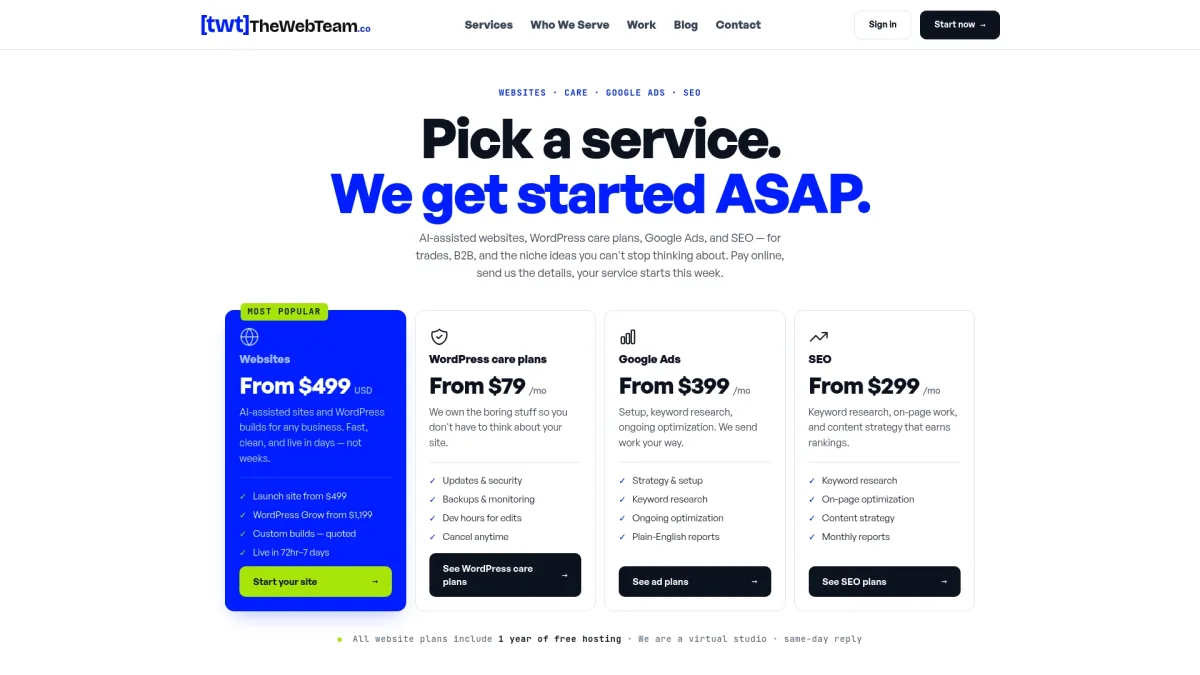
Thewebteam designs and builds B2B websites with on-page SEO baked into the structure, not added as an afterthought. From schema markup and heading hierarchy to page speed and content architecture, every element is configured to perform in both traditional and AI-driven search. The team's SEO and web design services are built for trades, industrial, and B2B companies that need results without months of back-and-forth. View the project portfolio to see how these principles translate into real-world rankings and lead generation for B2B clients.