
B2B buying cycles directly determine how your SEO strategy must be structured, timed, and measured. The average B2B SaaS sales cycle now runs 134 days, up 25% from 2023. That single number rewrites the rules for content planning, keyword targeting, and attribution. Buyers spend months researching before they ever contact a vendor. If your SEO content only supports the first 30 days of that process, you are invisible for the other 100. This guide breaks down exactly how the B2B buying process shapes SEO decisions at every stage, and what you need to do differently in 2026.
How B2B buying cycles affect SEO strategy at every stage
B2B buying cycles follow a predictable path, and each stage demands a different type of content. Miss a stage, and you lose the buyer to a competitor who showed up when you did not.
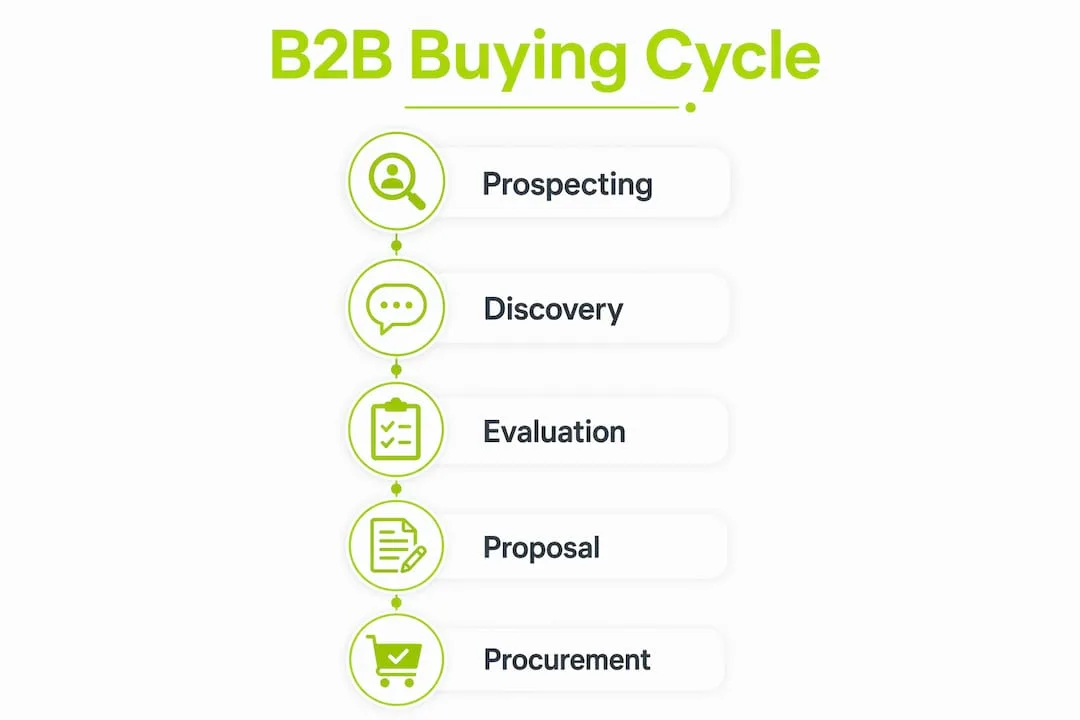
The five core stages are prospecting, discovery, evaluation, proposal and negotiation, and procurement or legal review. Each one carries distinct search behavior and content needs.

| Stage | Typical Duration | Primary SEO Content Need |
|---|---|---|
| Prospecting | 1–3 weeks | Thought leadership, industry benchmarks |
| Discovery | 2–4 weeks | Problem-aware blog posts, comparison guides |
| Evaluation | 4–8 weeks | Case studies, ROI calculators, technical specs |
| Proposal and negotiation | 2–4 weeks | Pricing pages, security FAQs, testimonials |
| Procurement and legal | 4–6 weeks | Compliance docs, vendor security questionnaires |
The procurement and legal stage alone adds 30–45 days to deals over $100,000 in contract value. That means your SEO content must address legal and security concerns before buyers even reach that stage. Buyers research vendor security posture and compliance requirements during evaluation, not after signing.
Evaluation and procurement stages consume 50–75% of total B2B sales cycle time. Buying committees have expanded to an average of 13 stakeholders. Each stakeholder searches independently, which means your SEO must surface relevant content for a CFO, an IT director, and an end user simultaneously.
- Prospecting content: Industry reports, benchmark studies, and trend articles capture buyers who do not yet know they have a problem.
- Discovery content: Problem-framing posts and "how to solve X" guides pull in buyers who recognize the pain but have not evaluated solutions.
- Evaluation content: Case studies in SEO and technical comparison pages directly influence shortlisting decisions.
- Procurement content: Vendor security FAQs, compliance summaries, and pre-clearance documentation reduce friction at the final gate.
Pro Tip: Map your existing content library against these five stages. Most B2B sites are overloaded with discovery content and nearly empty at the evaluation and procurement stages. Fill those gaps first.
How do longer sales cycles change your content strategy?
A 60-day nurture campaign is a structural mismatch for a 134-day sales cycle. Running short nurture sequences is one of the costliest mistakes in B2B marketing. Buyers drop out of short sequences and then re-engage months later. If your content has expired or gone stale, you lose them.
The shift required is from campaign thinking to asset thinking. Campaigns have end dates. Assets do not. A well-built ROI calculator, a technical benchmark report, or a community-sourced insight document stays relevant for 12–18 months and compounds in search authority over time.
Long-form content strategy built around buyer journey stages outperforms short-cycle content in B2B because it matches the actual research timeline. Buyers return to the same resources multiple times across a 90–180 day evaluation window. Your content needs to hold up under that repeated scrutiny.
Multi-stakeholder buying groups also change what content needs to do. A single piece of content rarely satisfies an entire committee. The most effective SEO assets are ones that buyers can share internally to build consensus.
- Ungated ROI calculators let financial stakeholders run their own numbers without waiting for a sales call.
- Technical benchmark reports give IT teams the data they need to justify a vendor choice to leadership.
- Security and compliance summaries reduce the back-and-forth between your team and the buyer's legal department.
- Playbooks and self-service sandboxes let end users evaluate fit without a demo bottleneck.
Pro Tip: Build every major content asset with internal sharing in mind. Add a one-page summary version of each long-form piece. Buyers print those summaries and bring them to committee meetings. That is free distribution inside accounts you cannot reach directly.
What role does AI-driven search play in B2B SEO?
Google AI Overviews now appear on over 25% of search results, and zero-click search rates have risen to 72%. That means the majority of B2B searches now end without a click to any website. This is not a future threat. It is the current reality.
The SEO goal has shifted. Ranking on page one still matters, but appearing inside an AI-generated summary matters more for brand visibility in zero-click environments. Buyers read the AI summary, form an opinion, and then search for the brand they just saw cited.
Brands are 6.5x more likely to be cited in AI summaries via third-party sources than through their own domain content. That single fact reframes the entire content strategy. Publishing on your own site is necessary but not sufficient. Earning citations in industry publications, analyst reports, and community forums is what drives AI visibility.
Here is how to build for AI citation in B2B:
- Publish original data. Proprietary benchmarks and survey results get cited by AI because they are primary sources. Rephrased industry stats do not.
- Use structured data markup. Schema.org markup for FAQPage, HowTo, and Article types helps AI systems parse and cite your content accurately.
- Earn third-party mentions. Guest articles in trade publications, analyst briefings, and community contributions all build the citation graph that AI systems draw from.
- Monitor AI visibility separately. Track how often your brand appears in AI Overviews for target queries. This is a different metric from organic ranking and requires different tools.
- Format for extraction. Use clear H2 and H3 headings, short answer paragraphs, and definition-style sentences. AI systems extract content that is easy to parse.
The brands winning B2B SEO in 2026 are not just ranking. They are being cited. That distinction drives how you allocate content production resources.
How can B2B marketers align SEO with buyer intent and procurement timelines?
Intent data is the bridge between SEO traffic and actual pipeline. Buyers signal purchase intent through search behavior weeks before they fill out a form. Monitoring which companies visit your pricing page, your security FAQ, or your case study library tells you who is in an active evaluation cycle.
Aligning SEO with procurement timelines means publishing content that addresses legal and security questions before buyers ask them. A dedicated vendor security page, a GDPR compliance summary, or a pre-filled security questionnaire template removes friction at the procurement stage. Buyers who find that content through search arrive at the legal stage already partially cleared.
Targeting decision-makers with SEO requires multi-threading your content across job functions. A CFO searches for ROI and payback period. A CTO searches for integration complexity and uptime guarantees. An end user searches for ease of use and training resources. Each search string is a different keyword cluster, and each cluster needs its own content.
- Use intent data platforms to identify accounts showing active research behavior.
- Create champion enablement assets, such as internal pitch decks and ROI summaries, that buyers can use to sell your solution internally.
- Build mutual action plan templates into your content library so buyers can share a structured evaluation timeline with their committee.
- Automate follow-up sequences that trigger based on content consumption signals, not just form fills.
What metrics actually measure SEO performance over long buying cycles?
Last-touch attribution undercounts SEO's real contribution to B2B pipeline. Traditional attribution models miss 3x to 5x the actual wins because 70–80% of pipeline conversations happen in untracked channels. A buyer reads your blog post in month one, attends a webinar in month three, and fills out a form in month five. Last-touch credits the form. SEO gets nothing.
Self-reported attribution fixes this. Ask every new customer how they first heard about you and what content influenced their decision. The answers consistently show that organic search content touched the deal far earlier than any tracked conversion event.
| Attribution Model | What It Captures | What It Misses |
|---|---|---|
| Last-touch | Final conversion event | All prior research touchpoints |
| First-touch | Initial awareness source | Mid-cycle nurture influence |
| Multi-touch | Weighted credit across touchpoints | Untracked channel interactions |
| Self-reported | Buyer's own account of influence | Precise channel-level data |
A technical SEO checklist for B2B sites should include site structure that supports stage-based content discovery, schema markup for all content types, and page speed optimization across all devices. Buyers return to your site multiple times over a 134-day cycle. A slow or disorganized site loses them on the second or third visit, not the first.
- Track keyword rankings across all five buying stages, not just high-volume awareness terms.
- Measure time-on-page and return visit rates for evaluation-stage content. These signal genuine buyer engagement.
- Use CRM data to connect organic traffic sessions to closed deals, even when the session happened months before the close.
- Build case studies that document specific results with named metrics. These rank for evaluation-stage queries and build trust over time.
Key Takeaways
B2B SEO fails when content strategy is built for a 30-day cycle but buyers take 134 days to decide.
| Point | Details |
|---|---|
| Buying cycle length reshapes SEO | A 134-day average cycle means content must support research across 5 distinct stages. |
| Procurement adds hidden delays | Deals over $100K trigger 30–45 day legal reviews that SEO content must address proactively. |
| AI citation beats page ranking | Brands cited via third-party sources are 6.5x more visible in AI Overviews than self-published content. |
| Short nurture campaigns waste budget | 60-day sequences fail for cycles averaging 134 days; durable, ungated assets outperform. |
| Last-touch attribution lies | Self-reported and multi-touch models reveal 3x to 5x more SEO influence than last-touch tracking shows. |
What I have learned from watching B2B SEO fail the same way, repeatedly
Most B2B marketers I work with are not failing at SEO because they lack skills. They are failing because they are solving a 2019 problem with 2019 tools in 2026. The buying cycle has stretched. The committee has grown. The search engine has changed. The content strategy has not.
The biggest mistake I see is treating SEO as a top-of-funnel awareness play and nothing else. Teams publish blog posts, watch traffic climb, and then wonder why pipeline does not follow. The answer is almost always the same: the content stops at discovery and leaves buyers alone during the 90 days when they are actually deciding.
The second mistake is ignoring AI search visibility entirely. Brands that are not actively building third-party citation graphs are becoming invisible in AI Overviews. That is not a ranking problem. It is a credibility problem. AI systems cite sources they trust, and trust is built through earned media, original data, and structured content, not through publishing more blog posts on your own domain.
The clients who get this right do three things consistently. They publish content that addresses every stage of the buying cycle, including the uncomfortable procurement and legal stages. They invest in original research that earns third-party citations. And they measure SEO influence across the full 134-day window, not just the last click. Patience is not a soft skill in B2B SEO. It is the core competency.
— Jonathon
How Thewebteam builds SEO for complex B2B buying cycles
B2B companies with long sales cycles need websites and SEO strategies that hold up over months of buyer scrutiny, not just weeks.
Thewebteam builds WordPress websites and SEO programs specifically for trades, industrial, and B2B businesses where buying decisions take time and involve multiple stakeholders. The work covers everything from site structure and technical SEO to content planning aligned with real buyer timelines. You can review client results and case studies to see how that approach performs across different industries. For a full picture of what is available, the services and pricing page covers every option without hidden costs.