
A technical SEO checklist for B2B websites is a structured audit process that ensures your site's infrastructure lets search engines discover, index, and rank your pages while supporting lead generation. 70% of B2B sites have undiscoverable pages due to critical technical barriers. That number explains why so many B2B marketers invest in content and ads but still struggle to generate organic leads. This guide covers every major checkpoint, from crawlability and Core Web Vitals to structured data and security, so you can fix what matters most and stop losing traffic to preventable errors.
1. Audit crawlability and indexing first
Crawlability is the foundation of any technical SEO audit for a B2B site. If search engines cannot reach your pages, nothing else in your checklist matters. Common blockers include broken links, redirect chains, incorrect canonical tags, and orphan pages that receive no internal links.
Start your audit with these checks:
- robots.txt: Confirm you are not accidentally blocking key lead pages or service sections.
- Meta robots tags: Check that no important pages carry a
noindexdirective. - XML sitemap: Submit a clean, updated sitemap in Google Search Console and verify all URLs return a 200 status.
- Canonical tags: Make sure every page points to the correct canonical URL to avoid duplicate content penalties.
- Redirect chains: Flatten any chains longer than one hop. Each extra redirect wastes crawl budget and slows load time.
- Broken links: Fix or remove any internal or external links returning 404 errors.
Google Search Console is the fastest free tool for spotting indexing errors, coverage issues, and manual actions. For deeper crawl data, desktop crawlers give you a full picture of your site's link graph and response codes.
Pro Tip: Filter your sitemap URLs in Google Search Console by "Excluded" status. Pages labeled "Crawled, currently not indexed" often signal thin content or canonicalization problems that a quick content audit can fix.

2. Structure your site architecture for crawl efficiency
Site architecture directly controls how crawl budget gets distributed across your B2B website. A flat structure, where any page is reachable within three clicks from the homepage, keeps your most valuable pages well within crawl range.
Follow these principles:
- Keep your URL structure short, descriptive, and keyword relevant. Avoid dynamic parameters where possible.
- Group related content into logical silos. For example, cluster all case studies under
/case-studies/and all service pages under/services/. - Use internal links to connect high-authority pages to conversion-focused pages like demo request forms or product pages.
- Handle faceted navigation carefully. Use canonical tags or parameter handling in Google Search Console to prevent duplicate URL proliferation.
- Audit JavaScript rendering. If your B2B site relies heavily on JavaScript frameworks, confirm that Googlebot can render and index the content correctly.
Pro Tip: Build a simple spreadsheet mapping your top 20 revenue-driving pages. Check how many internal links each one receives. Pages with fewer than three internal links are underserved and should be prioritized in your next content or navigation update.
A well-structured site also supports your B2B content strategy, since search engines reward sites where topical clusters are clearly organized and internally linked.
3. Fix page speed and Core Web Vitals
Page speed is a direct ranking factor and a conversion driver. Fast, optimized B2B sites see roughly 20% higher conversion rates compared to slow ones. That uplift is significant when a single enterprise lead can be worth tens of thousands of dollars.
Google's Core Web Vitals measure three specific performance signals:
- LCP (Largest Contentful Paint): Targets under 2.5 seconds. Aim for under 1.8 seconds on B2B sites where first impressions drive trust.
- INP (Interaction to Next Paint): Measures responsiveness to user input. Keep it under 200 milliseconds.
- CLS (Cumulative Layout Shift): Measures visual stability. A score under 0.1 prevents the jarring layout shifts that erode credibility.
Common B2B-specific bottlenecks include heavy CRM embed scripts, marketing automation tags, and unoptimized hero images on service pages. Audit your third-party scripts with browser developer tools and defer or remove any that are not critical to page function. Use Google PageSpeed Insights or WebPageTest to benchmark your scores before and after changes.
4. Verify HTTPS security across the entire site
HTTPS is a confirmed Google ranking signal, and security lapses cause roughly a 30% drop in organic traffic. Modern browsers label HTTP pages as "Not Secure," which kills trust before a B2B buyer even reads your value proposition.
Run these security checks:
- Confirm your SSL certificate is valid and not expired.
- Check that all internal links, images, and scripts load over HTTPS, not HTTP. Mixed content warnings appear even when the page itself is secure.
- Verify that HTTP URLs redirect to HTTPS with a 301 redirect.
- Check that your
wwwand non-wwwversions resolve to a single canonical domain.
"An insecure site does not just hurt rankings. It signals to procurement teams and IT buyers that your company does not take data protection seriously."
Security audits belong in your monthly website maintenance routine. A DIY maintenance checklist helps you stay on top of certificate renewals and mixed content issues before they compound into ranking drops.
5. Confirm mobile responsiveness with mobile-first indexing in mind
Google uses the mobile version of your site as the primary basis for indexing and ranking. Poor mobile experience leads to ranking penalties and higher bounce rates, even for B2B sites where most conversions happen on desktop.
Test and fix these mobile issues:
- Use Google's Mobile-Friendly Test to check each key page.
- Confirm that text is readable without zooming and that tap targets are spaced at least 48 pixels apart.
- Check that your mobile layout does not hide content that appears on desktop. Hidden content may not be indexed.
- Verify that forms, CTAs, and navigation menus function correctly on small screens.
- Test page load speed on a simulated 4G connection, not just broadband.
B2B buyers increasingly research vendors on mobile during commutes and between meetings. A site that works poorly on a phone loses those early-stage research visits permanently.
6. Add structured data and schema markup
Structured data tells search engines exactly what your content means, not just what it says. Schema markup improves SERP presence and prepares B2B sites for AI-enhanced search features that are becoming standard in 2026.
Common schema types for B2B websites include:
| Schema Type | Best Use Case |
|---|---|
| Organization | Brand identity, contact info, social profiles |
| LocalBusiness | Location-based service providers |
| FAQPage | FAQ sections targeting featured snippets |
| Product | SaaS or physical product pages |
| BreadcrumbList | Site navigation clarity in SERPs |
Implement schema using JSON-LD format, which Google recommends. Validate your markup with Google's Rich Results Test before publishing. Structured data also increases your eligibility for rich snippets, which lift click-through rates without requiring a higher ranking position.
Pro Tip: Add FAQPage schema to your most-visited service pages. B2B buyers often search with question-based queries, and FAQ rich snippets can capture that traffic even when you rank in position 4 or 5.
Key takeaways
A technical SEO audit for a B2B site must address crawlability, architecture, speed, security, mobile usability, and structured data to generate consistent organic leads.
| Point | Details |
|---|---|
| Crawlability comes first | Fix robots.txt, canonicals, and broken links before any other SEO work. |
| Architecture drives indexing | Keep pages within three clicks of the homepage and use internal links to support conversion pages. |
| Speed lifts conversions | Optimizing Core Web Vitals can increase B2B conversion rates by around 20%. |
| HTTPS is non-negotiable | Security lapses cause significant traffic drops and destroy buyer trust. |
| Schema prepares you for AI search | Structured data improves SERP visibility and readiness for AI-driven search features in 2026. |
What I've learned from auditing B2B sites that look fine on the surface
Most B2B sites I review have the same problem. They look polished, but the technical foundation is quietly blocking organic growth. The issues are rarely dramatic. They are usually a handful of noindex tags left over from a staging site, a redirect chain that nobody cleaned up after a redesign, or a sitemap that still lists pages deleted two years ago.
The fix is a consistent audit schedule. Weekly 15-minute checks in Google Search Console, monthly link and speed reviews, and a half-day deep crawl every quarter catch problems before they compound. That schedule sounds like a lot, but the weekly check is genuinely 15 minutes once you know what to look for.
Tool choice matters too. Specialists favor desktop crawlers for raw diagnostic data, while marketing teams get more value from cloud-based platforms that generate shareable reports and track regressions over time. The right answer depends on who owns the audit in your organization.
My honest advice: do not try to fix everything at once. Prioritize crawlability and indexing first, then speed, then structured data. Quick wins build momentum and buy you the time to tackle the deeper architectural work.
— Jonathon
How Thewebteam helps B2B companies get the technical foundation right
B2B websites carry a heavier technical load than most. Gated content, CRM integrations, and complex service architectures create SEO problems that generic web agencies miss.
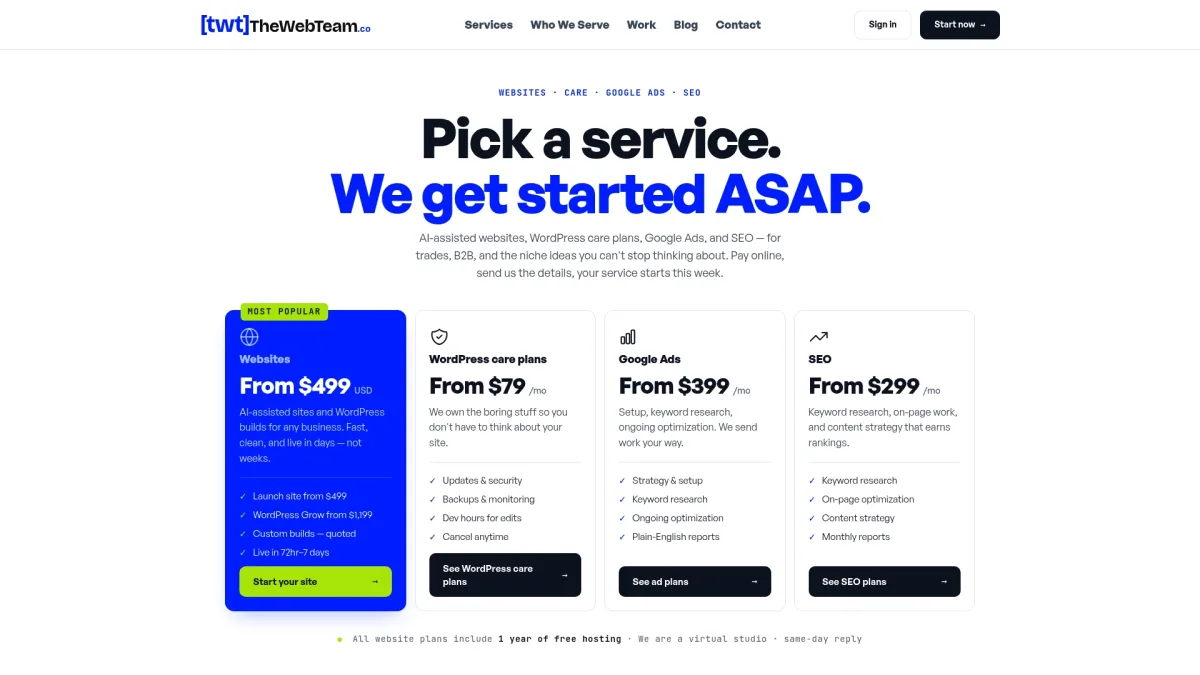
Thewebteam builds and maintains B2B-focused websites with technical SEO built in from day one, not bolted on later. From site architecture and page speed to schema markup and ongoing care plans, the team handles the technical work so you can focus on your pipeline. See the services and pricing or browse the client portfolio to see what a properly optimized B2B site looks like in practice.