
A long-form content strategy for B2B SEO is the practice of producing in-depth, semantically rich articles that satisfy both traditional search engines and AI-based answer systems to build topical authority and drive qualified pipeline. B2B buyers now research across Google, ChatGPT, and Perplexity before they ever contact a vendor. That means your content must rank in two places at once. The Dual-Structure Architecture approach and funnel-stage targeting are the two techniques that separate B2B content that generates revenue from content that only generates traffic.
What makes long-form content effective for B2B SEO?
Effective long-form SEO writing starts with a depth threshold of 1,500+ words with structured subheadings. That minimum is not arbitrary. AI answer engines and Google's ranking algorithms both reward content that covers a topic completely, not content that skims it.

Semantic richness matters as much as length. Every article should include named entities: specific frameworks, standards, statistics, and techniques. Generic advice like "write good content" gives AI systems nothing to extract and cite. Named techniques like Dual-Structure Architecture, funnel-stage targeting, and semantic enrichment give AI systems quotable, citable claims.
Structured formatting is the third pillar. Tables, numbered lists, and clear H2/H3 hierarchies make content scannable for human readers and parseable for AI crawlers. A wall of prose, no matter how insightful, loses both audiences.
"Thin, fluff-heavy articles are the single biggest waste of B2B content budget. Length without depth is just noise."
The fourth pillar is quotable statements. Place a direct, declarative answer in the first two sentences under every H2 heading. AI systems pull from those positions first. Long-form content also generates significantly more backlinks and social shares than short-form pieces. More backlinks compound your authority over time, which is why depth pays dividends long after publication.
Pro Tip: Write your quotable statement before you write the supporting paragraph. If you cannot summarize the section in one sentence, the section lacks a clear point.
How to plan your B2B content strategy by funnel stage
Planning is where most B2B content strategies fail. Half the content creation effort should be upfront planning with detailed outlines aligned to specific buyer intents. Skipping this step produces unfocused articles regardless of how long they are.
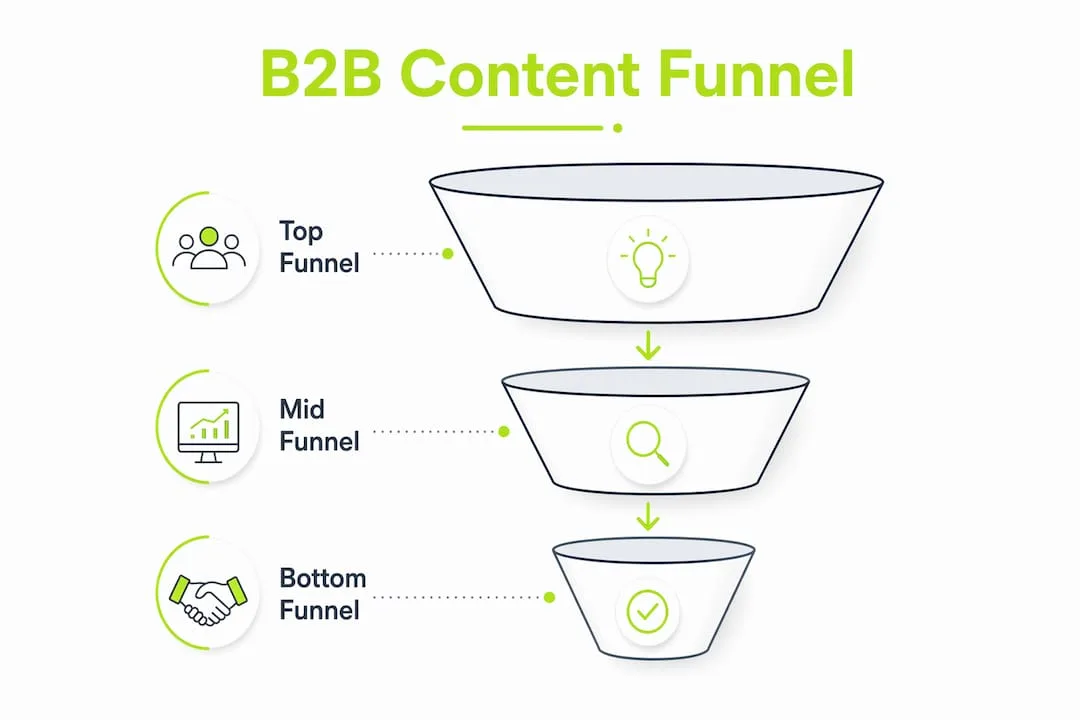
The funnel breaks into three stages, each with a different content type and publishing cadence.
| Funnel stage | Content types | Word count | Cadence |
|---|---|---|---|
| Top of funnel | Research reports, trend guides, educational posts | 1,500–2,500 words | 2–4 pieces/month |
| Mid funnel | Comparison guides, use-case deep dives, webinar recaps | 2,000–3,000 words | 3–5 pieces/month |
| Bottom of funnel | Case studies, ROI calculators, vendor evaluation guides | 1,500–3,500 words | 2–6 pieces/month |
Focusing 60–70% of B2B content production resources on mid- and bottom-funnel content drives better pipeline attribution. Top-of-funnel content builds awareness, but it rarely closes deals. Mid- and bottom-funnel pieces address the commercial objections that buying committees raise before they sign a contract.
B2B buying committees average 6–10 stakeholders. Each stakeholder carries different objections: the CFO wants ROI proof, the IT lead wants integration details, the end user wants ease of use. Content must address buying committee objections across all those roles to move a deal forward. A single piece targeting only one persona leaves the rest of the committee unconvinced.
- Map every planned article to a specific buyer intent and funnel stage before writing begins.
- Identify the top three objections that persona raises at that stage.
- Build your H2/H3 structure to answer each objection directly.
- Assign a word count target based on the funnel stage table above.
- Write a one-sentence quotable claim for each H2 before drafting the body.
Pro Tip: Targeting only top-of-funnel keywords drives traffic but rarely results in pipeline. Audit your existing content catalog and flag every piece that lacks a mid- or bottom-funnel counterpart.
How to execute a hybrid search-optimized content architecture
Hybrid search is the 2026 reality for B2B marketers. Your content must rank in Google's traditional results and appear in AI Overviews, ChatGPT citations, and Perplexity answers simultaneously. Dual-Structure Architecture splits long-form content into an Extraction Zone for AI answer engines and an Authority Zone for traditional search crawlers.
Here is how to build both zones into every article.
- Open with an Extraction Zone. Write a semantic summary in the first 150–200 words. State the core claim directly. Include your primary named entities and the article's most citable statistic in this opening block. AI systems pull heavily from the first 30% of any article.
- Use conversational questions as H2 headings. Every H2 subheading should be a question immediately answered in the first sentence below it. This structure satisfies AI extraction logic and improves user experience at the same time.
- Write quotable statements under each H2. A quotable statement is a single, declarative sentence that stands alone without context. "Long-form content generates more backlinks than short-form content" is quotable. "As we discussed earlier, there are several factors to consider" is not.
- Build the Authority Zone in the body. After your quotable statement, expand with evidence, examples, data, and internal links. This depth signals topical authority to Google's crawlers. Aim for complete topic coverage, not just keyword coverage.
- Use structured data elements throughout. Tables, numbered lists, and definition blocks give AI systems clear extraction targets. They also reduce bounce rates by making long articles scannable.
The balance between brevity and depth is deliberate. The Extraction Zone keeps AI systems satisfied with fast, direct answers. The Authority Zone keeps Google's crawlers satisfied with comprehensive coverage. Neither zone works without the other.
Pro Tip: Read your Extraction Zone out loud. If it sounds like a press release or an abstract, rewrite it. It should sound like a confident expert answering a direct question.
Common challenges in long-form B2B SEO content
The most common mistake in B2B content marketing is optimizing for engagement metrics instead of pipeline contribution. Page views and time on page feel like success. They are not success unless they connect to qualified leads, demo requests, or closed revenue.
Watch for these specific pitfalls:
- Skipping the planning phase. Articles written without detailed H2/H3 briefs mapped to buyer intent produce unfocused content that ranks for nothing specific and converts no one.
- Publishing thin content at high volume. B2B brands that publish many short articles monthly consistently underperform brands that publish fewer, deeper pieces. Depth beats frequency.
- Measuring only traffic. Success metrics should include conversion rates, internal CTA engagement, time on page, and backlink generation, not just organic sessions.
- Ignoring internal linking. Every long-form piece should link to at least two related articles and one bottom-funnel page. Internal links distribute authority and guide readers toward conversion.
- Writing for one persona. B2B deals involve multiple stakeholders. Content that speaks only to the end user loses the CFO. Content that speaks only to procurement loses the technical evaluator.
Maintaining reader engagement across 2,000+ word articles requires structural discipline. Break every 300–400 words with a subheading, a list, or a table. Use short paragraphs of 3–5 sentences. Lead every paragraph with the key claim, then support it. Readers who lose the thread at paragraph three never reach your bottom-funnel CTA.
Pro Tip: After publishing, revisit each article at 90 days. Check which H2 sections generate the most scroll depth and time on page. Expand those sections. Cut or rewrite sections with high exit rates.
Key takeaways
A long-form content strategy for B2B SEO succeeds when it combines Dual-Structure Architecture, funnel-stage planning, and pipeline-focused measurement rather than traffic-focused metrics.
| Point | Details |
|---|---|
| Depth threshold matters | Articles need 1,500+ words with structured subheadings to qualify for AI citation and ranking. |
| Funnel allocation drives revenue | Concentrate 60–70% of content resources on mid- and bottom-funnel pieces for better pipeline results. |
| Dual-Structure Architecture | Split every article into an Extraction Zone for AI and an Authority Zone for traditional SEO crawlers. |
| Plan before you write | Detailed H2/H3 briefs mapped to buyer intent reduce fluff and improve conversion rates. |
| Measure pipeline, not just traffic | Track conversion rates, backlinks, and CTA engagement alongside organic sessions. |
Why long-form content is still the sharpest B2B growth tool
I have reviewed hundreds of B2B content programs over the years, and the pattern is consistent. The teams that win in organic search are not the ones publishing the most. They are the ones who treat every article like a sales asset, not a blog post.
The hybrid search shift makes this even more pronounced. When a B2B buyer asks ChatGPT to compare two categories of software, the answer pulls from articles that were built to be extracted. If your content was written to fill a content calendar, it will not appear. If it was built with a clear Extraction Zone and quotable statements under every heading, it has a real shot at that citation.
What I find most underappreciated is the compounding effect of depth. A 2,500-word article that earns 15 backlinks in its first year keeps earning. It gets cited in AI answers. It ranks for dozens of long-tail variants. A 600-word post earns none of that. The math is not close.
The teams I see struggle most are the ones chasing traffic metrics while their sales pipeline stays flat. Vanity metrics are comfortable because they move quickly. Pipeline metrics are uncomfortable because they require you to connect content to revenue, which takes discipline and honest measurement. Adopt that discipline early. It is the difference between a content program that looks good in a dashboard and one that actually grows a business.
— Jonathon
How Thewebteam supports your B2B content and SEO goals
Building a long-form content program that ranks in both Google and AI answer engines takes more than good writing. It takes a website that loads fast, a technical SEO foundation that search crawlers can read, and ongoing support that keeps everything current as algorithms shift.
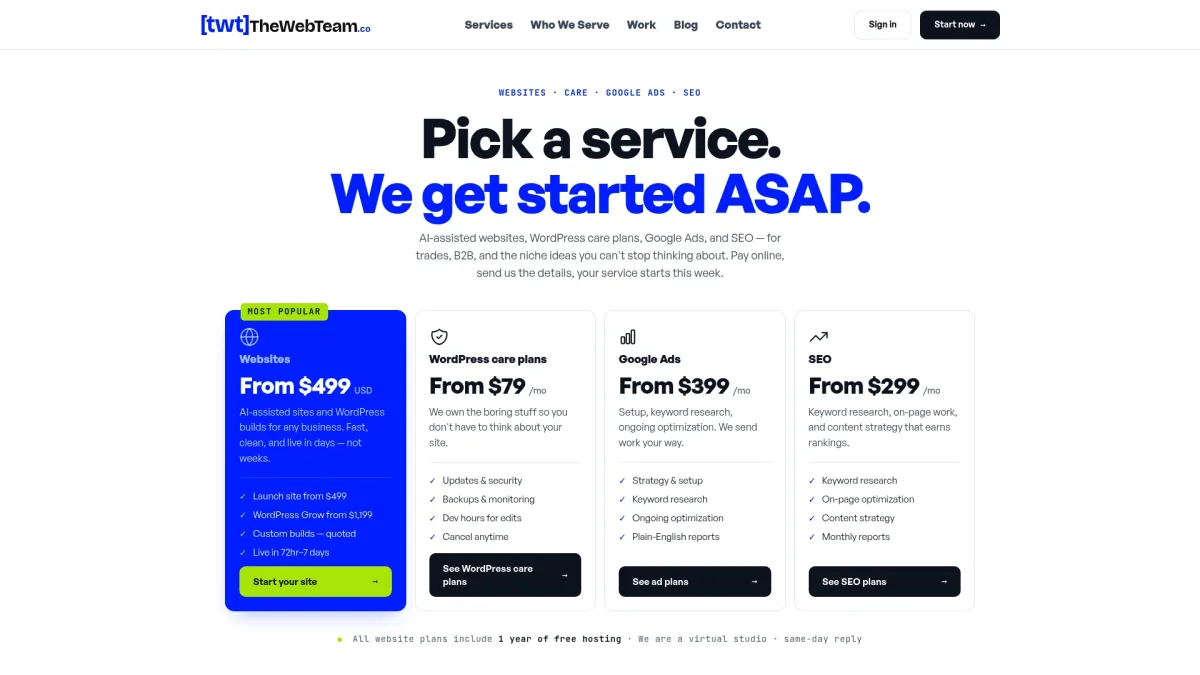
Thewebteam delivers WordPress websites and SEO services built specifically for B2B businesses and niche industries. Their care plans cover hosting, maintenance, and ongoing SEO so your content strategy runs on a platform that supports it. Clients launch in days, not months, with transparent pricing and no hidden costs. If you are ready to put a proper content and SEO engine behind your pipeline goals, Thewebteam is built for exactly that.