
Site architecture is defined as the way a website's pages are organized, linked, and grouped into a hierarchy that search engines and users can navigate. The role of site architecture in SEO is direct: it controls how crawlers discover your pages, how authority flows between them, and how clearly Google understands your content's topics. Strong architecture improves search engines' ability to discover, understand, and trust content, which positively impacts rankings. For developers and digital marketers, getting this structure right before publishing a single page is the highest-leverage SEO decision you will make.
How does site architecture affect crawlability and indexing?
Crawlability is the foundation of SEO. If Google's bots cannot find a page, that page does not rank, regardless of its content quality.
Internal linking creates pathways for crawlers to move through your site. Every link from one page to another is an instruction telling Googlebot: "This page exists and matters." Pages that receive many internal links get crawled more frequently and indexed faster.

Crawl budget is the number of pages Google will crawl on your site within a given time window. Sites with bloated, poorly linked structures waste this budget on low-value pages while important pages go unvisited. A clean hierarchy solves this by concentrating crawl activity where it counts.
Google favors sites with shallow structures where most pages sit within two to three clicks from the homepage. Flat architectures increase crawl budget efficiency and distribute link equity more evenly. Deep structures, where a product page requires seven clicks to reach, signal low importance to Google.
Orphan pages are a silent SEO killer. Pages not linked from anywhere on your site often go undiscovered by crawlers entirely. A blog post published without any internal links pointing to it is effectively invisible to search engines.
Key crawlability best practices:
- Map your click depth. Every core page should be reachable in three clicks or fewer from the homepage.
- Link new content immediately. Publish a new page and add at least two internal links to it from existing, indexed pages.
- Fix orphan pages monthly. Run a crawl audit using tools like Screaming Frog or Sitebulb to surface unlinked pages.
- Use XML sitemaps as a backup. Sitemaps help Google find pages your internal links may have missed.
- Avoid redirect chains. Each redirect hop reduces crawl efficiency and dilutes link signals.
Pro Tip: Run a technical SEO audit every quarter specifically to check click depth. Sort pages by depth in your crawl tool and prioritize any core page sitting deeper than three clicks.
What is link equity and how does architecture optimize its flow?
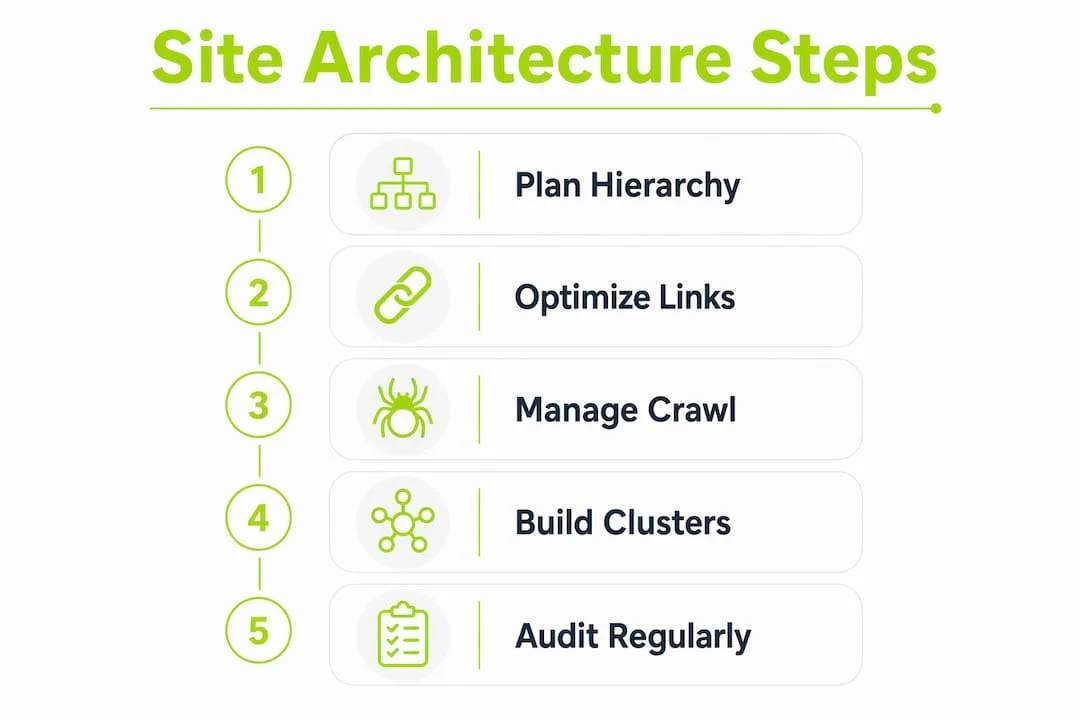
Link equity, sometimes called PageRank, is the ranking power that flows from one page to another through hyperlinks. Your homepage typically holds the most authority because external sites link to it most often. Architecture determines how that authority reaches your deeper pages.
Pages with many high-authority inbound internal links rank better than isolated pages. This means your category pages, service pages, and pillar content should receive internal links from multiple locations across the site. A service page linked only from the navigation menu gets far less equity than one linked from the homepage, three blog posts, and a case study.
Anchor text matters as much as the link itself. Internal links carry both authority signals and contextual relevance through descriptive anchor text. Linking to your "commercial roofing services" page with the anchor text "click here" wastes a relevance signal. Linking with "commercial roofing services" tells Google exactly what that destination page covers.
Poor linking structures waste equity in predictable ways:
- Footer links to every page dilute authority by spreading it too thin across dozens of destinations.
- Nofollow tags on internal links block equity flow unnecessarily. Reserve nofollow for external links you do not want to endorse.
- Broken internal links create dead ends where equity disappears entirely.
- Duplicate content pages split equity between two URLs competing for the same keyword.
Pro Tip: Identify your three highest-priority pages and count how many internal links point to each one. If the number is under five, add contextual links from your most-visited blog posts and category pages. This alone can move rankings within weeks.
How to design SEO-friendly URL and navigation structures?
URL structure is the written expression of your site hierarchy. A well-designed URL tells both users and search engines where a page sits in the overall organization. Well-structured URLs and navigation elements like breadcrumbs improve crawl efficiency and user experience, which indirectly boosts SEO.
Follow these steps to build an SEO-friendly URL and navigation system:
- Use descriptive, keyword-relevant slugs. A URL like
/services/commercial-roofing/flat-roof-repaircommunicates hierarchy and topic clearly. A URL like/page?id=4821communicates nothing. - Keep URLs short and lowercase. Remove stop words like "and," "the," and "a" where they add no meaning. Shorter URLs are easier to share and read.
- Match URL structure to navigation depth. If your navigation has three levels (Home > Services > Specific Service), your URLs should reflect those same three levels.
- Add breadcrumb navigation. Breadcrumbs clarify category relationships for users and give Google an additional structural signal. They also reduce page abandonment by showing users exactly where they are.
- Implement BreadcrumbList schema markup. Adding structured data to breadcrumbs makes them appear in Google search results as navigational paths, improving click-through rates.
- Limit navigation menu items. A top-level menu with 15 items overwhelms users and dilutes crawl signals. Aim for five to seven primary categories, with subcategories in dropdown menus.
- Use canonical tags for URL variations. If your site generates multiple URLs for the same content (filtered product pages, for example), canonical tags consolidate equity to the preferred URL.
Pro Tip: When planning a website redesign, map your existing URL structure before touching anything. Changing URLs without 301 redirects destroys accumulated link equity overnight.
What are practical approaches to building topic clusters?
Topic clusters are the most effective modern approach to site organization for search engines. A topic cluster consists of one pillar page covering a broad subject in depth, supported by multiple cluster pages covering specific subtopics, all linked back to the pillar.
The pillar page for "commercial roofing" might link to cluster pages on "flat roof repair," "metal roofing installation," and "roof maintenance contracts." Each cluster page links back to the pillar. This creates a web of relevance that signals topical authority to Google.
A hybrid site architecture with clear hierarchies and contextual cross-linking between related clusters aligns better with user behavior and AI-driven search. Pure silo structures, where content categories never link to each other, limit natural discovery. A hybrid model adds cross-links between related cluster pages from different topic groups, which improves semantic relevance.
Here is how the two models compare in practice:
| Feature | Pure silo structure | Hybrid cluster model |
|---|---|---|
| Hierarchy clarity | High | High |
| Cross-topic linking | None | Contextual and selective |
| User discovery paths | Linear | Multiple entry points |
| Semantic relevance signals | Moderate | Strong |
| AI search compatibility | Limited | Well-suited |
Pure siloing can restrict natural discovery. Most top-performing sites use hybrid models that combine pillar hierarchies with cluster cross-links for better user and crawler experience. The key is keeping cross-links contextual. Link between clusters only when the connection genuinely helps the reader.
Site structure also eliminates keyword cannibalization by clearly defining page topics through grouping and linking. When two pages target the same keyword, Google struggles to decide which one to rank. A well-organized cluster structure prevents this by assigning each keyword to exactly one page.
Pro Tip: Audit your cluster integrity every month. Use a spreadsheet to track which cluster pages link back to their pillar. Any cluster page missing that link is leaking authority instead of reinforcing it.
Key Takeaways
Site architecture directly controls how search engines crawl, index, and rank your pages, making it the structural foundation of every SEO decision you make.
| Point | Details |
|---|---|
| Crawl depth matters | Keep all core pages within three clicks of the homepage to maximize crawl efficiency. |
| Fix orphan pages monthly | Unlinked pages go undiscovered; run regular audits to connect them into the site structure. |
| Anchor text carries relevance | Use descriptive, keyword-relevant anchor text on internal links to pass both authority and context. |
| Hybrid models outperform silos | Combine clear hierarchies with contextual cross-links between clusters for stronger topical authority. |
| URL structure signals hierarchy | Descriptive URLs that reflect your navigation depth help both crawlers and users understand page relationships. |
What I've learned from auditing hundreds of site structures
Most developers treat site architecture as a one-time decision made during the initial build. That is the wrong mental model. Architecture is a living system that degrades as content is added without a plan.
The most common problem I see is orphan pages. A developer publishes a new service page, links it from the navigation, then never adds a single contextual internal link from the blog or related service pages. Six months later, that page has no rankings and no one knows why. The fix takes ten minutes. The cost of ignoring it compounds for months.
Pure silo thinking is the second most common mistake. I understand the appeal. Silos feel clean and logical. But when a user reading about "flat roof repair" would genuinely benefit from knowing about "roof maintenance contracts," blocking that link to preserve silo purity hurts both the user and your rankings. The case studies and internal linking approach that top-performing sites use proves this point repeatedly.
The sites I have seen recover the fastest after architecture fixes are the ones that commit to monthly link audits. Not quarterly. Monthly. Content gets published, pages get orphaned, and redirects break faster than most teams realize. A monthly 30-minute crawl check catches problems before they compound.
My strongest advice: plan your topic clusters before you write a single piece of content. Retrofitting cluster architecture onto an existing site is painful and slow. Building it from the start takes the same amount of time and produces dramatically better results.
— Jonathon
How Thewebteam builds SEO-ready site structures from day one
Thewebteam designs websites for trades, B2B businesses, and niche industries where site structure directly affects whether customers find you or your competitor. Every project starts with a content hierarchy plan, not a visual mockup.
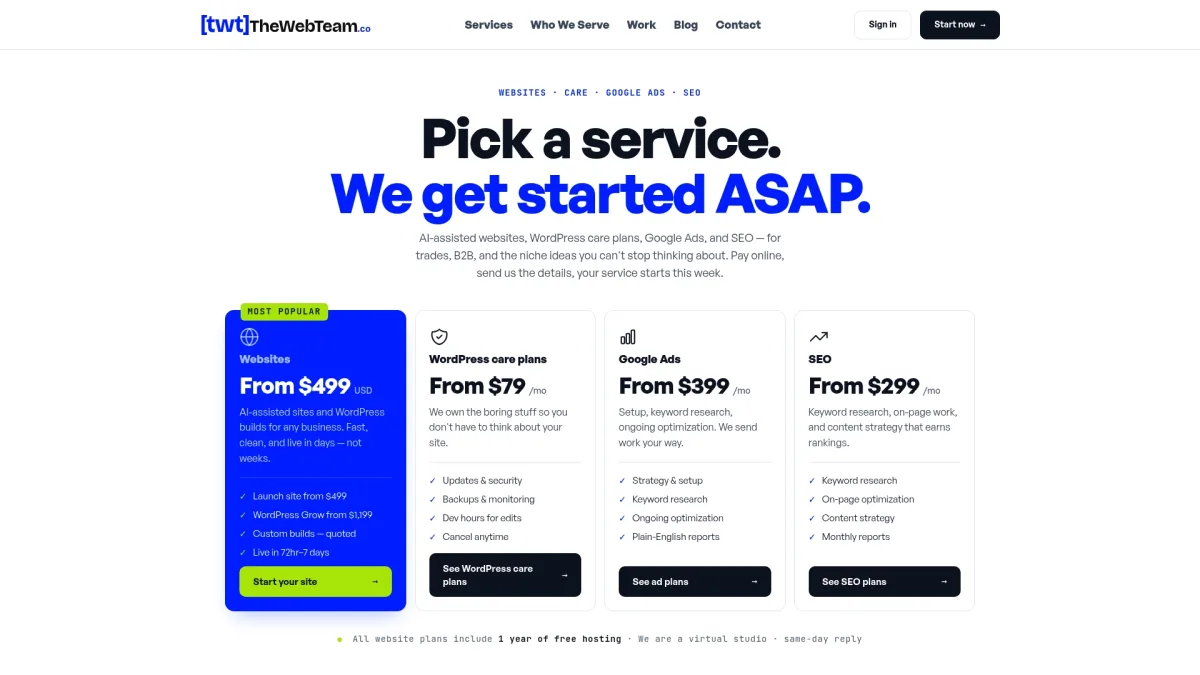
The team maps pillar pages, cluster content, and internal linking paths before a single page is built. That means clients launch with a structure that search engines can crawl efficiently and users can navigate without confusion. You can see the results across Thewebteam's web design portfolio, where architecture-first thinking shows up in faster indexing and stronger rankings for competitive local and B2B keywords. If your current site structure is holding back your SEO, Thewebteam's web design and SEO services are built to fix exactly that.