
Ongoing SEO maintenance is defined as the continuous process of monitoring, updating, and refining a website's technical and content elements to sustain strong search engine rankings over time. Business owners and digital marketers who ask what does ongoing SEO maintenance mean are really asking how to keep their site competitive as Google's algorithm, user behavior, and competitor strategies shift constantly. The industry term for this practice is "SEO upkeep," and it covers everything from fixing crawl errors to refreshing keyword targeting. A site that ranked well six months ago can lose ground quickly without regular attention. Treating SEO as a one-time project is one of the most expensive mistakes a business can make.
What does ongoing SEO maintenance include?
Ongoing SEO maintenance covers five core areas, each requiring a different type of attention and skill.
Technical monitoring is the foundation. This means checking for crawl errors, broken links, SSL certificate expiration, and robots.txt changes. Daily automated checks cover critical alerts like crawl error spikes and SSL expiry warnings with zero manual review until an alert fires. That approach keeps your team focused on real problems rather than routine scanning.

Content updates and keyword optimization come next. Search intent shifts over time, and pages that once ranked for a target phrase can slip when fresher, more relevant content appears. Reviewing top-performing pages monthly and updating them with current data, examples, and keyword variants keeps them competitive. A solid content strategy ties these updates to business goals rather than guesswork.
Performance tracking and analytics review means reading Google Search Console data weekly to spot index coverage changes, click-through rate drops, and Core Web Vitals shifts. Without this review, you can miss a ranking drop for weeks.
Competitive benchmarking rounds out the picture. Quarterly audits compare your rankings, backlink profile, and page speed against the sites sitting above you in search results. This tells you whether your gains are real or just the result of a competitor stumbling.
Off-page maintenance, specifically backlink management, also matters. Disavowing toxic links and earning new authoritative links protects your domain authority over time.
- Crawl error and SSL monitoring (daily automated)
- Core Web Vitals and broken link review (weekly)
- Content refresh and keyword gap analysis (monthly)
- Competitor benchmarking and full technical audit (quarterly)
- Backlink profile review and disavow file updates (quarterly)
Pro Tip: Start with the tasks that protect existing rankings before chasing new ones. Fixing a crawl error costs an hour. Recovering lost rankings can take months.
How often should SEO maintenance tasks be performed?
SEO maintenance follows a tiered schedule: daily and weekly checks handle critical site health, monthly deep dives cover structural issues, and quarterly sessions benchmark against competitors. That structure prevents small problems from compounding into major ranking losses.
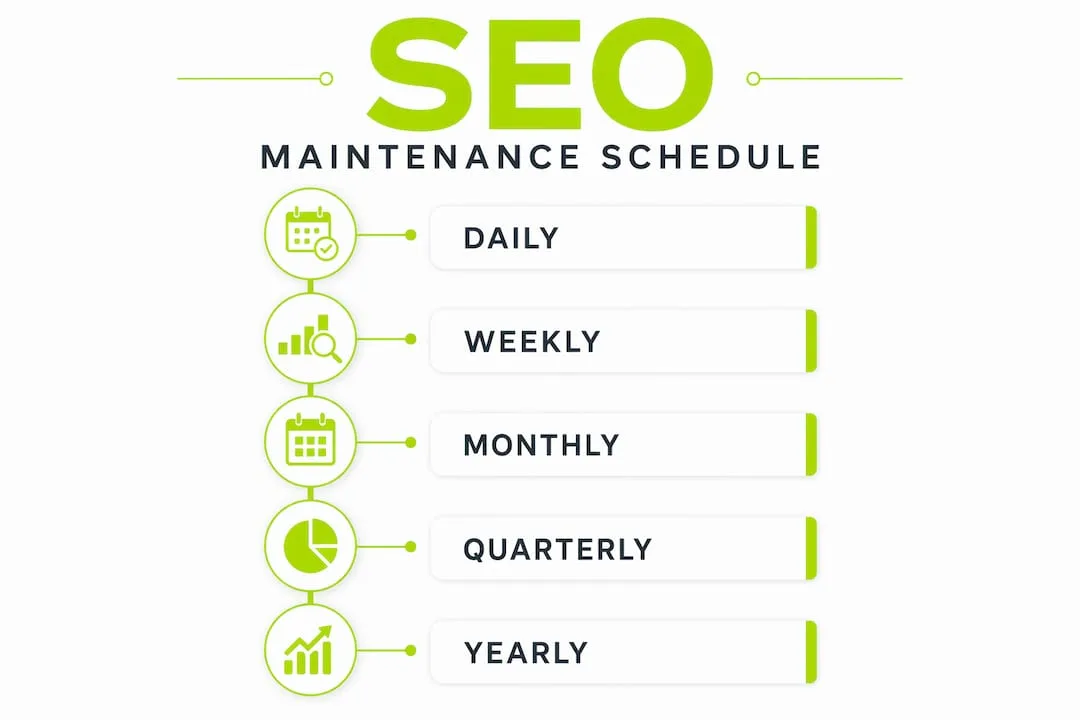
| Task | Frequency | Time Required |
|---|---|---|
| Crawl error alerts, SSL expiry checks, robots.txt monitoring | Daily (automated) | Zero manual time until alert fires |
| Core Web Vitals trends, broken links, redirect chains | Weekly (manual review) | ~90 minutes |
| Sitemap health, page speed regression, duplicate meta, mobile usability | Monthly | 3–4 hours |
| Full technical audit, competitor benchmarking, backlink review | Quarterly | Half day |
Weekly 90-minute review sessions analyze automated data to decide whether immediate action is needed. That discipline separates sites that maintain rankings from sites that react to crises.
Monthly reviews go deeper. Monthly deep dives examine page speed regressions using Lighthouse and Chrome UX Report data, canonicalization issues, orphan pages, and mobile usability. These are the structural problems that quietly erode rankings over a quarter if left unchecked.
Setting up this system takes real effort upfront. Initial setup for a comprehensive monitoring system takes roughly 12 hours of engineering time. That investment prevents two to three major technical issues per year, each of which would take 10–40 hours to fix after the fact.
Pro Tip: Automate the daily layer first using Google Search Console alerts and a free SSL monitoring service. That gives you a safety net before you build out the weekly and monthly review process.
Why is ongoing SEO maintenance essential for long-term success?
SEO is not a one-time service. The ranking environment shifts continuously, and sites that do not keep pace through regular maintenance risk losing traffic and ranking authority. That statement is not a warning. It is a description of how search engines actually work.
The clearest proof is what happens after algorithm updates. After the march 2026 LCP threshold update, sites using continuous monitoring caught sudden ranking drops immediately. Sites relying on quarterly-only audits detected the same drops 10–12 weeks later. That gap represents weeks of lost traffic, leads, and revenue.
Proactive maintenance also improves user experience directly. Faster pages, working links, and correct mobile rendering keep visitors on your site longer. Search engines measure those signals and reward sites that deliver them consistently.
The business case for regular SEO upkeep comes down to four concrete benefits:
- Ranking protection against algorithm updates
- Early detection of technical issues before they compound
- Consistent user experience that reduces bounce rates
- Compounding content authority as updated pages earn more links
"Sites that treat SEO as a continuous process rather than a periodic project maintain ranking stability through algorithm changes and competitive shifts. The compounding effect of consistent upkeep outperforms any single optimization sprint."
Understanding site architecture's role in SEO is part of this picture. A well-structured site makes every maintenance task easier and every algorithm update less damaging.
What tools support effective ongoing SEO maintenance?
The right tools make the difference between a maintenance program that runs smoothly and one that depends entirely on manual effort.
Combining Google Search Console, Lighthouse CI, and openSSL daily cron jobs covers the highest-severity technical SEO failures at no cost. That free baseline handles the daily monitoring layer before you invest in paid platforms.
Here is a practical toolkit organized by function:
- Google Search Console: Index coverage, Core Web Vitals, manual actions, and search performance data. Free and non-negotiable.
- Lighthouse CI: Automated page speed and accessibility audits integrated into your deployment pipeline.
- OpenSSL cron jobs: Daily SSL certificate expiry checks that alert you before a certificate lapses and tanks your rankings.
- Screaming Frog SEO Spider: Monthly crawl audits that surface broken links, duplicate content, and redirect chains.
- Google Analytics 4: Traffic trend analysis that connects SEO performance to actual business outcomes.
Automation handles the daily layer. Alert systems handle the exceptions. Human review handles the interpretation. That three-layer approach is what separates a real maintenance program from a checklist that gets ignored.
For business owners who want a practical starting point, the DIY website maintenance checklist from Thewebteam covers the core tasks in plain language. For B2B sites with more complex technical requirements, the technical SEO checklist for B2B websites goes deeper into crawl budget, structured data, and indexing priorities.
Thewebteam builds and manages these monitoring systems for trades, B2B, and niche industry clients who need reliable SEO upkeep without hiring a full-time specialist.
Key Takeaways
Ongoing SEO maintenance is a structured, tiered process that protects rankings, catches technical issues early, and compounds content authority over time.
| Point | Details |
|---|---|
| SEO upkeep is continuous | Treating SEO as a one-time project leads to ranking loss as algorithms and competitors evolve. |
| Use a tiered schedule | Daily automation, weekly reviews, monthly deep dives, and quarterly audits each serve a distinct purpose. |
| Automate the daily layer first | Google Search Console, Lighthouse CI, and SSL cron jobs cover critical failures at no cost. |
| Early detection saves time | Continuous monitoring catches ranking drops weeks before quarterly-only audits would flag them. |
| Setup investment pays off | Roughly 12 hours of initial setup prevents 10–40 hours of annual troubleshooting per major issue avoided. |
Why I think most businesses get SEO maintenance backwards
Most business owners I work with treat SEO maintenance the same way they treat a car service: they wait until something breaks, then pay to fix it. That approach costs more and takes longer than anyone expects.
The real problem is not laziness. It is that ad hoc fixes feel productive. You find a broken link, you fix it, you feel good. But you never built the system that would have caught it three weeks earlier, before it started affecting your crawl budget.
The businesses that hold rankings through algorithm updates are not doing anything exotic. They run their weekly 90-minute review without skipping it. They refresh their top five pages every quarter. They check their Core Web Vitals before and after every site update. That discipline compounds. A site that does this consistently for 18 months builds a technical and content foundation that is genuinely hard for competitors to displace.
My recommendation is to combine technical and content SEO efforts in the same maintenance cycle. Most teams split them across different people or different months. That creates gaps where a content update breaks a canonical tag, or a technical fix removes an internal link that was driving traffic. Treating them as one program, reviewed together, closes those gaps.
Partnering with a team that already has the monitoring systems, checklists, and review cadence in place shortens the path considerably. Building it from scratch takes time that most business owners do not have.
— Jonathon
How Thewebteam handles ongoing SEO maintenance for your site
Thewebteam builds WordPress websites and care plans for trades, B2B, and niche industry businesses that need reliable SEO upkeep without the overhead of an in-house team.
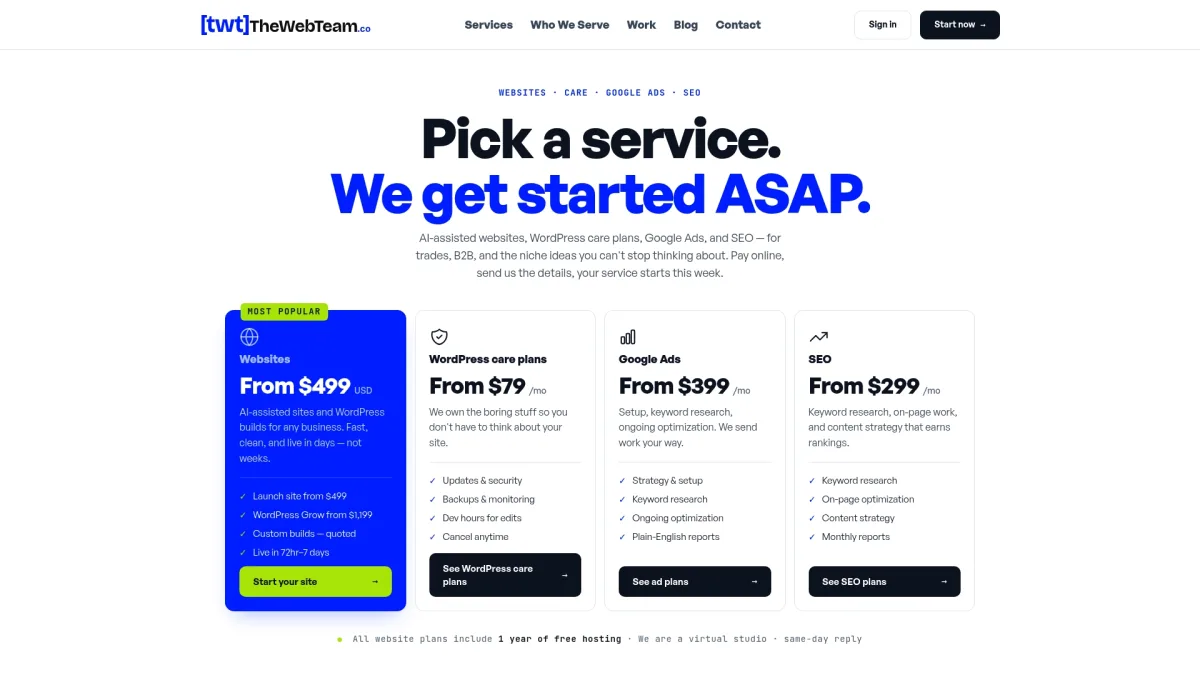
Every care plan includes ongoing SEO health checks: technical monitoring, Core Web Vitals tracking, and content review cycles built into the service from day one. There are no hidden costs and no waiting weeks for a response. If you want to see the quality of work before committing, the project portfolio shows completed sites and outcomes across industries. When you are ready to talk specifics, the services and pricing page lays out exactly what each plan includes.