
Meta descriptions are defined as HTML attributes that summarize a page's content in search engine results, and their role in meta descriptions rankings is widely misunderstood. They are not a direct ranking factor in Google's algorithm, a position Google has held since 2009. What they do control is whether a searcher clicks your result. That click behavior feeds engagement signals back to Google, creating an indirect but measurable path from a well-written description to better search performance.
What does Google officially say about meta descriptions and rankings?
Google's position on meta descriptions is clear and consistent. The company retired meta keyword tags as a ranking signal in 2009 and has reaffirmed that meta descriptions carry no direct ranking weight through 2026. No algorithm update has changed this. The distinction matters because many website owners still treat meta descriptions as a ranking lever, which leads them to stuff keywords into descriptions instead of writing copy that actually earns clicks.
John Mueller at Google has stated that writing meta descriptions is worthwhile for clarifying page focus, even though they are not required. That framing is precise and useful. Mueller's point is that a well-written description forces you to articulate what makes a page unique, which benefits both users and your own content clarity.
"Meta descriptions are not a ranking factor. However, having a good meta description can encourage users to click through to your site, which can indirectly affect your rankings."
— Google Search Central documentation
The practical implication is straightforward. Chasing rankings through meta description keyword density is a dead end. The real opportunity is in writing descriptions that make your search snippet more compelling than the results above and below yours.
How do meta descriptions affect user behavior and contribute indirectly to rankings?
The indirect mechanism is what makes meta description SEO genuinely worth your attention. Google's algorithm collects behavioral data from search results, including how often users click a result and how long they stay on the page. A higher click-through rate signals that a result is relevant and satisfying, which can push that result higher over time.

Pages with optimized meta descriptions outperform identical pages without them over a 90-day observation window, based on SEO testing as of march 2026. That gap is driven entirely by CTR differences, not by any direct algorithmic preference for the description itself. The description wins clicks; the clicks improve rankings.
One specific mechanism worth knowing: when your meta description contains the searcher's query terms, Google bolds those matching terms in snippets. Bold text draws the eye. A snippet with bolded keywords stands out visually against plain-text competitors, which increases the probability of a click even when your ranking position is the same.
The impact of meta descriptions on user behavior works through several distinct channels:
- Visual prominence: Bolded query terms in your description attract attention before the user consciously reads the text.
- Relevance signaling: A description that mirrors the searcher's intent tells them immediately that your page answers their question.
- Trust building: A specific, accurate description sets expectations. Users who click and find what was promised stay longer and bounce less.
- Competitive differentiation: At positions 3 through 7, where rankings are close, a stronger description can pull clicks away from higher-ranked results.
Pro Tip: Write your meta description as if it were a two-line ad. Lead with the specific benefit or answer the page delivers, then add a short call to action. "Learn how X works" outperforms "This page is about X" every time.
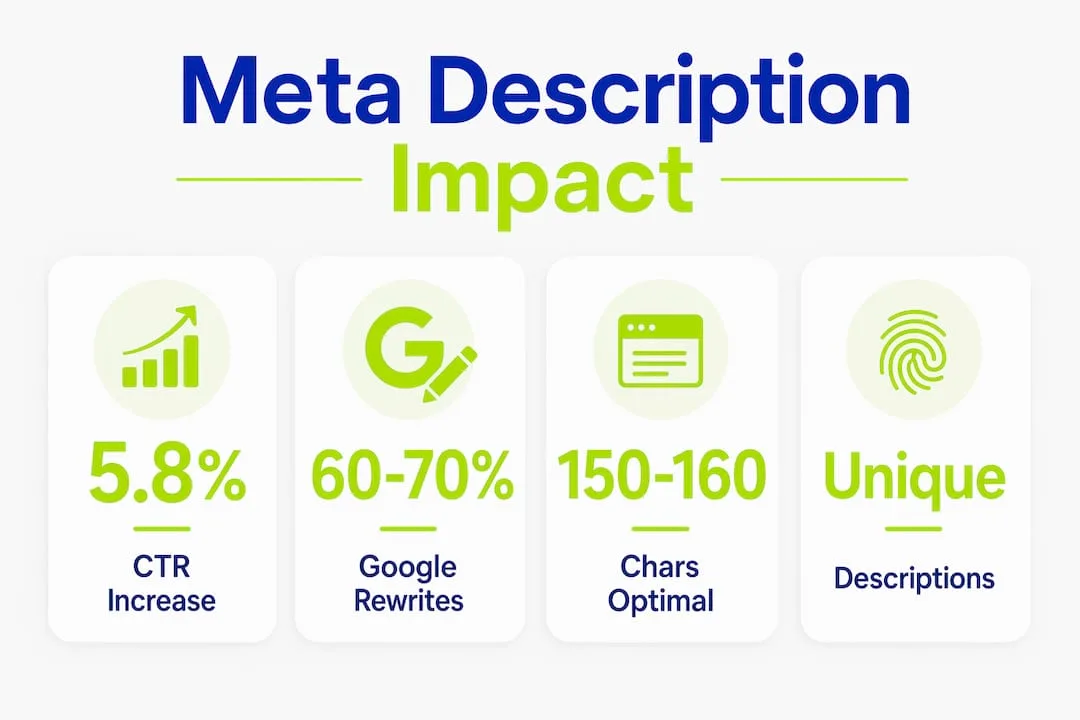
A compelling meta description can increase CTR by approximately 5.8% versus auto-generated snippets. That number compounds across an entire site. A 5.8% CTR lift on 50 pages represents a meaningful traffic increase with no change to your content or link profile.
Why does Google rewrite meta descriptions and what does that mean for SEO?
Google generates its own snippet instead of using your meta description 60–70% of the time as of 2026. That is the majority of queries. When Google rewrites your description, your custom copy has no direct effect on CTR for those searches.
Understanding why Google rewrites descriptions turns this statistic from discouraging into useful. Google overrides your description when it judges that your text does not match the searcher's intent well enough. The algorithm pulls text from your page body that it believes is more relevant. Frequent rewrites on a specific page are a diagnostic signal: your description and your page content are not aligned with how people are actually searching for that topic.
The fix follows a clear sequence:
- Identify rewritten pages. Use Google Search Console to compare your written descriptions against the snippets Google actually displays. Gaps reveal misalignment.
- Audit search intent. Search your target keyword and read the top results. Note whether searchers want a definition, a how-to, a comparison, or a product. Your description must match that intent type.
- Rewrite for specificity. Generic descriptions get overridden most often. A description that names a specific outcome, audience, or method gives Google less reason to substitute its own text.
- Update page content to match. If Google consistently pulls a different sentence from your page body, that sentence is probably more relevant than your description. Revise your description to match it, or revise your page to lead with the right information.
Consistent rewrites on a page indicate a mismatch with search intent, which SEO practitioners use as a signal to improve on-page relevance. Treating rewrites as feedback rather than failure is the more productive approach.
Best practices for writing effective meta descriptions
The goal of every meta description is to earn the click. Google treats meta descriptions as conversion tools, not ranking factors, and that framing should guide how you write them.
Length and format
Keep descriptions between 150 and 160 characters. Google truncates longer descriptions in desktop results, and mobile truncation happens even earlier. Front-load the most important information so truncation does not cut your key message.
Content and tone
Write a natural summary that reflects what the page actually delivers. Keyword stuffing in meta descriptions is ineffective and increases the likelihood that Google will override your text. One or two natural uses of your target phrase are enough to trigger bolding without making the description read like a tag list.
| Approach | Effect on CTR | Effect on Google override rate |
|---|---|---|
| Keyword-stuffed description | Neutral to negative | Higher override rate |
| Generic summary ("This page covers X") | Low | High override rate |
| Intent-matched, specific summary | Positive | Lower override rate |
| Benefit-led with a clear call to action | Highest | Lowest override rate |
Uniqueness across pages
Every page needs its own description. Duplicate descriptions across multiple pages give Google no reason to prefer your snippet over a competitor's, and they signal that you have not thought carefully about what each page offers. For a site with hundreds of pages, prioritize descriptions for your highest-traffic and highest-value pages first.
Tracking and iteration
Connect your descriptions to performance data. Google Search Console shows CTR by page and query. If a page ranks in the top 5 but has a below-average CTR, the description is the first place to look. Rewrite it, wait 30 days, and compare. This evidence-based SEO approach to description testing produces measurable gains without guesswork about algorithm behavior.
Pro Tip: For B2B pages, include a specific outcome or audience in the description. "How trades businesses cut quote time by 40%" outperforms "Learn about our quoting process" because it speaks directly to a result the reader wants.
The importance of meta tags extends beyond descriptions. Title tags, canonical tags, and structured data all interact with how Google reads and displays your pages. Meta descriptions are one piece of a larger on-page SEO system, and they perform best when the rest of that system is also well-maintained. A strong long-form content strategy gives your descriptions more substance to summarize, which makes them easier to write and more likely to survive Google's override process.
Key Takeaways
Meta descriptions do not directly affect Google rankings, but they control click-through rates, which feed behavioral signals that influence where your pages rank over time.
| Point | Details |
|---|---|
| Not a direct ranking factor | Google has confirmed since 2009 that meta descriptions carry no direct ranking weight. |
| CTR drives indirect impact | Optimized descriptions improve click-through rates, which signal relevance to Google's algorithm. |
| Google overrides most descriptions | Google rewrites snippets 60–70% of the time; frequent overrides signal intent misalignment. |
| Bolded keywords increase clicks | Query terms in your description appear bold in results, drawing visual attention and improving CTR. |
| Treat rewrites as diagnostics | Pages with consistent overrides need content and description alignment, not just a rewrite. |
Meta descriptions are a conversion lever, not a ranking shortcut
I have reviewed hundreds of sites where the meta description strategy was either completely absent or built around keyword density. Both approaches miss the point. The pages that consistently outperform their ranking position share one trait: their descriptions read like a promise the page actually keeps.
The mistake I see most often is treating meta descriptions as an afterthought, something to fill in after the content is published. That order is backwards. Writing the description first forces you to define what the page is actually for. If you cannot write a clear 155-character summary, the page probably lacks focus. The description becomes a content quality check.
The other pattern worth naming: obsessing over descriptions while ignoring the technical and content foundations underneath them. A great description on a slow-loading page, or a page with thin content, will not save your rankings. Meta descriptions work best as the final layer of a well-built page, not as a patch for a weak one. The SEO and web design services that move the needle treat descriptions as part of a complete system, not a standalone fix.
— Jonathon
How Thewebteam can help with your SEO and web presence
Thewebteam works with trades businesses, B2B companies, and niche industries that need their websites to perform, not just exist. That means building pages with clear structure, intent-matched content, and descriptions that earn clicks rather than get overridden by Google.
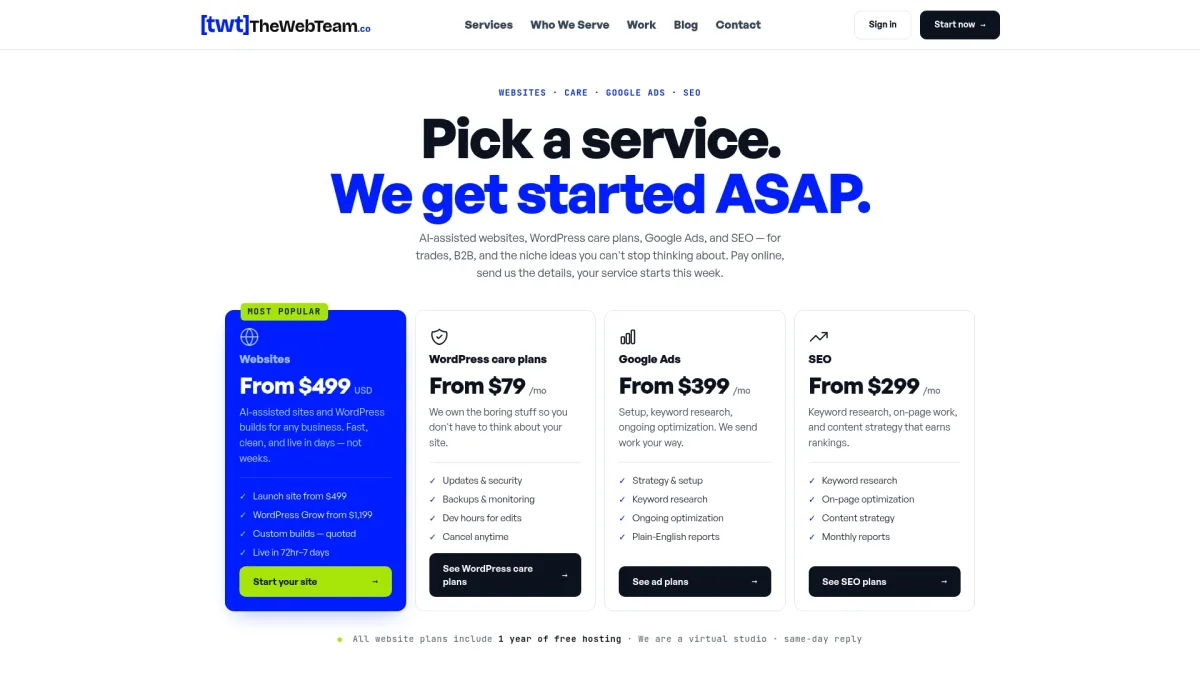
Every site Thewebteam builds includes attention to the on-page elements that drive real search performance, from title tags to page speed to the copy that appears in your search snippets. If your site is ranking but not converting searchers into visitors, the web design and SEO work Thewebteam delivers is built to close that gap. Transparent pricing, fast turnaround, and no hidden costs make it straightforward to get started.