
Targeting decision makers with SEO is defined as building content and keyword strategies that match the specific search behaviors of executives, procurement leads, and buying committees rather than general audiences. B2B buying cycles average 3–18 months and involve 6–8 stakeholders. That complexity means generic SEO built for traffic volume will miss the buyers who actually sign contracts. The good news: organic search delivers 748% ROI compared to 36% for paid search, and organic leads convert 1.5 to 3 times better. The gap between those numbers is exactly where a well-built B2B SEO strategy lives.
How to target decision makers with SEO: roles and intent
Decision makers and influencers are not the same buyer, and treating them as one is the most common B2B SEO mistake. A CFO searches for "total cost of ownership software migration." A CTO searches for "API security compliance framework." A department manager searches for "project management tool for remote teams." Each query reflects a different job title, a different risk tolerance, and a different definition of success.
Influencers, such as analysts, technical leads, and department heads, shape the shortlist. Decision makers approve the budget and sign off. SEO content must speak to both groups without conflating them. A page written for a technical evaluator will lose a CFO in the first paragraph. A page written for a CFO will fail to satisfy a security architect.
Typical B2B stakeholder profiles and their search behaviors:
- CFO / Finance lead: Searches for ROI benchmarks, cost comparisons, and payback period data. Responds to financial frameworks and case studies with hard numbers.
- CTO / IT lead: Searches for integration specs, security certifications, and architecture documentation. Responds to technical depth and third-party validation.
- Procurement manager: Searches for vendor comparison criteria, contract terms, and compliance requirements. Responds to structured comparison content.
- Department manager / End user: Searches for feature walkthroughs, onboarding timelines, and peer reviews. Responds to practical, outcome-focused content.
- CEO / Business owner: Searches for market positioning, competitive differentiation, and strategic outcomes. Responds to executive summaries and high-level ROI narratives.
Executives search for strategic frameworks and market analysis, not product features. Mirroring their language in your SEO content is the single fastest way to improve resonance with C-suite readers.
Pro Tip: Use LinkedIn Sales Navigator or a company's leadership page to identify the exact titles in your target accounts. Then run those titles through AI tools to extract the vocabulary those executives use publicly. Build your keyword list from that language, not from keyword volume reports alone.
What keywords and content types attract executives?
The right keyword strategy for B2B SEO targeting prioritizes intent over search volume. A phrase like "enterprise ERP implementation checklist" may generate 200 monthly searches. But every one of those searchers is deep in a buying cycle, has budget authority, and is comparing vendors. That query outperforms a 10,000-search-per-month term like "what is ERP" in pipeline value by a wide margin.

Content without actionable depth will fail even if it ranks well. Decision makers do not read thin content. They forward content that helps them build internal consensus. A 3,000-word guide comparing deployment models, with a downloadable summary, gets shared in Slack channels and executive briefings. A 600-word blog post does not.
| Characteristic | Decision maker SEO content | General SEO content |
|---|---|---|
| Keyword intent | High-intent, low-volume, role-specific | Broad, informational, high-volume |
| Content depth | Long-form guides, research, comparison pages | Short blog posts, listicles |
| Language register | Executive vocabulary, strategic frameworks | Consumer-friendly, accessible |
| Primary goal | Build consensus, support vendor evaluation | Drive traffic, generate awareness |
| Conversion action | Demo request, sales call, RFP submission | Email signup, page view |
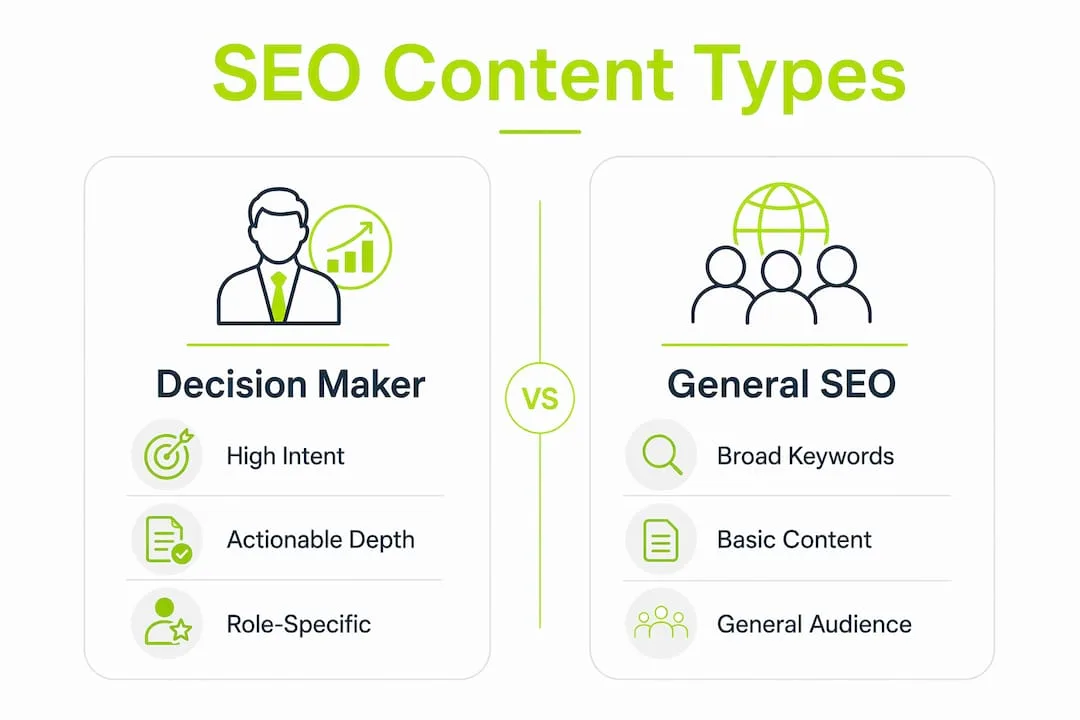
Content formats that consistently perform with executive audiences include long-form B2B buying guides, original research reports, vendor comparison pages, and ROI calculators. Each format serves a different moment in the evaluation process. Original research gives executives something to cite internally. Comparison pages reduce the effort of building a shortlist from scratch.
AI tools that analyze LinkedIn profiles help identify the exact vocabulary executives use when describing business problems. That vocabulary becomes your keyword seed list. Phrases like "operational resilience," "margin compression," and "supply chain visibility" appear in executive posts long before they appear in keyword research tools.
Pro Tip: Build every major content asset with a one-page executive summary at the top. Decision makers rarely read full documents before deciding whether to forward them. A tight summary with three key findings and one clear recommendation makes your content far more likely to travel through an organization.
How to map SEO content to the B2B buyer journey
The B2B buyer journey has three stages: awareness, consideration, and decision. Each stage requires a different keyword strategy and a different content format. Mapping content to these stages is not optional for B2B SEO. Without it, you create content that ranks but does not move buyers forward.
Topic clusters with pillar pages signal authority to search engines and guide decision makers through complex evaluations. A pillar page on "enterprise cybersecurity" links to cluster pages on compliance frameworks, vendor evaluation criteria, and implementation timelines. That structure serves both the algorithm and the buying committee.
A practical approach to mapping content and keywords across the buyer journey:
- Identify your core topic pillars. Choose three to five themes that reflect your product's primary use cases. Each pillar becomes the anchor for a cluster of supporting content.
- Map keywords to journey stages. Awareness keywords are broad and educational ("what is zero-trust security"). Consideration keywords are comparative ("zero-trust vs. perimeter security"). Decision keywords are specific and action-oriented ("zero-trust implementation vendor").
- Assign content formats to each stage. Awareness content works as blog posts and explainer pages. Consideration content works as comparison guides and research reports. Decision content works as case studies, ROI calculators, and product pages.
- Layer content for multiple stakeholders. A single pillar page can include a technical deep-dive section for IT leads and a financial impact summary for finance teams. Both audiences land on the same URL but find the content relevant to their role.
- Audit for gaps quarterly. Map your existing content against the journey stages and identify where buyers drop off. Missing consideration-stage content is the most common gap in B2B SEO programs.
Effective B2B SEO content must be shareable internally across multi-stakeholder groups. Content that serves only one role in the buying committee will stall at that role. Content that addresses technical, financial, and operational concerns in one asset moves faster through approval chains.
What metrics prove SEO value to business leaders?
Revenue-focused SEO metrics convince executives. Traffic and ranking reports do not. Pipeline contribution and organic customer acquisition cost are the two metrics that translate SEO performance into language a CFO understands immediately.
Enterprise leaders must treat SEO as a revenue-driving business unit, not a traffic channel. That shift in framing changes how you measure, report, and defend SEO budgets. Organic CAC is often significantly lower than paid CAC. Showing that gap in a monthly report is more persuasive than any ranking dashboard.
Reporting best practices for improving visibility to decision makers inside your own organization:
- Track organic-sourced pipeline in your CRM. Tag leads by acquisition channel at the point of form submission. Connect those leads to closed revenue six months later.
- Report organic CAC monthly. Divide total SEO spend by the number of customers acquired through organic search. Compare that figure directly to your paid search CAC.
- Use LTV:CAC ratio as a headline metric. A high lifetime value relative to acquisition cost is the clearest signal that SEO is generating quality buyers, not just traffic.
- Measure content-assisted conversions. Identify which pages appear in the conversion path for closed deals. Those pages are your highest-value SEO assets.
- Present a pipeline contribution percentage. Show what share of total pipeline originated from organic search. That single number frames SEO as a revenue driver, not a cost center.
Case studies that connect SEO activity to closed revenue are the most credible format for internal reporting. They show the full journey from search query to signed contract, which is exactly the story a CFO or CEO needs to justify continued investment.
Pro Tip: Connect your CRM directly to your analytics platform using UTM parameters and first-touch attribution. That connection lets you report on organic-sourced revenue without relying on manual tracking or last-click models that undercount SEO's contribution.
Key Takeaways
Reaching executives through organic search requires intent-driven keywords, role-specific content, and revenue metrics that speak the language of the boardroom.
| Point | Details |
|---|---|
| Prioritize intent over volume | Low-volume, high-intent keywords drive better pipeline than broad, high-traffic terms. |
| Build forwardable content | Long-form guides with executive summaries travel through buying committees and accelerate decisions. |
| Map content to buyer stages | Assign awareness, consideration, and decision content to distinct keyword clusters and formats. |
| Report in revenue terms | Track organic CAC, pipeline contribution, and LTV:CAC to justify SEO investment to executives. |
| Mirror executive language | Use AI and LinkedIn research to find the vocabulary decision makers use, then build keywords from it. |
Why most B2B SEO programs stall at the wrong audience
I have reviewed dozens of B2B SEO programs that generated strong traffic numbers and zero pipeline. The pattern is almost always the same. The content was written for the person who types the most queries, not the person who signs the check. Those are rarely the same individual.
The shift I have seen work consistently is treating SEO as a sales support function rather than a marketing vanity metric. When you build content that a VP of Operations can forward to a CFO with a single sentence of context, you have created something that does real commercial work. That content does not need to rank for a 10,000-search-per-month keyword. It needs to be found by the right 50 people per month and trusted enough to move forward.
The future of engaging decision makers online points toward AI-driven persona targeting, where tools simulate how a specific executive role browses and evaluates content. AI-based audit tools already simulate executive browsing personas to fine-tune landing pages for decision makers. That capability will become standard practice within two years. The teams building role-specific content architectures now will have a structural advantage when that shift arrives.
The uncomfortable truth is that most SEO programs are optimized for the algorithm, not the buyer. The programs that win at the enterprise level are optimized for the buying committee first and the algorithm second. Google rewards depth, authority, and relevance. So do CFOs.
— Jonathon
Thewebteam's approach to B2B decision maker SEO
Thewebteam builds SEO programs for B2B businesses in trades, technology, and niche industries where the buyer is never a single person and the sales cycle is never short. The work covers keyword research built around executive intent, content architecture mapped to multi-stakeholder buying journeys, and reporting frameworks that connect organic search to pipeline and closed revenue.
If your current SEO program generates traffic but not qualified conversations with the buyers who matter, the gap is almost always in content depth and keyword intent. Thewebteam's SEO and content services are built to close that gap with a clear process, transparent pricing, and measurable outcomes tied to revenue rather than rankings.