
What is a niche website strategy?
A niche website strategy is the deliberate decision to build a website around one narrowly defined topic or audience, rather than trying to cover everything. Instead of competing with massive publishers on broad terms, you go deep on a specific problem, serve a specific group of people, and become the most trusted resource in that corner of the internet.
The core components look like this:
- Focused topic scope: The site covers one subject area thoroughly rather than skimming many.
- Audience specificity: Content speaks directly to one defined group with shared needs or problems.
- Intent-driven keyword targeting: Pages target high-intent, low-competition searches rather than high-volume, generic terms.
- Topical authority building: Organized content clusters signal to Google that the site owns a subject area.
- Monetization alignment: Revenue methods (affiliate links, ads, digital products) match what the audience actually buys.
The strategic objective is not just traffic. It's becoming the go-to resource for a specific problem, which compounds into authority, trust, and sustainable revenue growth over time.
What do successful niche websites actually look like?
Niche sites exist across nearly every industry. The common thread is specificity, not subject matter.
Health and wellness:
- A site focused exclusively on managing Type 2 diabetes through low-carb eating (not general nutrition)
- A resource for postpartum fitness for mothers returning to running after childbirth
Personal finance:
- A site covering credit card rewards optimization for frequent domestic travelers
- A resource dedicated to FIRE (Financial Independence, Retire Early) strategies for teachers and public-sector workers
Hobbies and gear:
- A site reviewing mechanical keyboards for programmers, targeting buyers comparing specific switch types
- A resource covering sourdough baking for apartment kitchens with no stand mixer
B2B and professional:
- A site helping independent HVAC contractors with pricing, quoting, and customer management
- A resource for freelance translators working in legal and medical documents
The narrower the focus, the easier it is to dominate. Micro-niche blogging targets subtopics so specific that major publishers ignore them entirely, which creates a clear path to ranking without massive domain authority.

Why building a niche website gives you a real business advantage
The benefits of niche sites go well beyond "less competition." Here's what actually changes when you go narrow:
- Higher conversion rates: Visitors arrive with specific intent. A reader searching "best trail running shoes for wide feet under $120" is far closer to buying than someone searching "running shoes." High-intent keywords convert at higher rates for affiliate and service offers.
- Lower marketing spend: Targeted messaging reaches the right people without wasting budget on broad audiences unlikely to buy.
- Faster authority building: Covering 40 articles on one micro-niche signals topical depth to Google faster than 40 articles spread across five loosely related topics.
- Stronger monetization fit: A focused audience generates more revenue than a scattered one because product recommendations match actual needs.
- Easier backlink acquisition: Micro-niche sites attract links more easily because they create the definitive resource that doesn't exist elsewhere.
- Multiple revenue streams: A well-chosen niche supports affiliate commissions, display ads, sponsored content, and digital products simultaneously.
- Resilience through specificity: Niche sites with genuine expertise weather Google algorithm updates better than thin, generic content farms.
The niche marketing advantage is fundamentally about efficiency. Every dollar of effort and every piece of content works harder because it speaks directly to people who already want what you're offering.
What to realistically expect when building a niche website
The honest answer: this takes longer than most people expect, and the early months feel like shouting into a void.
Building a niche site is a long-term project, commonly taking 18–24 months to reach peak profitability. Google needs time to establish topical authority for new domains, a period often called the "sandbox phase." Patience during this window is not optional.
What the realistic timeline looks like:
- Months 1–3: Foundation. Publish cornerstone articles, set up Google Analytics 4 and Google Search Console, build basic internal linking.
- Months 4–6: Authority signals. Add additional articles, begin link outreach, apply for affiliate programs.
- Months 7–12: Traction. Long-tail keywords start ranking, early affiliate commissions appear, email list begins growing.
- Months 13–24: Compounding. Traffic accelerates, revenue diversifies, content gaps get filled systematically.
The challenges are real. Algorithm updates can shift rankings overnight. Niche saturation in personal finance, fitness, and tech reviews means you need genuine expertise, not recycled information. Niche sites require serious business management with ongoing content quality control, technical SEO, and research-led planning. Anyone expecting passive income from day one will be disappointed.
The upside is that a mature niche site functions like digital real estate. Once established, it generates traffic and revenue continuously, often with minimal day-to-day involvement, and can eventually be sold.
How niche SEO differs from general SEO
Niche SEO and general SEO share the same technical foundations, but the strategy diverges sharply at the keyword and content level.
General SEO chases high-volume terms and broad authority. Niche SEO does the opposite on purpose.
- Keyword philosophy: Niche SEO targets lower search volume, higher-intent queries with less competition. A keyword with 400 monthly searches and clear buying intent often outperforms a 40,000-search term dominated by major publishers.
- Topical depth over breadth: Rather than covering many subjects shallowly, niche SEO builds a pillar and cluster content architecture where one pillar page covers a major topic broadly, and supporting cluster articles address every specific question underneath it.
- Programmatic SEO potential: Narrow niches with structured, comparable data (product specs, location data, pricing tiers) are ideal for programmatic SEO, where templated pages capture hundreds of long-tail searches simultaneously.
- E-E-A-T signals: Google's experience, expertise, authoritativeness, and trustworthiness guidelines reward demonstrated first-hand knowledge. In a micro-niche, showing real experience matters more than domain authority.
- Funnel construction: Expert marketers prioritize niche-specific keywords with clear buying intent to build a funnel from education to transaction, improving long-term monetization.
One common misconception: niche SEO is not about gaming low-competition keywords and waiting for passive income. It requires consistent content investment, technical hygiene, and strategic internal linking to work.
Pro Tip: Use Google Search Console's "Search results" report to identify which cluster articles are already gaining impressions. Those are your signals for which subtopics Google considers you relevant for. Double down on those areas with additional supporting content before expanding to new clusters.
How to develop your niche website strategy step by step
Step 1: Choose and validate your niche
A profitable niche sits at the intersection of demand, commercial value, and manageable competition. Before committing, run three checks: confirm search volume exists (use Ahrefs or Semrush to find at least 50–100 relevant keywords), verify affiliate products or services are available to promote, and check that an active community exists on Reddit, Facebook groups, or forums.

Step 2: Define your audience precisely
Go beyond demographics. Identify the specific problem your audience is trying to solve, the language they use when searching, and the products or services they buy. This drives every content and monetization decision downstream.
Step 3: Map your content architecture
Before writing a single article, plan your pillar pages and cluster topics. Pillar pages target high-value commercial keywords. Cluster articles answer every specific question related to each pillar. Every cluster links back to its pillar, concentrating SEO authority where it matters most.
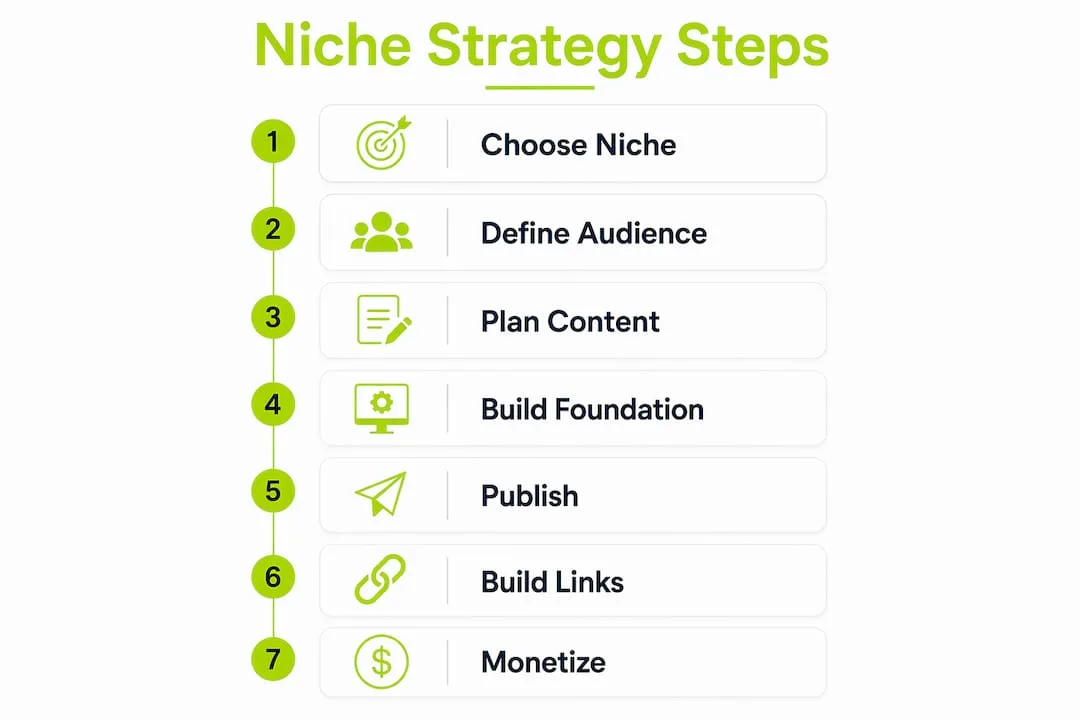
Step 4: Build on a solid technical foundation
A fast, mobile-responsive WordPress site with clean architecture gives your content the best chance to rank. Pay attention to technical SEO fundamentals from day one: proper URL structure, schema markup, page speed, and internal linking.
Step 5: Publish consistently and prioritize depth
Aim for a steady flow of articles during the launch phase. Quality beats quantity, but volume matters for topical authority signals. Each article should answer its target query more thoroughly than existing results.
Step 6: Build links and community presence
Guest posting, original research, and active participation in niche communities (subreddits, Discord servers, Facebook groups) generate the backlinks and trust signals that accelerate ranking.
Step 7: Monetize strategically as traffic grows
Start with affiliate links and display ads. Layer in digital products, sponsored content, or services around months 18–24 once you have an engaged email list.
Which tools help you research and select a profitable niche?
The right tools cut months of guesswork out of niche validation.
Keyword research:
- Ahrefs and Semrush show search volume, keyword difficulty, and competitor gap analysis. Use them to confirm that a suitable number of keywords exist in your potential niche with realistic competition levels.
- Google Keyword Planner gives free search volume estimates for seed keywords.
- Google Search Console reveals what queries your existing content already ranks for, useful for expanding an existing site.
Competitor and content analysis:
- Ahrefs Site Explorer lets you see exactly which pages drive traffic for competing sites, revealing content gaps you can fill.
- Google Trends confirms whether a niche has stable, evergreen demand or is tied to a fading trend.
Community validation:
- Reddit and Facebook Groups show whether an active audience exists and what questions they ask repeatedly.
- Amazon Best Sellers and affiliate network catalogs (ShareASale, CJ Affiliate, Impact) confirm that products exist with real commercial demand.
Site architecture and content planning:
- A solid site architecture strategy determines how well your content clusters communicate topical authority to search engines.
How to plan and create content for a niche website
Content planning for a niche site is not the same as running a blog. Every piece has a job.
The pillar and cluster model is the most effective architecture for building topical authority. A pillar page covers a major topic comprehensively (3,000+ words), while cluster articles address specific subtopics, questions, and comparisons, all linking back to the pillar. Over time, this structure signals to Google that the site owns the subject area.
Content types that perform well on niche sites:
- Buyer guides and "best of" roundups: High commercial intent, strong affiliate conversion.
- Comparison articles ("Product A vs. Product B"): Searchers at this stage are close to buying.
- How-to and tutorial content: Builds trust and captures informational searches early in the funnel.
- Data-driven or original research pieces: Attract backlinks naturally because no one else has the data.
- FAQ and glossary pages: Capture long-tail queries efficiently and support featured snippet rankings.
A practical content strategy framework maps each article to a specific keyword, a content type, and a funnel stage before writing begins. This prevents the common mistake of publishing randomly and hoping something ranks.
Content optimization matters as much as creation. Tools like Google Search Console and content optimization practices help you identify which published articles need updating, which are gaining traction, and where gaps remain.
How niche websites make money
Niche websites monetize through display ads, affiliate links, sponsored posts, and digital products, with affiliate commissions being the largest revenue stream for most operators.
Affiliate marketing is the most common starting point. You write product reviews, comparison posts, and buyer guides, then earn commissions when readers purchase through your links. Commission rates vary widely: Amazon Associates pays 4–8% on most categories, while SaaS, finance, and digital services programs often pay 20–50%.
Display advertising through networks like Mediavine (which requires 50,000 monthly sessions minimum) or AdThrive provides passive income once traffic scales. RPMs typically range from $3–$12 per thousand pageviews depending on niche and audience geography.
Digital products (ebooks, courses, templates, memberships) offer the highest margin because you keep 100% of revenue. This model works best after you've built an email list and established trust with your audience.
Sponsored content and brand partnerships become available once a site has clear authority in its niche. Brands pay for placement because your audience is exactly who they want to reach.
Lead generation works for local service niches (contractors, legal, medical) where connecting visitors with service providers can generate $25–$100 per qualified lead.
Most successful operators run a hybrid model: affiliate links and display ads from launch, then digital products added around month 18–24 once an engaged email list exists.
How to measure and improve your niche website's performance
You can't improve what you don't track. The metrics that matter for niche sites are different from those for e-commerce or SaaS.
Traffic metrics (Google Analytics 4 and Google Search Console):
- Organic sessions by landing page: which articles drive real search traffic?
- Click-through rate by query: are your title tags compelling enough to earn clicks?
- Average position for target keywords: are you moving from page 2 to page 1?
Revenue metrics:
- Revenue per thousand visitors (RPM) across all monetization channels combined
- Affiliate click-through rate and conversion rate by article
- Email list growth rate and open rates (a proxy for audience quality)
Authority metrics:
- Domain Rating (Ahrefs) or Domain Authority (Moz): tracks backlink profile growth over time
- Number of ranking keywords: a growing keyword count signals expanding topical authority
- Referring domains: quality matters more than quantity here
Analytics-driven decisions separate operators who compound growth from those who plateau. The practical workflow: monthly, identify your top 10 traffic pages and check whether they're monetized well. Identify your top 10 ranking pages by impressions that haven't yet cracked page 1, and update them. Find articles with high impressions but low click-through rates, and rewrite their title tags and meta descriptions.
The sites that grow consistently treat their content as a portfolio, actively managing it rather than just publishing and moving on.
Key Takeaways
A niche website strategy succeeds by going deep on one specific topic, building topical authority over 18–24 months, and monetizing high-intent traffic through aligned revenue streams.
| Point | Details |
|---|---|
| Niche selection is the critical decision | A profitable niche needs demand, commercial products, and manageable competition before you commit. |
| Growth takes 18–24 months | Google's sandbox phase is normal; consistent content and link building during this window determines long-term ranking. |
| Pillar and cluster architecture builds authority | Organizing content into pillar pages and supporting clusters signals topical depth to search engines. |
| Affiliate commissions lead revenue | Most niche site operators earn the majority of income through affiliate marketing, layering in display ads and digital products as traffic grows. |
| Track content as a portfolio | Monthly review of rankings, click-through rates, and revenue per page drives compounding improvement over time. |
Ready to build your niche website on a solid foundation?
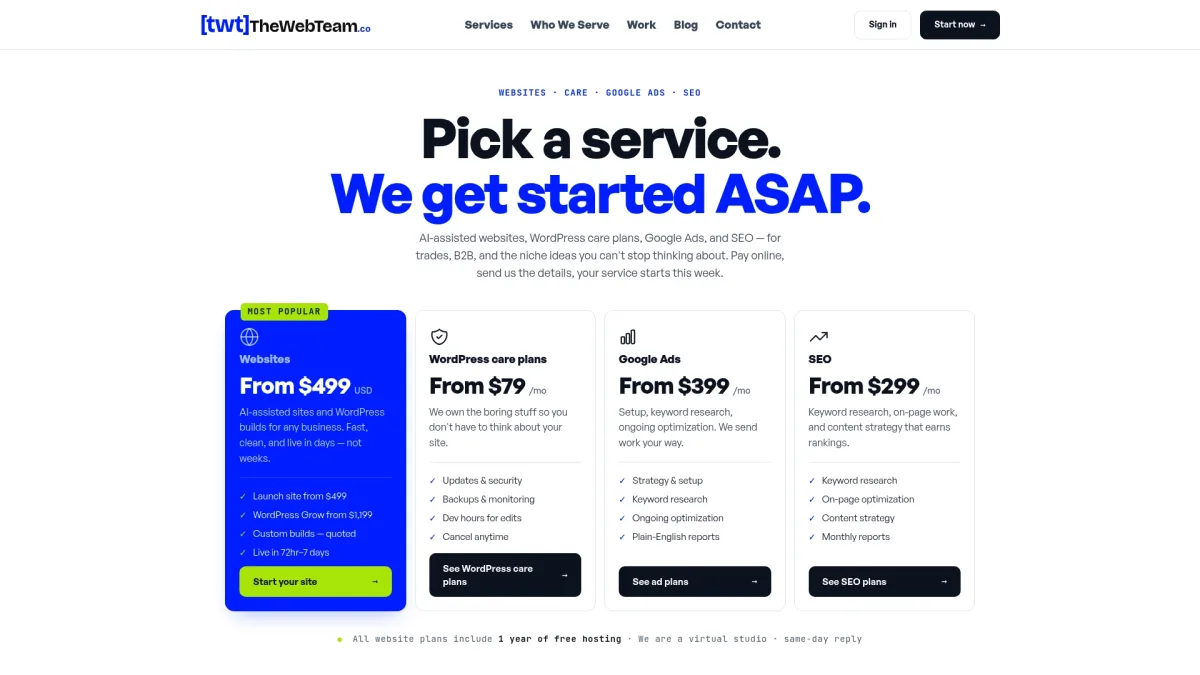
A niche website strategy only works if the site itself is fast, technically sound, and built to rank. Thewebteam builds WordPress websites for trades, B2B businesses, and niche industries, with launches measured in days rather than months. From site architecture to ongoing SEO, the team handles the technical side so you can focus on content and growth.
Explore niche industry web design or check out services and pricing to see what a purpose-built niche site looks like in practice.