
If you sell in a narrow category, eight changes to your product pages will move the needle faster than anything else: optimize your title tag and H1 with the primary keyword in the first three words, write a substantial length of unique benefit-first copy, serve images in WebP with srcset and fixed dimensions to prevent layout shift, embed Product + Offer + AggregateRating schema markup directly in your HTML, place a sticky add-to-cart button above the fold, add a structured FAQ block with FAQPage schema, canonicalize all variants to one URL, and build 3–5 internal links from category pages and buying guides.
Do those eight things and you get faster indexing, eligibility for rich results, and a measurable lift in click-through rate. Pages with proper product schema can raise CTR by roughly 20–35%. Hitting an LCP under 2.5 seconds improves both rankings and conversion. These are not theoretical gains. Thewebteam builds and maintains WordPress and WooCommerce stores for niche businesses, and the pattern holds across every category.
Quick checklist:
- Optimize title tag and H1 (primary keyword in first 3–5 words)
- Write 200–400 words of unique, benefit-first product copy
- Serve images in WebP with
srcsetand explicitwidth/heightattributes - Add Product + Offer + AggregateRating schema in server-rendered HTML
- Place a clear add-to-cart CTA above the fold (sticky on mobile)
- Build a structured FAQ section with FAQPage schema
- Canonicalize product variants to a single URL
- Add 3–5 internal links from category pages and related buying guides
Table of Contents
- What is niche product page optimisation, and how does it differ?
- Core on-page elements that make a product page findable and persuasive
- What does technical SEO look like for niche product pages?
- How do you hit Core Web Vitals targets on product pages?
- What conversion assets actually lift product page performance?
- How do you measure product page performance and run reliable A/B tests?
- Platform-specific quick wins for Shopify, WooCommerce, and headless
- Niche-ready templates and an action kit you can copy-paste
- What does a 90-day implementation roadmap look like?
- What should every product page say about shipping, returns, and payment?
- How do you research competitors and keywords for niche product pages?
- How do you personalize the experience for niche audiences?
- What copy psychology works for niche buyers specifically?
- How do you drive niche product page traffic from email and social?
- Key Takeaways
- The part of niche product SEO most stores get backwards
- Thewebteam builds product pages that rank and hold their gains
- FAQ
- Primary sources and further reading
What is niche product page optimisation, and how does it differ?
Product page optimisation is the combination of on-page SEO, conversion design, and technical setup that makes a page discoverable, rankable for buyer intent, and capable of turning visitors into customers. For a mainstream retailer selling commodity products, the challenge is mostly volume and competition. For a niche store, the challenge is different: lower search volume per keyword, higher buyer intent, and a real need to demonstrate expertise that a big-box competitor simply cannot match.
Niche stores should prioritize long-tail keywords over head terms, invest in category-level buying guides to capture earlier-stage researchers, and treat image quality and expert content as ranking signals rather than nice-to-haves. A buyer searching "handcrafted 8-ply merino yarn 200g skein" already knows what they want. Your page needs to confirm you have it, explain why yours is the right choice, and remove every friction point between that conviction and the checkout button.
Inventory messaging matters more in niche markets too. Scarce SKUs need honest lead times and pre-order options, not vague "limited stock" claims that erode trust.
Pro Tip: Treat your category pages as revenue multipliers. Invest sufficient buying guidance content on each category page to capture researchers who haven't committed to a specific SKU yet. Category pages can outperform individual product pages for revenue in niche markets because they capture "what should I buy" intent first.
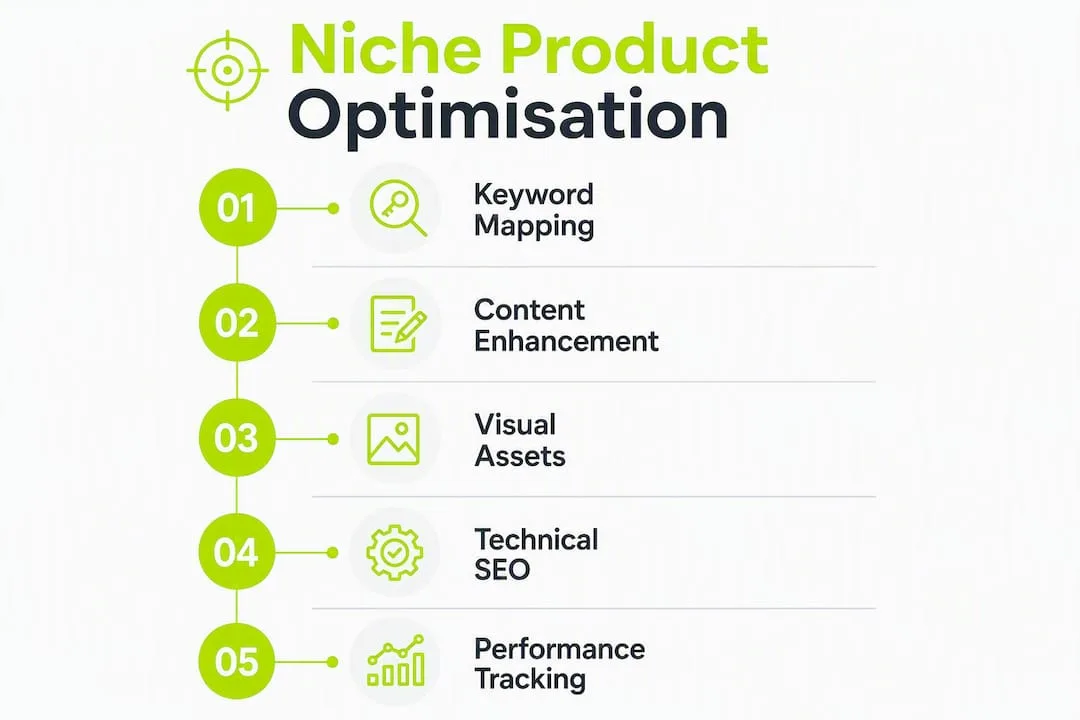
Core on-page elements that make a product page findable and persuasive
Title tags and H1
Format your title tag as Brand + Product + Key Attribute, keep it under 60 characters, and put the primary keyword in the first three to five words. Your H1 can be slightly longer and more descriptive, but it should match the title tag closely enough that a visitor landing from search feels no disconnect. Avoid stuffing multiple attributes into the title; pick the one that matches buyer intent.
Product descriptions that actually sell
Product descriptions under 200 words are frequently treated as thin content. For competitive niche SKUs, aim for 200–400 words. Lead with the primary benefit in the first sentence, include the primary keyword within the first 100 words, and structure the copy in short paragraphs a buyer can scan. Then follow with a spec block.
A spec block should include dimensions, weight, materials, SKU, and any niche-specific attributes (fiber content, cure temperature, thread count). Keep it in a bulleted list so it's scannable and so search engines can parse the attributes cleanly.
Pro Tip: Don't try to rewrite every product at once. Identify your top 20% of SKUs by revenue and write benefit-first descriptions for those first. That's where the conversion lift will show up fastest.
Images, CTAs, and internal links
Name image files descriptively (handcrafted-merino-yarn-200g-blue.webp), write alt text that describes the image literally, and always set width and height attributes to prevent Cumulative Layout Shift. For CTAs, sticky add-to-cart bars on mobile outperform static buttons buried below the fold. Include microcopy near the CTA that addresses shipping time and return policy for niche items where lead time is a real concern.

Internal linking is underused on product pages. Point 3–5 links from your category pages and buying guides to each key product, and add breadcrumbs that reflect your site hierarchy. For site architecture that supports this, the structure should flow: Home ? Category ? Subcategory ? Product.
| On-page element | Action | Why it matters |
|---|---|---|
| Title tag | Brand + Product + Attribute, under 60 chars | Matches buyer intent, improves CTR |
| H1 | Mirror title tag, include primary keyword | Confirms relevance to search engines |
| Product description | 200–400 words, benefit-first, keyword in first 100 words | Avoids thin content, supports ranking |
| Spec block | Bulleted list: dimensions, weight, materials, SKU | Scannable for buyers, parseable for crawlers |
| Images | WebP, descriptive filename, alt text, width/height |
Prevents CLS, improves image search visibility |
| CTA | Sticky on mobile, above fold, microcopy for shipping | Reduces friction, lifts add-to-cart rate |
| Internal links | 3–5 from category/buying guides, breadcrumbs | Distributes authority, aids navigation |
| FAQ section | Structured Q&A with FAQPage schema | Feeds rich results and AI Overviews |
What does technical SEO look like for niche product pages?
Keyword strategy
Map one primary keyword per product page and a small cluster of close variants. Use your category pages for broader intent ("merino yarn for knitting") and reserve product pages for specific buyer queries ("200g merino yarn fingering weight"). Tools like Google Search Console, Ahrefs, or Semrush surface the long-tail queries your niche buyers actually use. For on-page SEO elements that support this mapping, the structure of title tags, meta descriptions, and URL slugs all need to align with the keyword assigned to that page.
Metadata and URLs
Meta descriptions don't directly affect rankings, but they drive CTR. Write them as a 150–160 character pitch: primary keyword, key benefit, and a soft call to action. For URLs, use lowercase with hyphens, include the primary keyword, and prefer a clean hierarchy: /products/handcrafted-merino-yarn-200g or /collections/yarn/products/merino-200g. Avoid parameters, session IDs, and auto-generated strings.
Canonicalization and variants
This is where many niche stores bleed ranking power. If your blue, green, and red versions of a product each live on a separate URL, you've split your link equity three ways and created near-duplicate content. Consolidate all variants onto one canonical URL, use rel=canonical to confirm it, and reflect variant availability in your Product/Offer schema rather than creating separate indexable pages. The canonical URL approach stacks all internal linking authority onto a single page instead of thinning it across dozens of near-identical ones.
Structured data
Include Product, Offer, AggregateRating (when real reviews exist), Review, BreadcrumbList, and FAQPage schema in your page HTML, not only via JavaScript. Here's a minimal valid example:
{
  "@context": "https://schema.org/",
  "@type": "Product",
  "name": "Handcrafted Merino Yarn 200g",
  "description": "Single-ply 8-ply merino yarn, 200g skein, hand-dyed.",
  "offers": {
    "@type": "Offer",
    "price": "24.00",
    "priceCurrency": "USD",
    "availability": "https://schema.org/InStock"
  },
  "aggregateRating": {
    "@type": "AggregateRating",
    "ratingValue": "4.8",
    "reviewCount": "47"
  }
}
Keep price and availability in server-rendered HTML so search engines and AI crawlers can read them on the first pass. Pages with proper product schema are eligible for rich results and can raise CTR by roughly 20–35%.
How do you hit Core Web Vitals targets on product pages?
Google's current thresholds are LCP under 2.5s, INP under 200ms, and CLS under 0.1. For product pages loaded with high-resolution images and third-party widgets, hitting those numbers takes deliberate effort.
Prioritized developer checklist:
- Compress the hero image to under 200KB and serve it in WebP or AVIF. WebP delivers 25–34% smaller file sizes than JPEG at equivalent quality.
- Set explicit
widthandheighton every image element to eliminate CLS. - Use
srcsetfor responsive images so mobile devices don't download desktop-sized files. - Lazy-load all images below the fold; preload the hero image with
<link rel="preload">. - Inline critical CSS; defer non-critical JavaScript.
- Preconnect to CDN origins and any third-party font hosts.
- Use server-side rendering for product content so price, availability, and schema are in the initial HTML response.
- Remove render-blocking scripts from the
<head>— move them to the bottom or useasync/defer. - Enable CDN caching for static assets.
- Test with PageSpeed Insights and monitor field data in Google Search Console's Core Web Vitals report.
For mobile, touch targets should be at least 48×48px. Sticky add-to-cart bars should sit in the thumb zone (bottom third of the screen). Product gallery swipe interactions are a common INP culprit — optimize event handlers and avoid heavy JavaScript on touch events.
A one-second improvement in load time can raise conversions materially. Monitor your field data, not just lab scores, because real-user performance is what Google measures for ranking.
What conversion assets actually lift product page performance?
Product pages that balance ranking signals and conversion elements outperform pages that focus on only one dimension. The assets below are where that balance gets built.
Photography and video
Every product page needs a hero shot, at least two contextual lifestyle images, and close-up detail shots for texture, finish, or scale. For niche items where size matters (a wall hanging, a precision tool, a specialty garment), include a scale reference in at least one image. Caption images with literal descriptions, not marketing copy, and write alt text the same way.

Short demo videos hosted as optimized MP4s outperform embedded YouTube for page speed. Use a poster image as a fallback, lazy-load the video element, and keep clips under 60 seconds. Schema.org's video markup makes these eligible for video rich results.
Reviews, UGC, and trust signals
Active review sections increase keyword coverage and contribute fresh content that supports long-tail ranking. Surface common phrases buyers use in reviews — those phrases are often the exact long-tail queries other buyers search. Display star ratings with AggregateRating schema so they appear in search results.
Trust signals near the CTA convert skeptical buyers: clear shipping timelines, return policy summary, warranty information, and secure checkout badges. For niche products with longer lead times, be specific. "Ships in 7–10 business days" converts better than "allow extra time for delivery."
For niche products, original expert content — a sizing guide, a how-to photo series, a materials comparison — consistently outranks generic listings. One high-quality how-to per top product is worth more than a dozen rewritten spec sheets.
Scarcity messaging
Show concrete inventory counts or lead times when they're real. "Only 4 left in stock" is credible when it's true and visible in your schema's availability field. Pre-order options with a confirmed ship date work well for made-to-order niche items. Avoid vague urgency language ("selling fast," "almost gone") without a real number — niche buyers are often enthusiasts who know the category well enough to spot manufactured pressure.
Pro Tip: For niche products, one high-quality how-to per top SKU — a real sizing guide, a materials comparison, a step-by-step use photo — outranks a generic listing every time. Use Spark Concept to validate your product messaging and content angles before you invest in production.
How do you measure product page performance and run reliable A/B tests?
KPIs to track
Primary metrics: organic sessions to product pages, CTR from SERP (Google Search Console), average position for product keywords, add-to-cart rate, product page conversion rate, and revenue per session. Secondary: bounce rate (or engagement rate in GA4), time on page, and scroll depth.
Instrument add-to-cart, view-product, begin-checkout, and purchase as events in GA4 and, where possible, as server-side events. Enhanced ecommerce tracking in GA4 gives you the full funnel. Don't rely on client-side events alone — ad blockers and browser privacy settings suppress them.
A/B test plan: benefit-led vs. feature-first descriptions
- Hypothesis: A benefit-led product description (leading with what the buyer gains) will increase the add-to-cart rate compared to a feature-first description (leading with specs) on the same SKU.
- Variant setup: Control = current feature-first copy. Variant = rewritten benefit-first copy, same length (250–300 words), same images and CTA.
- Sample size: Calculate required sample size before launch using a tool like Evan Miller's sample size calculator. For a baseline conversion rate of 3% and a minimum detectable effect of 0.5%, you'll need roughly 5,000 sessions per variant.
- Run time: Minimum two full business cycles (typically 4 weeks for most niche stores). Do not change traffic sources mid-test.
- Primary metric: Add-to-cart rate. Secondary: average order value, SERP CTR.
- Segment results: Split mobile vs. desktop before declaring a winner. Niche buyers often research on desktop and purchase on mobile, so the winning variant may differ by device.
Roll out the winning variant, document the result, and move to the next hypothesis. A/B testing is a process, not a one-time event.
Platform-specific quick wins for Shopify, WooCommerce, and headless
Shopify
Edit title tags and meta descriptions directly in the product admin under "Search engine listing preview." For schema, use a theme that outputs JSON-LD Product markup in the <head>, or add a trusted app. Make sure price and availability are in the server-rendered HTML, not injected by a client-side app after page load. Use Shopify's built-in image processing to serve responsive images, and enable lazy loading for gallery images below the fold.
WooCommerce and WordPress
This is where Thewebteam's work is concentrated. The most common mistake on WooCommerce stores is injecting price via JavaScript after the initial page load. Search engines and AI crawlers often miss dynamically inserted content. Keep price, availability, and schema in the server-rendered HTML using a well-coded theme or block-based templates.
For schema, implement Product and Offer markup via custom theme code or a trusted plugin. Image optimization plugins paired with a CDN handle the WebP conversion and responsive delivery pipeline. The technical SEO checklist for WordPress covers the full stack: schema, Core Web Vitals, canonicalization, and crawl settings.
On WooCommerce, the single highest-impact technical fix is moving price and availability into server-rendered HTML. If a crawler can't read your price on the first HTTP response, your Offer schema is invisible to AI Overviews and rich result parsers — regardless of how well the rest of the page is built.
Headless setups
Keep critical product fields (name, price, availability, description) in SSR endpoints so crawlers get them in the initial response. Use stable canonical URLs and expose JSON-LD in the HTML shell, not only in client-side React or Vue components. Headless gives you performance flexibility, but it creates real indexability risks if the product data lives only in client-rendered JavaScript.
Niche-ready templates and an action kit you can copy-paste
Benefit-first product description template
Hero benefit line: [Product name] gives [target buyer] [primary benefit] without [common objection].
Body (2–3 short paragraphs): Expand on the benefit, address the primary use case, and include the primary keyword naturally within the first 100 words. Follow with a second paragraph on materials, process, or provenance — whatever your niche buyer cares about most.
Spec block:
- Dimensions: [X × Y × Z]
- Weight: [X g / oz]
- Materials: [list]
- SKU: [code]
FAQ prompts for niche buyers
- "Is [product] suitable for [specific use case or skill level]?"
- "What is the lead time for [product], and can I pre-order?"
- "How does [product] compare to [common alternative] for [niche application]?"
Map each FAQ answer to FAQPage schema so it feeds AI Overviews and conversational search results. Price and availability should be in plain HTML so AI crawlers can parse them reliably.
Before/after: handcrafted macrame wall hanging
Before (feature-first): "Cotton macrame wall hanging, 18 inches wide, natural color, handmade."
After (benefit-first): "This handcrafted macrame wall hanging brings texture and warmth to any wall in minutes — no tools, no hardware beyond a single nail. Woven from 3mm natural cotton rope in our studio, each piece measures 18 inches wide and hangs 32 inches long, with a driftwood dowel included. The open-weave pattern works in boho, Scandinavian, and minimalist interiors alike."
The after version is 68 words, includes the primary keyword context, addresses the buyer's installation concern, and gives enough detail to satisfy a niche buyer who knows their materials.
Checklist for your top 10 SKUs:
- Write benefit-first hero line and 250–300 word description
- Build spec bullet block with all niche-specific attributes
- Source hero image, 2 lifestyle shots, and 1 scale-reference image
- Write 3 FAQ Q&As and map to FAQPage schema
- Add Product + Offer + AggregateRating JSON-LD to page HTML
- Assign owner: copywriter for copy, developer for schema and images
- Set canonical URL and confirm no variant URLs are indexed separately
- Add internal links from category page and at least one buying guide
What does a 90-day implementation roadmap look like?
Niche product page work breaks cleanly into four phases. The table below gives you the timeline, roles, and ballpark cost ranges for each.
| Phase | Weeks | Key tasks | Roles needed | Ballpark cost (USD) |
|---|---|---|---|---|
| Audit | 1–2 | Crawl audit, thin-content report, CWV baseline, schema gap analysis | SEO specialist, developer | — |
| Quick wins and tech fixes | 3–6 | Hero image compression, schema implementation, canonical fixes, CDN setup | Front-end developer, SEO | — |
| Content and assets | 6–10 | Benefit-first descriptions for top 20% SKUs, photography, FAQ copy, internal links | Copywriter, photographer, SEO | $2,000–$4,000 |
| Testing and iteration | 10 | A/B tests, analytics review, rollout of winners, care plan handoff | SEO/analytics, developer, QA | — |
For a small store doing this DIY or with a single contractor, the total investment typically runs $3,000–$8,000 over 90 days. A mid-size niche store working with an agency and developer lands in the $8,000–$18,000 range. Enterprise niche brands with large catalogs and ongoing care plan needs typically budget $2,000–$5,000 per month on a retainer.
WordPress and WooCommerce stores benefit most from having a developer handle server-rendered schema, image pipeline setup, and CDN configuration in weeks 3–6. Those are the tasks that unlock the technical eligibility for rich results and AI Overview pulls. Thewebteam's care plans cover ongoing maintenance after the initial build, so the gains don't erode as the store grows and the catalog changes.
Pages with proper product schema are eligible for rich results and can raise CTR meaningfully, which means the audit and schema work in weeks 1–6 often pays for itself before the content phase even starts.
What should every product page say about shipping, returns, and payment?
Buyers in niche markets are often making considered purchases. They want to know exactly what happens after they click "buy." Put shipping timelines, return policy, and accepted payment methods on the product page itself, not buried in a footer link.
Shipping copy should be specific: carrier, estimated transit time, and any handling time for made-to-order items. Returns should state the window (e.g., "30-day returns on unworn items") and whether the buyer or seller covers return shipping. For niche products with a higher price point, a clear warranty statement near the CTA removes a significant objection.
Payment options displayed as icons (Visa, Mastercard, PayPal, Shop Pay, Affirm for higher-ticket items) reduce checkout anxiety. For niche stores selling internationally, show the currency selector near the price. An FAQ block on the page that answers "When will my order ship?" and "What if it doesn't fit?" feeds FAQPage schema and reduces support tickets simultaneously.
How do you research competitors and keywords for niche product pages?
Start with Google Search Console to find which queries already bring traffic to your product pages, then look for gaps where competitors rank and you don't. For keyword research, tools like Ahrefs, Semrush, or even Google's own autocomplete surface the long-tail variants niche buyers use. A query like "best merino yarn for colorwork" is a buying-intent phrase that a category page can own; "200g fingering weight merino skein" is a product-page keyword.
For competitor analysis, pull the top three to five ranking pages for your target product keyword and audit them: word count, schema presence, image count, review count, and internal link structure. You're not copying them. You're identifying the floor. Niche stores can outrank larger competitors by combining strong technical foundations with deep expert content that addresses questions a big-box retailer's generic page never answers.
Map your findings to a simple spreadsheet: keyword, current ranking URL, competitor URL, gap (schema missing? thin copy? no reviews?). That gap list becomes your prioritized task list for the content and tech phases of the 90-day roadmap.
How do you personalize the experience for niche audiences?
Niche buyers are often enthusiasts or professionals who know more about the product than a general buyer would. Personalization for them isn't about showing "customers also viewed" carousels. It's about surfacing the right information at the right depth.
Segment your product page content by buyer type where you can. A beginner buying their first macrame kit needs a "what's included" breakdown and a difficulty rating. An experienced maker wants fiber specs and a tension guide. If your platform supports it, use URL parameters or customer tags to show different content blocks to different segments. WooCommerce with a page builder or a headless setup gives you the most flexibility here.
Browsing history-based recommendations ("you viewed X, here's Y") work well for niche stores with related SKUs. Cross-sells should be genuinely complementary, not just high-margin items. A buyer looking at a specialty yarn wants to see the matching needles or a pattern book, not a random bestseller. For long-form content strategy that supports personalization, buying guides and comparison content let you segment by intent before the buyer even reaches a product page.
What copy psychology works for niche buyers specifically?
Niche buyers are skeptical of generic claims. "High quality" and "best in class" mean nothing to someone who has been buying in a category for years. What converts them is specificity: the exact fiber content, the country of origin, the production method, the person who made it.
Lead with the outcome the buyer wants, not the feature that delivers it. "Knits at 22 stitches per 4 inches on US 4 needles" is more persuasive to a knitter than "premium fingering weight yarn." Address the objection that's specific to your niche. For a made-to-order product, that's lead time. For a technical tool, it's compatibility. For a food product, it's allergens and sourcing.
Use the language your buyers use, not the language your supplier uses. Pull phrases from your own review section, from Reddit threads in your niche, from the questions your support team gets. Those phrases are the long-tail keywords your product description should contain naturally. Reviews and UGC are a continuous source of fresh keyword content and social proof simultaneously. Use Spark Concept to stress-test your product messaging before committing to a full rewrite.
How do you drive niche product page traffic from email and social?
Email is the highest-ROI channel for niche stores because your list is already self-selected. Segment by purchase history and send product-specific emails that link directly to the optimized product page, not the homepage. A "back in stock" email for a scarce niche SKU with a direct link and a clear CTA converts at rates that paid social rarely matches.
For social, niche communities on Instagram, Pinterest, and Reddit respond to content that demonstrates expertise, not just product shots. A how-to reel that shows your product in use, with a link to the product page in the bio or caption, drives qualified traffic. Pinterest is particularly strong for niche physical products because pins have a long shelf life and drive search-like intent traffic. Tag products in Instagram Shopping and Pinterest Catalogs so the product page is one tap away.
The connection between social content and product page SEO is indirect but real. Social traffic that engages with your page (scrolls, clicks, adds to cart) sends behavioral signals that support rankings. More practically, social content that gets shared generates backlinks and brand mentions that build the domain authority your niche product pages need to rank. Coordinate your email and social calendars with your product page update schedule so new content and new traffic arrive together.
Key Takeaways
Niche product page optimisation works when you combine server-rendered schema, benefit-first copy for your top revenue SKUs, and Core Web Vitals targets (LCP under 2.5s, INP under 200ms, CLS under 0.1) into a single coordinated effort.
| Point | Details |
|---|---|
| Schema raises CTR | Product + Offer + AggregateRating schema can lift click-through rates by roughly 20–35%. |
| Copy length matters | Descriptions under 200 words risk thin-content treatment; aim for 200–400 words on competitive SKUs. |
| Variants need one URL | Consolidate all product variants onto a single canonical URL to stack link equity, not split it. |
| Prioritize top 20% SKUs | Rewrite benefit-first descriptions for your highest-revenue products before touching the rest of the catalog. |
| Thewebteam handles the build | Thewebteam implements server-rendered schema, image pipelines, and WordPress care plans so your gains hold long-term. |
The part of niche product SEO most stores get backwards
Most ecommerce owners treat product page SEO as a content problem. Write better descriptions, add more keywords, get more reviews. That's not wrong, but it misses the bigger lever. The stores that see the sharpest ranking and conversion gains are the ones that fix the technical foundation first, then layer content on top.
Schema in client-side JavaScript, price injected after page load, variant URLs indexed separately, hero images at 1.2MB with no width/height attributes — these are the issues that make well-written copy invisible to search engines and slow to load for buyers. A beautifully written 400-word description on a page that takes 6 seconds to load on mobile will underperform a mediocre 200-word description on a fast, schema-complete page.
The other thing most guides understate: niche buyers are more patient researchers than general buyers, but they're also more demanding. They'll read your full description, check your specs against a competitor, look at your review count, and notice if your FAQ doesn't answer the question they actually have. That's not a problem. It's an opportunity. A page that genuinely answers every question a niche buyer has, loads fast, and makes checkout frictionless will outrank and outconvert a generic listing every time.
Thewebteam builds product pages that rank and hold their gains
If you've read this far, you have a clear picture of what needs doing. The harder question is who does it. Thewebteam builds fast WordPress and WooCommerce stores for niche businesses, trades, and B2B clients, with server-rendered schema, image optimization pipelines, and CDN setup handled from day one. Hosting is included for the first year, and care plans keep the technical foundation intact as your catalog grows.
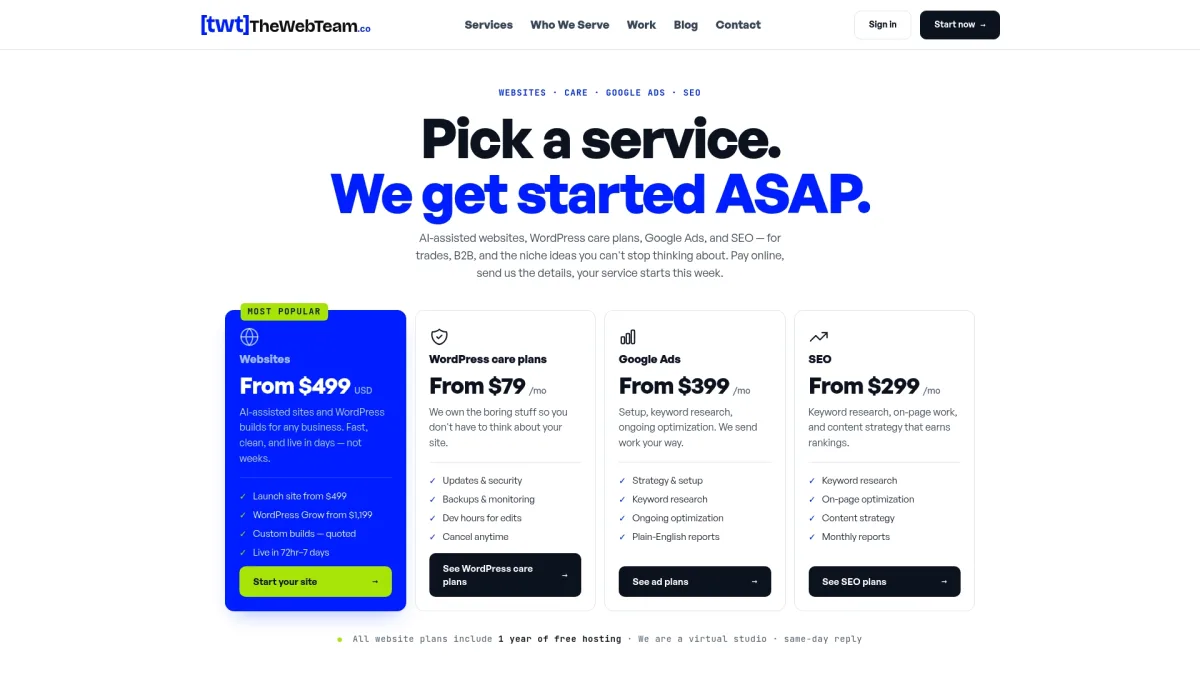
The difference between a one-time build and a care plan is compounding. Schema that stays current, images that stay optimized, and Core Web Vitals that don't drift as plugins update. For niche stores where every SKU counts, that continuity matters. Browse Thewebteam's services and pricing to see the full scope, or check the portfolio for examples of executed work. If you're ready to hand off the technical implementation and focus on your products, book a 30–60 minute diagnostic session to scope the project.