
Industry-specific SEO is the practice of tailoring every SEO decision, from keyword selection to page structure to link-building, around the distinct search behaviors, competitive pressures, and compliance requirements of a particular sector. Generic SEO treats every business the same. Industry-specific SEO does not.
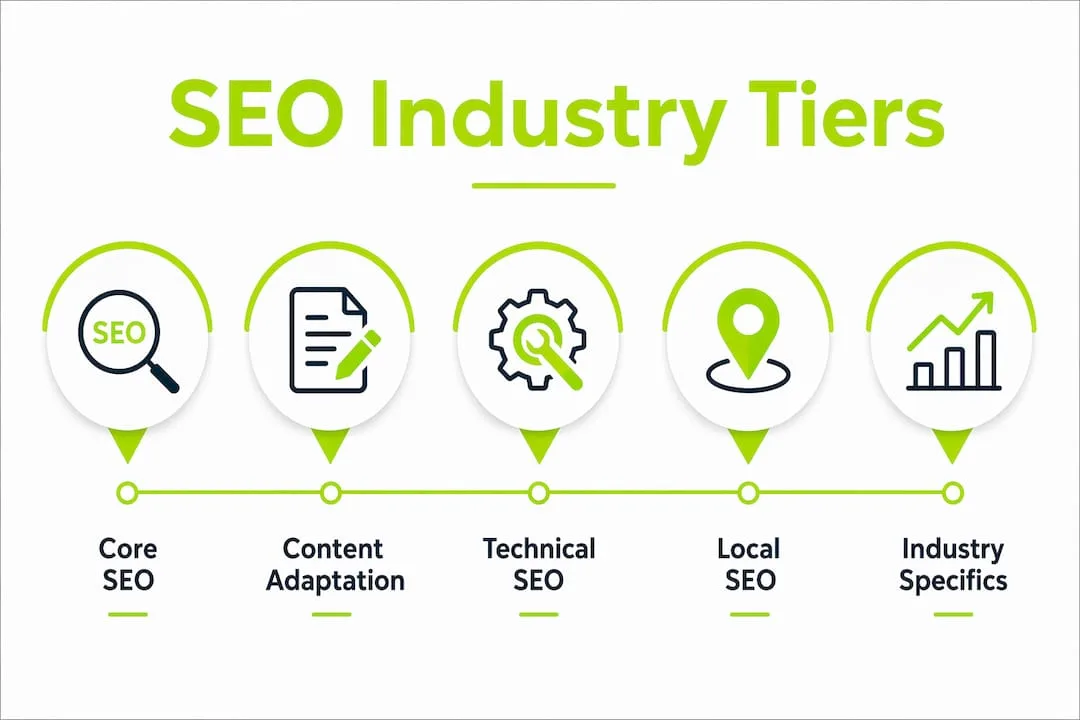
The four core disciplines of SEO, on-page, off-page, technical, and local, all shift in emphasis depending on the industry. A healthcare practice needs content that satisfies Google's E-E-A-T standards and avoids regulatory landmines. A plumbing company needs hyper-local pages that capture urgent, location-based searches. A SaaS company needs long-form pillar content and authoritative backlinks from recognized tech publications. Same four disciplines, completely different execution.
The 3 Cs framework, Content, Code, and Credibility, gives marketers a practical lens for prioritizing SEO work across any industry:
- Content: What your site says, including articles, service pages, FAQs, and every word Google reads to assess relevance and authority.
- Code: How your site is built, covering site speed, crawlability, structured data, and mobile optimization.
- Credibility: Who trusts your site, measured through backlinks, entity mentions, and brand signals from authoritative external sources.
Search intent also shifts dramatically by industry. A person searching "emergency electrician Austin" wants a phone number within seconds. A person searching "what is a 1031 exchange" is in research mode and won't convert for weeks. Understanding that gap is where industry-focused SEO separates itself from a generic keyword list.

How SEO needs differ across key North American industries
Every industry has its own search ecosystem. The keyword volumes, content formats, competitive dynamics, and trust requirements that work in e-commerce will actively hurt a law firm's rankings. Here is how the major North American sectors diverge.
1. E-commerce
E-commerce SEO lives and dies on product page optimization, structured data, and category architecture. The keyword challenge is volume: thousands of product variants competing for similar terms. The winning approach uses faceted navigation carefully, implements Product and Review schema, and builds topical authority through buying guides that capture mid-funnel searches before competitors do.
2. Healthcare
Healthcare falls under Google's "Your Money or Your Life" category, meaning content quality standards are exceptionally high. Pages need named authors with verifiable credentials, citations to peer-reviewed sources, and clear separation between informational and promotional content. Local SEO also matters here: patients search for "dermatologist near me" with the same urgency as someone searching for a plumber.
3. Legal
Law firms compete for some of the most expensive keywords in North America. "Personal injury lawyer" and similar terms carry high cost-per-click values in paid search, which signals how competitive organic rankings are. The SEO edge comes from practice-area pages that go deep on specific case types, attorney bio pages optimized for E-E-A-T, and local citations in bar association directories.
Pro Tip: For legal and healthcare sites, add author schema with verifiable credentials to every content page. Google's Quality Rater Guidelines explicitly evaluate author expertise in these sectors, and pages with proper authorship markup tend to hold rankings better during algorithm updates.
4. Real estate
Real estate SEO is almost entirely local. Buyers and renters search by neighborhood, school district, and price range. The content strategy that works is hyper-local neighborhood guides, market report pages updated monthly, and IDX integration that keeps listing pages indexed. Stale content kills rankings in this sector faster than almost any other.
5. Hospitality
Hotels and restaurants compete against aggregator sites like TripAdvisor and Yelp for branded and category searches. The counter-strategy is owning the direct booking experience through structured data for events and menus, Google Business Profile optimization with photo-heavy posts, and review generation that builds trust signals Google can read.
6. Finance
Finance content faces the same E-E-A-T scrutiny as healthcare. Accuracy, author credentials, and source citations are table stakes. The keyword opportunity lies in long-tail educational queries: "how to open a Roth IRA in Canada" or "best high-yield savings account for small business." These terms have lower competition than broad financial terms and attract readers with clear intent.
7. Technology and SaaS
Tech companies need long-form content that demonstrates deep topical authority. Comparison pages, integration guides, and use-case articles capture decision-makers researching solutions. Link-building in this sector often comes through original data studies and guest bylines in recognized industry publications, both of which also build entity co-occurrence signals.
8. Manufacturing and industrial
Manufacturing SEO targets procurement managers and engineers, not general consumers. The keyword language is technical: part numbers, material specifications, compliance standards. Content that converts in this sector includes spec sheets formatted for SEO, case studies showing real project outcomes, and targeting decision-makers through educational content that addresses their specific purchasing criteria.
9. Trades and specialty services
Trades businesses like plumbing, HVAC, electrical, and roofing operate in one of the highest-intent search environments that exists. 78% of local mobile searches lead to a purchase within 24 hours. The SEO strategy is built around dedicated service pages for each offering, location pages for every city served, and a Google Business Profile that is fully built out with photos, services, and weekly posts.
10. Education
Education SEO splits between institutions targeting prospective students and online course providers targeting adult learners. Program-specific landing pages, scholarship and financial aid content, and virtual tour schema all drive organic traffic. The competitive challenge is that large universities dominate broad terms, so smaller institutions win by going narrow: specific programs, specific cities, specific career outcomes.
How content, technical SEO, and local SEO each adapt by industry
The three pillars of SEO execution, content, technical infrastructure, and local presence, each require different adjustments depending on what industry you are in. Here is where those adjustments actually happen.

Content adaptation
Content depth and format requirements vary more than most marketers expect. A trades business needs service pages of at least 1,000 words covering what the service includes, typical costs, and what customers should expect before calling. A SaaS company needs pillar pages that map an entire topic cluster, linking to subtopic articles that build topical authority over time.
FAQ schema is one of the highest-leverage content tactics across nearly every industry. Pages with FAQ schema and clear data attribution appear in Google AI Overviews at a rate 4.7x higher than pages without it. For industries where AI Overview citations drive significant traffic, adding a direct 40-word answer in the first 100 words of a page is no longer optional.
Sites that publish content regularly generate more organic leads than those that do not, and this holds across sectors from specialty trades to B2B software. The topic focus shifts by industry: trades businesses publish "how to know when you need a new HVAC system," while finance companies publish "how to structure a buy-sell agreement." Same publishing discipline, completely different subject matter.
Technical SEO adaptation
Technical SEO priorities shift based on site complexity and the devices your audience uses. Google switched to mobile-first indexing fully in 2024, meaning the mobile version of every page is what gets crawled and ranked. For trades businesses where most searches happen on a phone during an emergency, a slow or broken mobile experience is a direct revenue problem.
- E-commerce: Crawl budget management, canonical tags for faceted navigation, and Product schema are the highest priorities.
- Healthcare and legal: HTTPS, accurate structured data for practitioners and organizations, and fast Core Web Vitals scores build the technical trust layer.
- Manufacturing: Indexability of deep product catalogs, proper handling of spec sheet PDFs, and clean URL structures for part categories.
- SaaS: Site architecture that supports topic clusters, with clear internal linking from pillar pages to subtopic articles.
The Pareto Principle of SEO applies here: fix indexability first, then SEO positioning, then the remaining technical issues, and finally build authority. Technical fixes deliver the fastest measurable return on existing sites because they unlock the value of content and links that are already there.
Local SEO adaptation
Local SEO is not just for brick-and-mortar businesses. Trades companies, healthcare practices, law firms, and real estate agents all depend on local rankings for the majority of their revenue. The core tactics are consistent: a fully optimized Google Business Profile, consistent name-address-phone data across all directories, and location-specific pages on the website.
What changes is the depth required. A local business visibility strategy for a single-location restaurant looks very different from a multi-city HVAC company that needs a unique location page for every city it serves. For trades businesses, each location page needs neighborhood references, specific project examples from that area, and local landmarks, not a template with the city name swapped in. Google recognizes thin duplicate content and ignores it.
Why industry-specific SEO outperforms generic SEO
Generic SEO produces generic results. When every business in a category runs the same keyword list and the same content template, nobody wins except the sites with the most domain authority. Industry-specific SEO breaks that pattern by targeting the exact queries your buyers use at the exact moment they are ready to act.
- Higher-intent keywords with lower competition: Broad terms like "plumber" are nearly impossible to rank for. "Emergency plumber in [city]" is winnable and converts at a far higher rate because the searcher has already decided they need help.
- Better alignment with user expectations: A searcher who lands on a page built specifically for their situation, their trade, their city, their problem, stays longer and converts more often than one who lands on a generic services page.
- Stronger trust signals: Industry-specific content that references real credentials, local projects, and sector-specific standards builds credibility that generic content cannot replicate.
- Improved local rankings: Dedicated service and location pages with unique local content outperform generic pages in local pack rankings because Google can match them to specific geo-intent queries.
According to HubSpot data cited by B2B industry sources, SEO tops all marketing channels for return on investment, outperforming email, paid social, and referrals. That advantage compounds when the SEO strategy is built around the specific search behaviors of a defined industry rather than broad, high-competition terms.
Pro Tip: Never build location pages by swapping the city name on a template. Write each page as if it is the only page on your site for that city: mention specific neighborhoods, reference the types of jobs you have completed there, and note anything unique about that area that affects your service. Google's local algorithm rewards specificity, and so do the people reading the page.
The content quality gap between industry-specific and generic SEO also shows up in content optimization metrics. Pages built around a specific industry's terminology, questions, and decision-making process naturally include the semantic signals that help Google understand topical authority. A generic page about "HVAC services" will rarely outrank a page titled "AC Repair in Phoenix: What to Expect, What It Costs, and How to Choose a Technician."
Best practices for building an industry-specific SEO strategy
Getting industry SEO right is a sequencing problem as much as a tactics problem. Most businesses fail not because they pick the wrong tactics but because they execute them in the wrong order.
-
Start with a keyword and competitor audit. Map the specific terms your buyers use at each stage of their search, from awareness queries like "how to know if my roof needs replacing" to high-intent queries like "roof repair [city]." Identify which terms have realistic ranking potential given your current domain authority.
-
Fix technical SEO before publishing new content. Confirm your site is indexed, your mobile experience is fast, and your URL structure is clean. Technical fixes unlock the value of everything else. A well-written service page that Google cannot crawl is invisible.
-
Build dedicated pages for each service and location. Generic service pages that list multiple offerings in bullet points perform poorly. Each service needs its own page with at least 1,000 words covering what the service includes, what it costs, and what the customer should expect. Each city you serve needs its own location page with unique content.
-
Add structured data appropriate to your industry. Trades and local businesses need LocalBusiness schema. Healthcare practices need Physician and MedicalOrganization schema. E-commerce sites need Product and Review schema. FAQ schema benefits nearly every industry and directly improves AI Overview citation eligibility.
-
Build credibility through reviews, backlinks, and entity mentions. Reviews are a ranking signal, not just a trust signal. More reviews with specific mentions of your trade and location carry more SEO weight than generic five-star ratings. For backlinks, focus on industry directories, local business associations, and digital PR placements in recognized publications.
-
Publish content that answers questions your buyers are asking before they are ready to buy. Educational content builds brand authority and plants your business in the minds of searchers who will need your service in the future. A roofing company that publishes "signs your roof needs replacing" captures readers months before they search "roof repair [city]."
-
Track the KPIs that actually matter for your industry. Organic traffic is a vanity metric if it does not convert. Trades businesses should track calls and form submissions from organic search. E-commerce tracks revenue per organic session. Healthcare tracks appointment bookings. SaaS tracks trial sign-ups and demo requests. Set up conversion tracking before you start so you can measure what the SEO is actually producing.
Pro Tip: Apply the Pareto Principle to your SEO priorities: 20% of your efforts will drive 80% of your results. Fix indexability first, then nail your SEO positioning with dedicated pages for each service and location, then build authority through content and links. Skipping to content and links before fixing technical issues is the most common and most expensive mistake in industry SEO.
Expert insights and current trends in industry-specific SEO
The biggest shift in industry SEO over the past 12 months is not a new tactic. It is a new audience: AI answer engines. Google AI Overviews, Perplexity, and similar tools now answer queries directly, and the pages they cite get a disproportionate share of the remaining clicks. Getting cited requires the same signals that have always mattered, but weighted differently.
- FAQ schema adoption is accelerating. Pages with valid FAQ schema are appearing in AI Overviews at dramatically higher rates than pages without it. For industries where informational queries drive significant traffic, adding FAQ schema to existing pages is one of the fastest wins available.
- Entity co-occurrence is becoming a credibility signal. Being mentioned alongside recognized industry authorities in the same content, even without a direct backlink, now correlates with AI citation eligibility at rates approaching formal backlinks. For smaller sites that cannot yet earn high-authority links, this is a meaningful opportunity.
- Trades and specialty services are seeing the clearest SEO returns. The combination of high search volume, clear purchase intent, and relatively unsophisticated competition means that a well-executed local SEO strategy can produce measurable lead growth within months, not years.
- Technical SEO is the prerequisite, not the afterthought. Sites with strong content and credibility but weak technical infrastructure leave rankings on the table. Fixing crawlability and structured data first unlocks the full value of content and link-building efforts that are already in place.
"SEO is the one piece of your digital advertising strategy that keeps building leads long after you stop feeding it. By growing organic search traffic that converts, SEO fuels a self-sustaining inbound pipeline that doesn't require payments for every click. For trades businesses like plumbing, HVAC, electrical services, and roofing, the opportunity to grow organic leads is massive. Search volume is high. Intent is through the roof. And the business that shows up first tends to win most jobs."
— B2B News Network, on specialty service SEO
Thewebteam works with trades, B2B, and niche industry businesses across North America to build websites and SEO strategies that reflect exactly these principles. The approach starts with a technically sound WordPress site, adds dedicated service and location pages built for specific search intent, and layers in ongoing SEO to build authority over time. The portfolio of completed projects shows what this looks like in practice across different industries and markets.
Pro Tip: For industries where AI Overview citations matter, put your direct answer in the first 100 words of every page, add FAQ schema, and include at least a few verifiable data points with source attribution. These three elements together are the highest-correlation signals for appearing in AI-generated answers, and most competitors in local and niche markets have not implemented any of them yet.
Thewebteam's industry-specific web and SEO services are built for businesses that cannot afford to wait months for results. If your current website is not generating leads from organic search, the gap is almost always in one of three places: technical issues preventing Google from reading your pages, service and location pages that are too thin to rank, or a credibility profile that has not been built yet. All three are fixable, and fixing them in the right order is what separates a strategy that compounds from one that stalls.
Key Takeaways
Industry-specific SEO consistently outperforms generic SEO because it targets the exact search behaviors, content formats, and trust signals that buyers in a given sector actually respond to.
| Point | Details |
|---|---|
| Content, Code, and Credibility | All three pillars must work together; technical fixes deliver the fastest ROI on existing sites. |
| Local intent drives trades conversions | 78% of local mobile searches lead to a purchase within 24 hours, making location pages critical. |
| Dedicated pages outrank generic ones | Each service and location needs its own unique page; template-swapped content gets ignored by Google. |
| FAQ schema boosts AI visibility | Pages with FAQ schema appear in Google AI Overviews at a rate 4.7x higher than pages without it. |
| Sequence your priorities | Fix indexability first, then SEO positioning, then build authority through content and links. |