
Specialized content SEO is the practice of building focused, interconnected content clusters that establish topical authority and drive targeted organic traffic to your site. Unlike broad content marketing strategies that chase volume, the role of specialized content SEO is to signal deep expertise to both traditional search engines and AI-powered tools like Google's Search Generative Experience. Google's E-E-A-T framework (Experience, Expertise, Authoritativeness, and Trustworthiness) rewards exactly this kind of depth. Businesses that commit to niche content development consistently outrank generalist competitors, not because they publish more, but because they publish smarter.
How does specialized content SEO build topical authority?
Topical authority is the composite signal search engines use to determine whether a site genuinely owns a subject area. It is not built by a single strong article. It comes from a network of semantically connected pages that cover a topic from every meaningful angle.
Publishing 25 or more authoritative, interconnected articles in a niche can increase keyword rankings by 40%–70% over 3–6 months. That kind of uplift does not come from keyword stuffing. It comes from search engines recognizing that your site answers the full spectrum of questions a reader might have on a topic.

The mechanism behind this is entity recognition. Search engines map content to real-world concepts, not just phrases. When your articles consistently reference the same entities, such as named processes, standards, or industry frameworks, Google's topic embeddings begin to associate your domain with that subject. The result is cluster-level ranking uplift, where even newer pages on your site rank faster because of the authority already established by surrounding content.
AI-powered search tools amplify this effect. Content with rich named-entity associations and structured data gains 267% more AI-generated search citations. That number reflects a 0.77 Spearman correlation between entity density and AI citation likelihood. In practical terms, a well-structured content cluster does not just rank. It gets quoted.
Topical authority content gains visibility 57% faster when sequencing and depth are prioritized over raw volume. This means publishing a pillar article first, then supporting cluster articles, then linking them together with descriptive anchor text.
| Factor | Specialized content | General content |
|---|---|---|
| Ranking speed | 57% faster visibility | Slower, volume-dependent |
| AI citation rate | Up to 267% higher with entity-rich content | Low without structured entities |
| Keyword ranking uplift | 40%–70% over 3–6 months | Marginal without cluster depth |
| Conversion alignment | High, addresses specific buyer intent | Low, broad audience mismatch |
Pro Tip: Map your content cluster before writing a single word. List the pillar topic, then identify 8–12 subtopics that a buyer would research before making a decision. Build those pages first.
What distinguishes specialized SEO from broad content strategies?
Niche SEO targets high-value, deeper-need audiences and builds authority significantly faster than generalist strategies. The reason is simple. A site covering 20 industries signals expertise in none of them. A site covering one industry in depth signals expertise in all of it.
Broad content strategies dilute your topical signal. When your site publishes about project management one week and kitchen remodeling the next, search engines struggle to categorize your domain. Your authority spreads thin across too many entity clusters, and no single topic area reaches the threshold needed to rank competitively.
Specialized SEO content addresses underlying buyer anxieties and real user intent better than general content. A plumbing company that publishes detailed guides on pipe relining, water pressure diagnostics, and emergency shutoff procedures earns trust from readers who are actively comparing providers. Generic "how to fix a leak" content does not convert those readers.
A specialty SEO campaign calibrates keywords, content, trust signals, and backlinks to a single vertical. That calibration compounds over time. Each new article reinforces the authority of existing ones, and each backlink earned in the niche carries more relevance than a link from an unrelated domain.
Best practices exclusive to specialized content SEO include:
- Entity mapping before writing: Identify the named concepts, standards, and processes your audience searches for, then build content around those entities.
- Subtopic sequencing: Publish foundational content first, then drill into subtopics. Never publish a subtopic without a pillar to link back to.
- Vertical-specific trust signals: Use case studies, certifications, and real project data from your niche. Generic testimonials do not build topical credibility.
- Pruning irrelevant content: Remove or redirect pages that fall outside your core topic cluster. Off-topic pages dilute your domain's topical signal.
- Consistent internal linking: Every cluster article should link to the pillar and to at least two sibling articles using descriptive, keyword-relevant anchor text.
Pro Tip: Before publishing any new page, ask: does this page belong to my core topic cluster? If the answer is no, reconsider. Off-topic content costs you more than it earns.
How to structure your website for specialized SEO effectiveness
The pillar-cluster model, also called the hub-and-spoke model, is the most effective site architecture for specialized content SEO. One comprehensive pillar page covers the broad topic. Multiple cluster articles cover specific subtopics in depth. Every cluster article links back to the pillar, and the pillar links out to each cluster.
Structured content architecture facilitates AI extraction and ranking for broad subtopic coverage, not just individual keywords. This means your site architecture directly affects how AI search tools read and cite your content. A flat site with no internal linking structure leaves AI systems with no clear signal about which page is authoritative.
AI search engines prioritize claim-shaped opening sentences, structured comparisons, and entity coverage for citation and ranking. Every page in your cluster should open with a direct definition or claim. Supporting paragraphs should use named entities, structured data markup where appropriate, and clear subheadings that match user search intent.
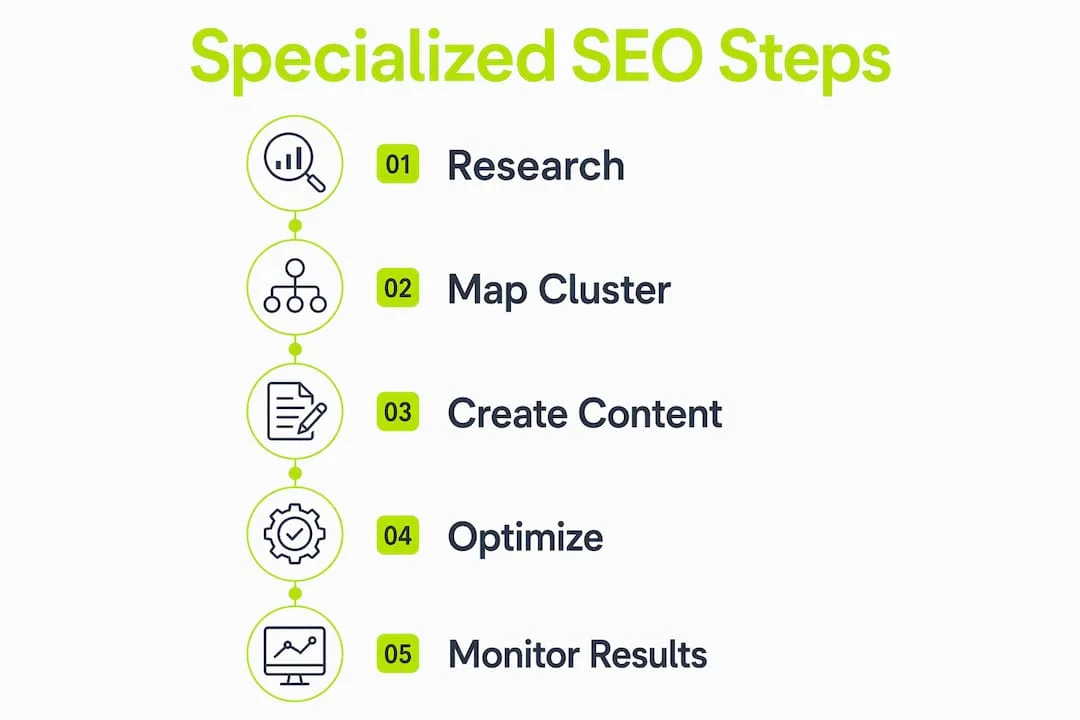
Follow this sequence to build a content cluster that performs:
- Choose your core topic. Pick one subject your business can own completely. For a B2B trades company, that might be commercial HVAC maintenance.
- Conduct entity mapping. List every named concept, process, standard, and question your audience searches for within that topic.
- Write the pillar page. Cover the full topic at a high level. Link to subtopics as you mention them, even before those pages exist.
- Publish cluster articles in sequence. Start with the subtopics that address the highest-intent buyer queries. Use your content strategy guide to prioritize order.
- Add structured data markup. Use schema types relevant to your industry, such as FAQPage, HowTo, or Article, to help search engines extract and cite your content.
- Interlink every cluster article. Use descriptive anchor text that names the destination topic. Avoid generic phrases like "click here."
- Monitor cluster performance monthly. Track rankings for each cluster article, not just the pillar. Identify gaps where competitors rank but you do not.
Google's Helpful Content System favors sites with depth, clarity, and cohesive topic coverage over thin, generic posts. That system actively demotes sites that publish broad, shallow content at scale. Depth is not optional. It is the ranking signal.
Pro Tip: Use Google Search Console's "Queries" report filtered by your pillar page URL. Any query that appears there but has no dedicated cluster article is a gap you should fill next.
What practical steps can you take to implement specialized content SEO?
Implementation starts with research, not writing. Before you create a single piece of content, you need a clear map of the topic territory you plan to own.
Topical authority requires consistent third-party validation and a unique point of view for AI system trust. This means your content cannot just summarize what others have said. It needs original data, real project examples, or a clear editorial stance that differentiates your site from every other page covering the same topic. For B2B businesses and trades companies, that original proof often comes from case studies in SEO that document real client outcomes.
Specialized SEO creates a competitive moat by addressing high-intent queries with unique data, original insights, and real-world proof signals unavailable in generic content. That moat compounds. The longer you publish within a niche, the harder it becomes for a generalist competitor to displace you.
Practical steps to get started:
- Audit your existing content. Identify which pages belong to your core topic cluster and which do not. Redirect or remove off-topic pages.
- Build an entity list. Use your industry's known standards, certifications, and named processes as the foundation for your content vocabulary.
- Prioritize buyer-ready queries. Pages targeting queries like "best commercial HVAC contractor in [city]" or "how to choose a pipe relining service" convert better than informational posts. Build those first.
- Establish expert authorship. Attribute content to named individuals with verifiable credentials. AI systems and Google's E-E-A-T guidelines both reward identifiable expertise.
- Run quarterly content audits. Remove pages that receive no traffic and have no internal links pointing to them. A smaller, tighter cluster outperforms a bloated site every time.
- Monitor AI citation rates. Use tools that track whether your content appears in AI-generated answers. If it does not, review your entity density and opening sentence structure.
For targeting decision makers with SEO, the same principle applies. Decision makers search with high intent and specific language. Specialized content that mirrors their exact vocabulary earns both rankings and trust.
Pro Tip: Focus your first three months on buyer-ready queries, not informational ones. Informational content builds authority over time, but buyer-ready content generates leads now. You need both, but sequence matters.
Key Takeaways
Specialized content SEO outperforms broad strategies because topical authority, entity-rich clusters, and structured architecture give search engines and AI tools the clearest possible signal of genuine expertise.
| Point | Details |
|---|---|
| Topical authority drives rankings | Publishing 25+ interconnected niche articles can lift keyword rankings by 40%–70% in 3–6 months. |
| Entity-rich content earns AI citations | Structured, entity-dense content gains up to 267% more AI-generated search citations than generic pages. |
| Niche focus beats broad volume | Specialized SEO builds authority faster and converts better by addressing specific buyer intent. |
| Pillar-cluster architecture is non-negotiable | Hub-and-spoke site structure helps both search engines and AI tools identify and cite your authoritative pages. |
| Ongoing audits protect your signal | Removing off-topic or thin pages keeps your topical cluster tight and your domain authority focused. |
Why I think most businesses are still thinking about content SEO the wrong way
Most digital marketers I talk to still treat content as a volume game. They want 20 blog posts a month. They want to cover every keyword in their industry. They think more pages equal more traffic. That thinking is costing them.
What I have seen actually work is the opposite. The businesses that gain ground fastest are the ones that pick a narrow lane and publish relentlessly within it. A trades company that owns the topic of commercial pipe relining in their region, with 15 deeply interconnected articles, will outrank a competitor with 200 generic blog posts. Every time.
The shift to AI-powered search has made this even more pronounced. AI tools do not just rank pages. They cite sources. And they cite sources that have clear entity associations, structured content, and a consistent point of view. A site that tries to be everything to everyone gets cited by no one.
The transition from broad to specialized SEO is uncomfortable. You will feel like you are leaving traffic on the table by not covering every topic. You are not. You are concentrating your authority where it counts. The long-form B2B content approach proves this repeatedly. Depth wins. Breadth dilutes.
My honest advice: audit your site this week. Count how many of your pages genuinely belong to a single topic cluster. If the answer is fewer than half, you have your roadmap.
— Jonathon
Thewebteam's approach to specialized SEO and web design
Thewebteam works with trades businesses, B2B companies, and niche industries that need more than a generic website. The team builds sites and content strategies designed around topical authority from day one, not as an afterthought.
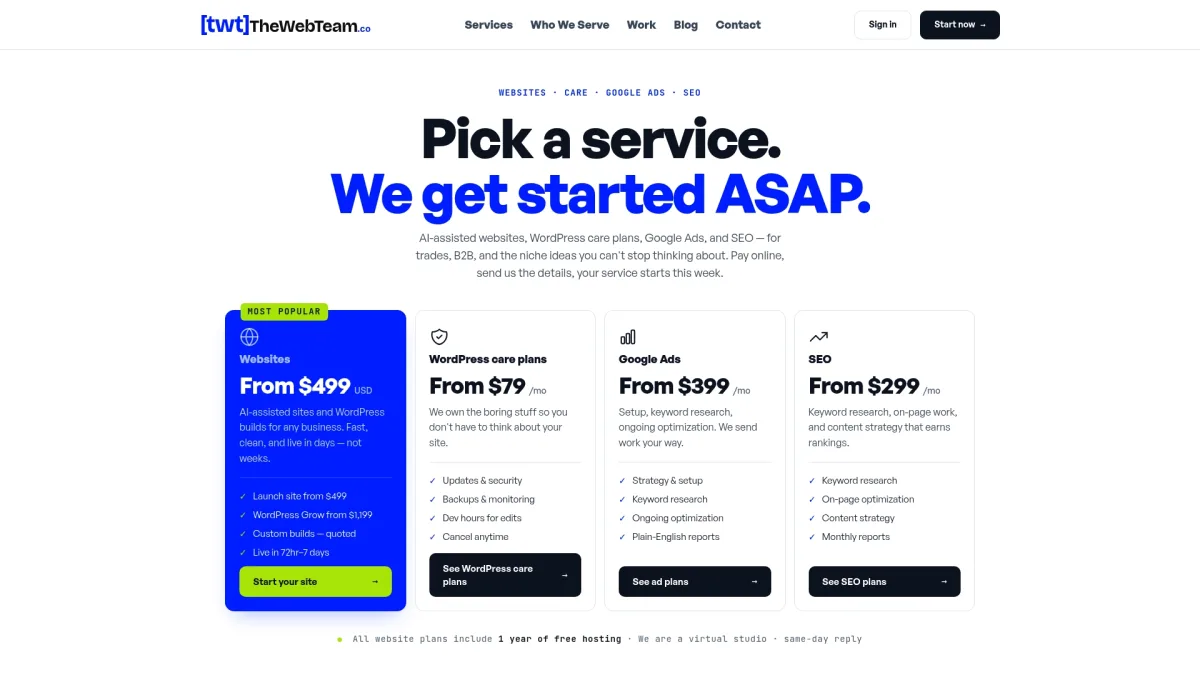
Every project at Thewebteam starts with a clear understanding of the client's niche, their buyers, and the content clusters that will drive qualified traffic. The services and pricing cover SEO content development, WordPress website builds, and ongoing digital marketing support, all without hidden costs. If you want to see what focused, niche-specific web design looks like in practice, the portfolio and case studies show real results from real industries. Thewebteam treats web development as a job with measurable outcomes, not a creative exercise.