
A website redesign is the comprehensive overhaul of a site's structure, design, content, and backend technology to align with business goals and improve user experience. This is not a cosmetic refresh. A true redesign addresses navigation, page speed, mobile responsiveness, SEO architecture, and conversion pathways all at once. Understanding how website redesigns work helps you set realistic expectations, avoid costly mistakes, and get measurable results from the investment. The process follows a defined sequence, and skipping any stage creates problems that surface after launch.
How does the website redesign process work?

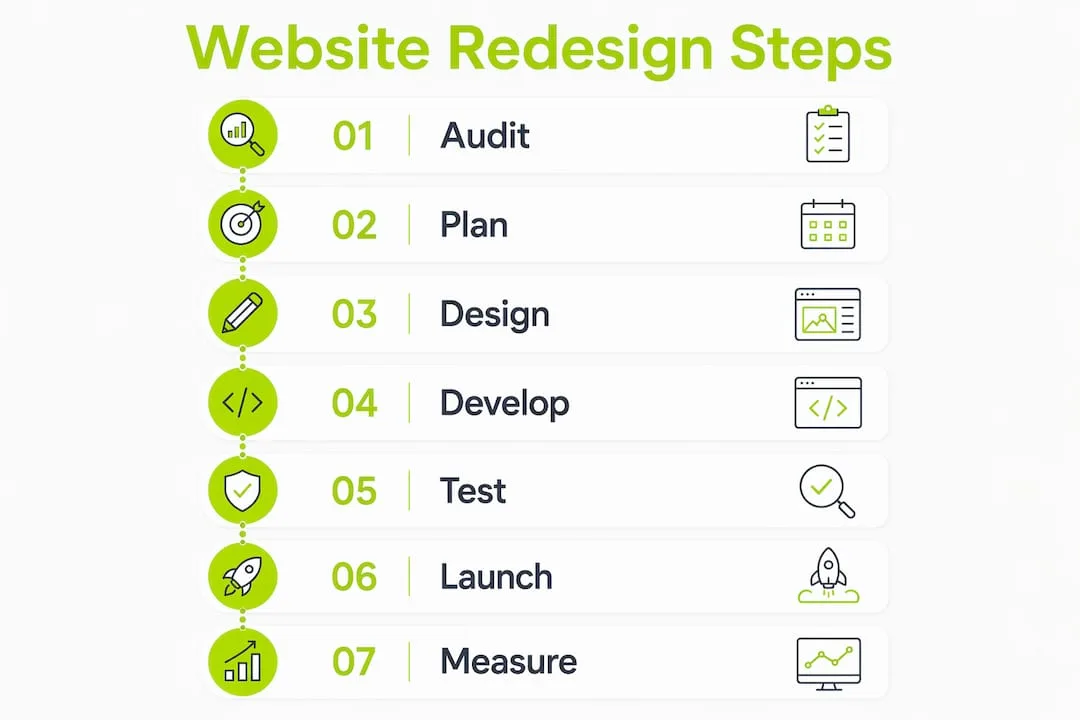
A website redesign follows a structured sequence of stages, each building on the last. Common redesign steps include audit, goal setting, prototyping, development, testing, launch, and monitoring. Skipping stages, especially the audit and testing phases, is the most common reason redesigns fail to deliver results.
The eight core stages
-
Website audit. Analyze your current site's traffic, bounce rate, page speed, and conversion data. Google Analytics and Google Search Console give you a baseline. Without this data, you are redesigning blind.
-
Goal setting. Define what success looks like before any design work begins. Goals might include a 20% increase in lead form submissions, faster mobile load times, or improved rankings for specific search terms.
-
Content audit and restructuring. Content audits and restructuring are essential for improving both UX and SEO during a redesign. Identify pages to keep, consolidate, rewrite, or remove entirely.
-
Wireframing and prototyping. Build low-fidelity wireframes before touching code. This stage lets stakeholders review layout and navigation without getting distracted by colors or fonts.
-
Development and mobile testing. Build the new site with mobile as the primary target, not an afterthought. Test every page on multiple screen sizes and browsers before moving forward.
-
SEO migration planning. Map every old URL to its new equivalent. 301 redirects during redesigns preserve search rankings and prevent traffic loss. This step is non-negotiable.
-
Pre-launch testing and soft launch. Testing before launch across browsers and devices helps identify issues without major disruptions. A soft launch to a limited audience catches real-world problems before full rollout.
-
Post-launch monitoring. Track rankings, traffic, and conversions for at least 90 days after launch. Redesigns often cause short-term ranking fluctuations that require quick technical responses.
How do website redesigns improve user experience and SEO?
A well-executed redesign improves both user experience and search visibility at the same time. These two outcomes are closely linked. Google's ranking algorithm rewards sites that load fast, work on mobile, and keep visitors engaged.
User experience improvements
88% of users are less likely to return to a website after a poor user experience. That statistic means one bad visit can permanently lose a customer. Redesigns address this by fixing navigation, reducing clutter, and making calls to action obvious.
Mobile responsiveness is the single most impactful UX change most businesses can make. A site that requires pinching and zooming on a phone loses visitors within seconds. Redesigns built on a mobile-first approach eliminate this problem at the structural level.
Page speed is the second major factor. Page speed optimizations including caching and optimized hosting reduce load times and improve conversions. A one-second delay in load time can significantly reduce conversions. That means faster hosting and proper image compression are not optional extras.
SEO improvements
SEO experts stress that a redesign is a critical time to safeguard technical SEO health through redirects and clean URL architecture. A poorly managed URL migration can wipe out years of accumulated search authority overnight.
Key SEO tasks during a redesign include:
- Mapping every old URL to a new destination with a 301 redirect
- Updating all internal links to point to new URLs
- Rewriting title tags and meta descriptions to match new page content
- Submitting an updated XML sitemap to Google Search Console
- Checking for duplicate content created by the new site structure
- Preserving or improving heading hierarchy (H1, H2, H3) across all pages
Content restructuring also plays a direct SEO role. Consolidating thin pages into stronger, more comprehensive ones improves topical authority. Google rewards depth and relevance over page count.
Pro Tip: Set up Google Search Console monitoring before you launch the redesigned site. This way you catch crawl errors, indexing issues, and ranking drops within hours rather than weeks.
What are the common challenges in a website redesign?
Most redesign problems are predictable. Knowing them in advance lets you build safeguards into the process from the start.
Stakeholder buy-in and clear communication reduce redesign risks and improve project success. Projects stall when decision-makers are not aligned on goals, timelines, or budget. A single stakeholder who changes direction mid-project can add weeks to the timeline and thousands to the cost.
Neglecting analytics continuity is another common failure point. If you change your URL structure without updating your Google Analytics tracking, you lose historical data comparisons. Always verify that tracking codes carry over to every page of the new site.
Ignoring mobile users during the design phase creates expensive rework. User experience remains the primary driver for business retention, and redesigns must prioritize mobile-first design and intuitive navigation. Designing for desktop first and adapting for mobile afterward produces a worse result every time.
Best practices that prevent these problems
- Lock down the sitemap and URL structure before development begins
- Assign one person as the single point of contact for all stakeholder feedback
- Run a full crawl of the old site before launch to capture every URL that needs a redirect
- Keep the old site accessible in a staging environment for at least 30 days after launch
- Document every change made to the site architecture so future teams can understand the decisions
Ongoing maintenance is part of the redesign lifecycle, not a separate concern. A site launched and left alone will degrade in performance, security, and relevance within 12 months. Build a maintenance plan into the project from day one.
How do you measure the success of a website redesign?
Success measurement starts before launch, not after. The baseline data you collect during the audit phase becomes your benchmark for every metric you track post-launch.
A well-executed redesign aligns site strategy with business goals, boosting traffic, engagement, and conversions. The metrics below show whether that alignment is actually working.
| Metric | What to measure | Target signal |
|---|---|---|
| Organic traffic | Sessions from search engines | Stable or increasing within 90 days |
| Bounce rate | Percentage of single-page visits | Decreasing compared to pre-launch |
| Page load speed | Time to first contentful paint | Under 2.5 seconds on mobile |
| Conversion rate | Form submissions, calls, purchases | Increasing month over month |
| Search rankings | Position for target keywords | Stable or improving within 60 days |
Google Analytics 4 tracks user engagement, session duration, and conversion events. Google Search Console tracks impressions, clicks, and ranking positions. Use both together for a complete picture.
Conversion rate is the most direct measure of business impact. A site that gets more traffic but converts fewer visitors has failed, regardless of how good it looks. Track conversions at the page level, not just site-wide, to identify which pages are underperforming.
Continuous testing after launch separates good redesigns from great ones. A/B testing different headlines, button placements, or form lengths on key landing pages produces incremental gains that compound over time.
Key Takeaways
A successful website redesign requires structured planning, SEO protection, and post-launch measurement to deliver lasting improvements in traffic, user experience, and conversions.
| Point | Details |
|---|---|
| Audit before you design | Collect baseline traffic, speed, and conversion data before any design work begins. |
| Protect SEO during migration | Implement 301 redirects for every changed URL to preserve search rankings. |
| Prioritize mobile-first design | Build for mobile screens first to retain the majority of modern web visitors. |
| Measure against a baseline | Track organic traffic, bounce rate, and conversions for 90 days post-launch. |
| Plan for ongoing maintenance | Treat the redesign as the start of a maintenance cycle, not a one-time project. |
What most redesign guides get wrong
I have reviewed hundreds of redesign projects over the years, and the same blind spot shows up repeatedly. Teams spend months perfecting the visual design and almost no time on the URL migration plan. Then they launch, rankings drop 40% in three weeks, and everyone panics. The fix is always the same: a redirect audit that should have happened before a single line of code was written.
The other thing most guides underplay is how much a redesign reveals about a business's internal communication problems. When a project stalls, it is almost never a technical issue. It is a stakeholder who was not consulted early enough, or a content team that was brought in too late to restructure pages properly. The technical work is the easy part.
My honest advice: treat the content audit as seriously as the design brief. The words on your pages, the structure of your URLs, and the clarity of your calls to action matter more than your color palette. A beautifully designed site with confusing navigation and slow load times will still lose customers. A clean, fast, well-organized site with clear messaging will outperform it every time.
Redesigns also work best when you view them as the beginning of an improvement cycle, not the end of a project. The data you collect in the first 90 days after launch is more valuable than any pre-launch assumption. Build in time and budget to act on what you learn.
— Jonathon
Thewebteam can handle your website redesign
A website redesign has a lot of moving parts. Getting the SEO migration, mobile design, and content structure right at the same time requires experience and a clear process.
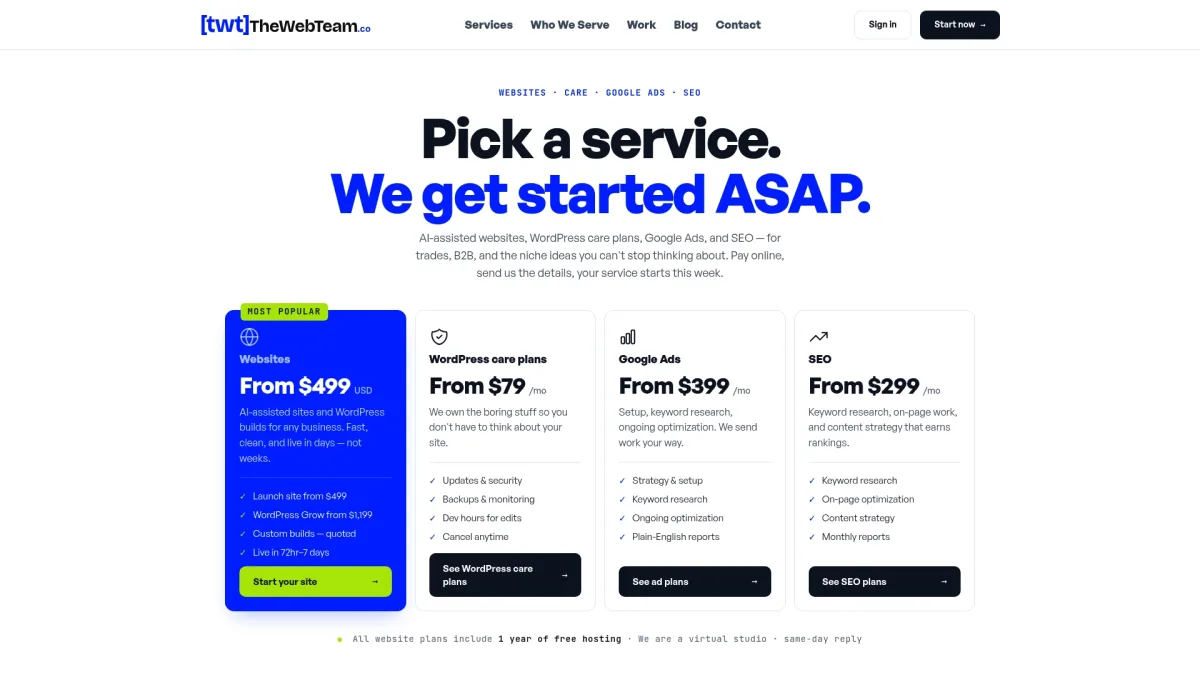
Thewebteam specializes in WordPress website redesigns for trades, B2B businesses, and niche industries. Their approach prioritizes speed and results, with new sites launching in days rather than months. Every project includes SEO setup, hosting, and ongoing care plans so your site stays fast and current after launch. If you want a redesign that improves rankings and converts more visitors, Thewebteam offers transparent pricing and no hidden costs. Reach out for a consultation and get a clear picture of what your redesign will involve.