
Niche business web design best practices are defined as the targeted set of design, architecture, and content decisions that turn a specialized website into a consistent source of qualified leads. Generic web design advice fails niche businesses because it ignores the specific buyer behaviors, technical contexts, and trust requirements of narrow markets. The practices covered here, including Ideal Customer Profile (ICP) alignment, hub-and-spoke site architecture, buyer-led navigation, Core Web Vitals compliance, and structured schema markup, are grounded in 2026 B2B research and apply directly to trades, industrial, and specialized service businesses. Thewebteam builds sites for exactly these markets, and the patterns below reflect what actually drives results.
1. Define your ideal customer profile before touching the design
ICP research is the first step in any effective niche website strategy. Skipping ICP work produces expensive websites that look polished but generate no pipeline. A niche business owner who cannot clearly describe their best customer will build a site that speaks to everyone and converts no one.
Your ICP defines which pages to build, what language to use, and which problems to lead with. A commercial HVAC contractor targeting property managers needs different messaging than one targeting general contractors. The navigation, the CTAs, and even the imagery should reflect that distinction.
Start by documenting three to five real customers who generated the most revenue with the least friction. Note their job titles, the problems they searched for, and the objections they raised before signing. That profile becomes your design brief.
- List the top three questions your best customers ask before buying
- Identify the one outcome they care about most (cost savings, compliance, speed)
- Map those outcomes to specific pages and headings on your site
- Test your assumptions by reviewing which pages currently generate contact form submissions
Pro Tip: Run a five-question survey with your last ten customers. Ask what almost stopped them from contacting you. Their answers will rewrite your homepage copy faster than any design trend.
2. Use hub-and-spoke architecture to build topical authority
The hub-and-spoke model is the most effective site structure for niche businesses aiming to rank on both broad and specific search queries. A hub page covers a broad pillar topic, such as "industrial pump maintenance," while spoke pages cover detailed subtopics like "centrifugal pump seal replacement" or "pump efficiency audits." Search engines reward this structure because it signals deep expertise in a defined subject area.

Internal links between hub and spoke pages do two jobs at once. They pass authority from high-traffic pages to conversion pages, and they guide visitors deeper into the content that matches their specific need. A buyer researching a broad topic lands on the hub, then follows links to the spoke that matches their exact situation.
Modular, component-based design makes this architecture scalable. You can add new spoke pages without rebuilding the entire site. For a niche business that adds services or expands into adjacent markets, that flexibility has real dollar value.
Pro Tip: Audit your current site with a free crawl tool. If your service pages have no internal links pointing to them from your blog or resource content, they are invisible to both search engines and buyers.
Websites that fail Core Web Vitals standards, specifically an LCP under 2.5 seconds and INP below 200 milliseconds, lose organic visibility to competitors who meet those thresholds. Architecture decisions affect load speed, so build lean from the start.
3. Organize navigation around buyer needs, not your org chart
Buyer-led navigation organizes menus by solution, industry, use case, or user role rather than by internal department names. A site that lists "Services," "About," and "Resources" in its top nav tells the visitor nothing about whether this business solves their specific problem. A site that lists "For Property Managers," "For General Contractors," and "Emergency Repairs" answers that question in under three seconds.
Niche businesses often serve multiple buyer types within one company. A B2B industrial supplier might sell to procurement managers, plant engineers, and safety officers simultaneously. Navigation that acknowledges those roles reduces the time each visitor spends figuring out where to go.
Each page should carry one clear, context-relevant primary CTA. Mismatched or multiple CTAs cause confusion and reduce conversion rates. A product page for a specialized coating system should say "Request a Sample," not "Contact Us" or "Learn More."
- Use role-based or industry-based top navigation labels
- Limit primary navigation to five to seven items
- Place the primary CTA in the top-right corner and repeat it at the bottom of every page
- Write CTA copy around outcomes, not actions: "Get Your Site Audit" beats "Submit"
- Remove navigation items that link to pages with no conversion purpose
Progressive form profiling reduces friction at first contact by asking only for a name and email initially, then gathering more detail in follow-up steps. Each additional form field reduces conversion rates measurably. Ask for the minimum needed to start a conversation.
4. Design for mobile utility, not just mobile appearance
Mobile optimization for niche businesses goes beyond making a site look good on a phone. Industrial and technical users often access websites on job sites, in warehouses, or while wearing gloves. That context demands large tap targets, high-contrast text, and data tables that scroll horizontally rather than collapsing into unreadable stacks.
WCAG 2.1 AA accessibility standards are the baseline for any niche site targeting professional buyers. These standards require sufficient color contrast, keyboard-navigable menus, and descriptive alt text on images. Meeting them is not just a legal consideration. It directly affects how many buyers can actually use your site.
Mobile-first design also affects SEO. Google indexes the mobile version of your site first. A site that performs well on desktop but breaks on mobile loses rankings regardless of how strong its content is.
- Set minimum tap target size at 44x44 pixels for all buttons and links
- Use a minimum 16px font size for body text on mobile
- Test data tables on a 375px wide screen before launch
- Avoid hamburger menus that hide primary navigation behind two taps
- Check that contact forms are fully functional on iOS and Android
Pro Tip: Load your site on a mid-range Android phone over a 4G connection, not your office Wi-Fi. That is the real experience your field-based customers have. Fix what frustrates you there first.
5. Embed trust signals and structure content for discoverability
81% of B2B buyers need to trust a brand before they will consider a purchase. That statistic means trust signals cannot live only on a dedicated testimonials page. They must appear in the conversion flow, on service pages, pricing pages, and contact pages, where buying decisions actually happen.
Effective trust signals for niche businesses include client logos from recognizable companies in the buyer's industry, specific outcome metrics ("reduced downtime by 30% for a regional manufacturer"), certifications relevant to the niche, and security badges near contact forms. Generic five-star reviews carry less weight than a named case study from a company the buyer recognizes.
Structured schema markup, specifically FAQPage, Product, and Organization schema, improves organic click-through rates by 20–30% by making content readable to AI-powered search tools and featured snippet algorithms. For a niche business competing against larger brands with bigger budgets, schema markup is one of the highest-return technical investments available.
Specialized buyers want substance-first content that puts critical information within one click of the homepage. Burying product specifications, pricing ranges, or service scope behind multiple layers of brand narrative costs you buyers who are under time pressure. A content strategy built around immediate access to key details outperforms one built around storytelling alone.
A technical SEO checklist that includes schema implementation, canonical tags, and crawl budget management keeps your niche site visible as search algorithms evolve through 2026.
Key Takeaways
Niche business web design best practices work because they align every design decision, from navigation labels to form length, with the specific needs of a defined buyer.
| Point | Details |
|---|---|
| ICP research comes first | Define your best customer before writing a single page heading or choosing a layout. |
| Hub-and-spoke architecture builds authority | Link pillar pages to detailed subtopics to rank on both broad and specific queries. |
| Buyer-led navigation converts faster | Organize menus by role, industry, or use case rather than internal department names. |
| Mobile utility beats mobile aesthetics | Design for real-world use contexts, including gloved hands and slow connections. |
| Trust signals belong in the conversion flow | Place client logos, metrics, and certifications on service and contact pages, not just a testimonials page. |
What I've learned designing sites for niche businesses
The most common mistake I see niche business owners make is treating their website like a brochure. They spend months on brand colors and photography, then launch a site that answers none of the questions their buyers actually ask. The site looks professional. It generates nothing.
The businesses that see real results treat their site as a product. They check which pages generate contact form submissions. They rewrite headings that get traffic but no clicks. They add a case study when they close a notable client. High-performing niche sites continuously optimize messaging and UX rather than treating launch as the finish line.
The second pattern I notice is that ICP misalignment causes lost revenue even after expensive redesigns. A business owner who redesigns their site without first clarifying who they serve will rebuild the same problem with better fonts. Clarity about your buyer is not a marketing exercise. It is the foundation of every design decision that follows.
My honest advice: launch faster than you think you should, with clear messaging and a working contact form. Then improve based on real visitor behavior. A site that is live and converting at 2% beats a perfect site that launches in six months.
— Jonathon
How Thewebteam helps niche businesses build sites that convert
Thewebteam specializes in web design for trades, industrial, and B2B businesses that need a site built around their specific buyers, not a generic template. Every project starts with understanding your ICP and ends with a site that loads fast, ranks well, and turns visitors into leads.
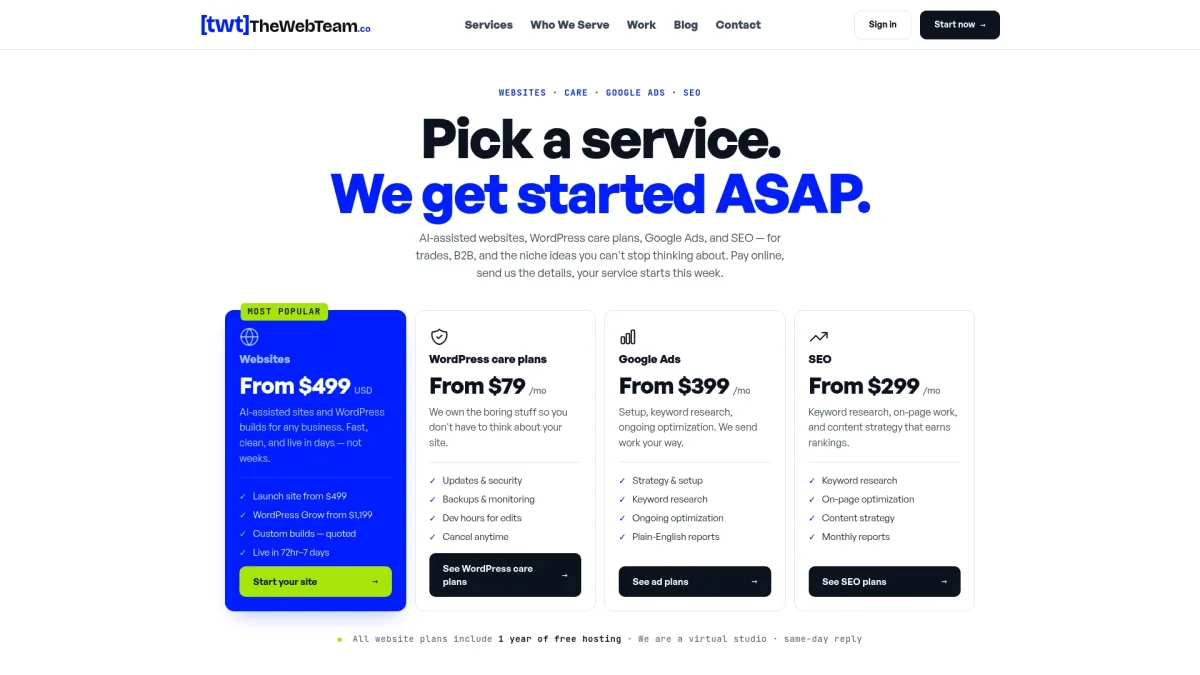
Thewebteam's niche business web design service includes site architecture planning, mobile optimization, schema markup, and ongoing WordPress maintenance, all with transparent pricing and no hidden costs. Most clients launch within days, not months. If you want to see what this looks like in practice, the project portfolio shows real results across specialized industries. Reach out to discuss your site and get a clear plan without a sales pitch.