
Niche sites outperform generic ones because specificity equals relevance, and relevance shortens every step between a visitor and a conversion. When your site speaks directly to one audience's exact problem, you earn their trust faster, rank for the queries they actually type, and give them an offer that fits. Here are the main ways niche sites win:
- Topical authority: Search engines reward concentrated expertise, so niche sites rank faster with fewer backlinks.
- Higher conversion rates: Tailored copy, imagery, and CTAs match visitor intent, reducing friction at every stage.
- Easier monetization: Specific audiences respond to targeted offers, affiliate content, and premium services at higher rates.
- Lower acquisition costs: Focused targeting wastes less ad spend and attracts visitors who are already close to a decision.
Key Takeaways
Niche sites outperform generic ones because specificity drives relevance at every stage: SEO, conversion, and monetization all improve when the site is built for one audience with one clear offer.
| Point | Details |
|---|---|
| Specificity drives every advantage | Niche sites win on SEO, conversion, and monetization because relevance shortens the path to action. |
| Faster rankings with less effort | For niche sites with consistent content and solid technical setup, concentrated topical authority can lead to first page rankings for long-tail queries within 90–120 days. |
| Validate before you build | Run a small paid test ($150–$300) and a landing page MVP before committing to a full content strategy. |
| Content hub structure compounds | Pillar pages plus cluster articles plus targeted landing pages create an internal linking system that builds authority over time. |
| Thewebteam launches niche sites fast | AI-assisted WordPress builds go live in days, with hosting, care plans, and SEO foundations included from the start. |
Table of Contents
- How does specificity create a measurable advantage?
- Why do niche sites rank faster and capture more search traffic?
- Why do niche sites convert better and monetize more effectively?
- What content strategy actually works for a niche site?
- How do you pick a niche and validate demand before investing?
- What metrics should you track, and what timelines are realistic?
- What does a fast, niche-focused site build actually look like?
- When a niche site is the wrong choice
- Thewebteam builds niche sites that rank and convert
- FAQ
- Sources
How does specificity create a measurable advantage?
Intent matching is the first mechanism. When someone searches "best HVAC contractor for commercial buildings in Phoenix," they are not browsing. They have a problem, a budget, and a timeline. A niche site built around commercial HVAC services in the Southwest meets that visitor exactly where they are. A generic home-services directory cannot. Niche marketing targets a specific, well-defined customer segment with tailored messaging and channels, which improves marketing efficiency and ROI compared with mass marketing.
The causal chain is straightforward: define the audience precisely, produce content that answers their specific questions, acquire traffic through focused channels, and then present an offer that maps directly to their need. Each step compounds. A visitor who found you through a long-tail query already trusts the relevance of your site before they read a single word of your copy.
Language and imagery accelerate that trust. A plumbing supply site that uses the phrase "press-fit fittings" instead of "pipe connectors" signals immediately to a licensed plumber that this is their place. Generic sites default to the lowest common denominator because they cannot afford to alienate anyone. Niche sites can afford to be precise, and precision reads as expertise.
Granular positioning shortens the commercial journey. When a visitor's language, problem, and intent all match what they find on your site, the decision to act becomes almost automatic. The friction that kills conversions on generic sites simply does not exist at the same level.
Pro Tip: Pull exact phrases from Reddit threads, Quora answers, and niche forums in your target vertical. Paste those phrases verbatim into your hero headline and CTA microcopy. Visitors who wrote those words will feel an immediate, almost uncanny recognition that no amount of polished brand language can replicate.
Why do niche sites rank faster and capture more search traffic?
Niche sites rank faster because their SEO signals concentrate around a tight semantic field. Google's systems can categorize the site quickly, trust its depth, and reward it with rankings for related queries it has not even targeted yet. Industry-specific SEO tactics, including structured content, clear silos, and technical fundamentals, help specialized sites win relevant SERPs more predictably than broad sites competing across dozens of unrelated topics.
The specific mechanisms that drive this advantage:
- Keyword clustering: Every article on a niche site reinforces the same semantic neighborhood, so each new piece of content lifts the authority of existing pages.
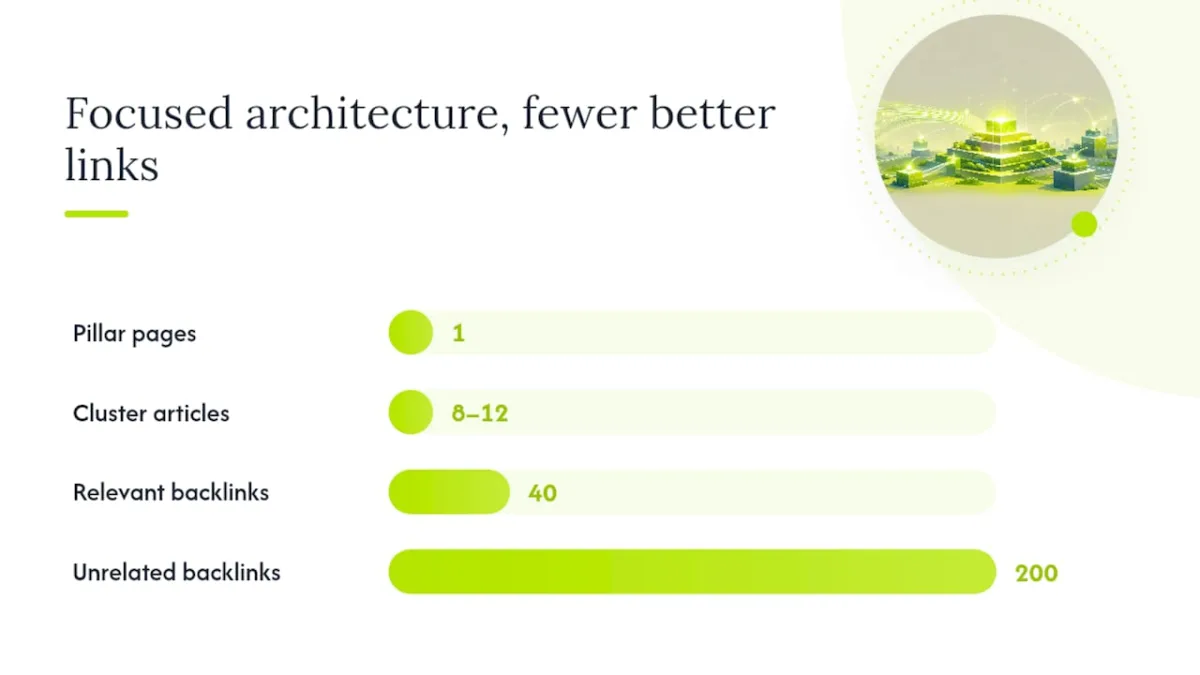
- Pillar and cluster architecture: A single pillar page on a core topic, supported by 8–12 cluster articles, creates an internal linking web that distributes authority efficiently.
- Long-tail capture: Niche sites naturally attract low-competition, high-intent queries that broad sites ignore because the volume looks small. Those queries convert at a far higher rate.
- E-E-A-T reinforcement: Niche-focused content helps creators build E-E-A-T and achieve stronger SEO gains on long-tail queries versus generalist blogs.
- Fewer backlinks required: A site with 40 highly relevant backlinks from industry publications will often outrank a generic site with 200 backlinks from unrelated domains for niche-specific queries.
Timeline reality: A well-structured niche site targeting low-to-medium competition keywords can see its first page-one rankings within 90–120 days of launch, assuming consistent content production and solid technical fundamentals. Broad sites competing across multiple verticals typically need 12–18 months to build comparable authority in any single topic area. However, this 90–120 day timeline applies to sites that meet the specific conditions described: focused keywords, solid technical setup, and consistent content output.
For a deeper look at the architecture behind these gains, Thewebteam's guide on specialized content SEO covers the structural decisions that matter most.
Why do niche sites convert better and monetize more effectively?
Targeting increases offer relevance and reduces friction, which raises both conversion rates and lifetime value. Industry-specific websites convert better because they address precise pain points and enable personalized CTAs that match user intent. A generic "Contact Us" button asks a visitor to take a leap of faith. A CTA that reads "Get a free quote for your commercial roofing project" tells the visitor exactly what happens next and confirms the site understands their situation.
Niche ecommerce stores achieve healthier profit margins and higher lifetime value by competing on expertise and personalization rather than on price and catalog breadth. That principle extends beyond ecommerce. A B2B service site that speaks directly to industrial buyers can charge a premium because the specificity of the offer signals expertise that a generic agency cannot match.
The monetization models where niche sites consistently outperform:
- Targeted product sales: Narrow catalogs with deep product knowledge outperform broad catalogs with thin descriptions.
- High-value services: Specialized service providers command higher rates because the audience perceives them as experts, not generalists.
- Affiliate content: Intent-rich reviews for niche products convert at multiples of what generic "best of" roundups achieve.
- Paid memberships and courses: A community built around a specific problem has a clear reason to pay for ongoing access.
- Lead-gen funnels: A niche-specific lead magnet (a checklist, a calculator, a template) attracts qualified leads at a lower cost per acquisition than a generic offer.
The conversion gap between a generic CTA and a niche-specific one is not subtle. When the offer matches the visitor's exact situation, the decision to click becomes low-risk. When it does not, even a well-designed page loses the visitor.
What content strategy actually works for a niche site?
The content pattern that consistently works for niche sites is a pillar hub supported by deep cluster articles and targeted landing pages. Research your audience's core questions, build one authoritative pillar page per major topic, then surround it with cluster articles that answer every related sub-question. Each cluster page links back to the pillar, and the pillar links out to the most relevant clusters. Transactional landing pages sit at the bottom of the funnel, optimized for a single conversion action.
Here is the build sequence:
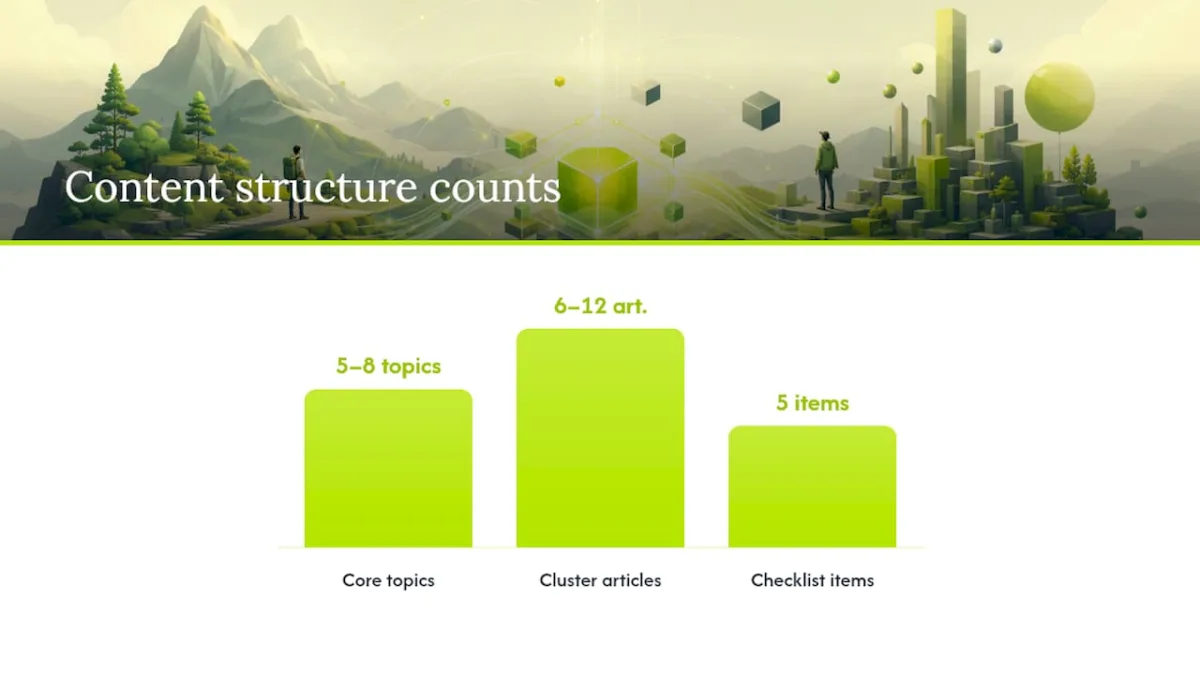
- Audience and keyword research: Identify the 5–8 core topics your audience searches most. Use tools like Ahrefs, Semrush, or Google Search Console to map search volume and intent.
- Pillar page creation: Write one comprehensive, 2,000-plus-word page per core topic. This is the authority anchor for that cluster.
- Cluster article production: Write 6–12 supporting articles per pillar, each targeting a specific long-tail question or sub-topic. Keep them tightly focused.
- FAQ and long-tail pages: Build dedicated pages for high-frequency questions. These often rank quickly and capture featured snippets.
- On-page conversion elements: Add conversion triggers to every page, not just landing pages.
For on-page conversion, the checklist for a niche page looks like this:
- A hero section that names the specific audience and their specific problem
- Microcopy that uses the audience's own language (pulled from forums, reviews, and support tickets)
- Social proof from recognizable names within the niche (not generic five-star badges)
- A single, focused CTA that tells the visitor exactly what they get
- A short form that asks only for what you actually need
The internal linking pattern reinforces both SEO and conversion. A pillar page on "commercial roofing services" links to cluster articles on "TPO vs. EPDM roofing for warehouses" and "how to budget a commercial roof replacement," both of which link to a transactional landing page for "get a commercial roofing quote." Each step moves the visitor closer to the conversion while building topical authority for the whole cluster.
Thewebteam's niche website strategy guide covers the content hub structure in detail, including how to sequence content production for fast early wins.
Pro Tip: Before writing a single cluster article, map the internal linking structure on paper. Know exactly which pillar page each cluster article will support and which transactional page it will feed. Sites that plan links before writing convert at a measurably higher rate than those that add links as an afterthought.
How do you pick a niche and validate demand before investing?
Choose a niche where demand, monetization fit, and defensibility align. A niche with strong search demand but no clear monetization path is a content project, not a business. A niche with great monetization but no accessible audience is a dead end. You need all three.
The validation checklist in prose form:
Search demand signals: Use Google Keyword Planner or Ahrefs to confirm that your core topics generate consistent monthly search volume. Look for clusters of related queries, not just one keyword. A healthy niche has dozens of addressable long-tail queries, not just one or two.
Audience accessibility: Can you reach this audience through organic search, paid ads, or existing communities? If the audience does not search for solutions online and has no active forums or social groups, acquisition will be expensive and slow.
Monetization paths: Map at least two revenue streams before you build. Services, products, affiliate commissions, and lead generation all work, but you need to confirm that the audience spends money on the problem you solve.
Competition audit: Search your core keywords and read the top-ranking pages. If the first page is dominated by large media companies with thousands of backlinks, find a sub-niche. If the top results are thin, outdated, or poorly written, you have a real opportunity.
Quick validation tests you can run in under a week:
- Run a small Google Ads campaign ($150–$300) targeting your core keywords. Watch CTR and cost-per-click. High CTR with manageable CPC confirms demand and commercial intent. Thewebteam's Google Ads targeting playbook outlines exactly how to set this up for niche audiences.
- Build a one-page landing page MVP and drive 200–300 visitors to it. A conversion rate above 3% on a lead-gen form is a strong go signal.
- Run a 10-question survey through a relevant Reddit community or LinkedIn group. Ask about their biggest frustrations and what they have already tried.
Go/no-go KPIs: paid CTR above 2%, landing page conversion rate above 3%, cost-per-lead below your target CAC, and at least 500 monthly searches across your core keyword cluster.
What metrics should you track, and what timelines are realistic?
A niche site follows a predictable progression: technical launch, then baseline traffic, then rank lift, then conversion optimization. Each phase has its own metrics.
Short-term goals (months 1–3): get the technical foundation right, publish your first pillar page and three cluster articles, and confirm that Google is indexing and crawling the site correctly. Thewebteam's technical SEO checklist for B2B websites covers the prerequisites.
Medium-term goals (months 3–9): reach page one for at least five long-tail keywords, hit a lead form conversion rate of 3% or higher, and begin tracking cost per acquisition against your revenue model.
Cost drivers to budget for:
- Content production: 4–8 articles per month at professional quality. This is the single largest variable cost for most niche sites.
- Technical build: A fast WordPress build from a specialist like Thewebteam can launch in days rather than weeks, which compresses the timeline significantly.
- Paid acquisition: Small validation budgets ($150–$500/month) during the first 90 days, scaling once organic traffic confirms the niche.
- Ongoing maintenance: WordPress care plans, hosting, and security updates. Skipping maintenance is the fastest way to lose rankings you worked months to earn.
What does a fast, niche-focused site build actually look like?
The result Thewebteam consistently delivers for niche clients is a production-ready WordPress site, live within days, with a content hub structure already in place and the technical SEO foundation set correctly from the start. That speed matters because the sooner the site is indexed, the sooner the ranking clock starts.
The project sequence in practice:
- Discovery: Define the niche, audience persona, core keyword clusters, and primary conversion goal. This takes one focused session.
- Fast WordPress build: AI-assisted development compresses the build phase. Design, structure, and on-page elements are built for the specific audience, not adapted from a generic template.
- Content hub setup: The pillar page and first cluster articles are structured and ready for content. Internal linking architecture is mapped before a single article goes live.
- Initial SEO optimizations: Title tags, meta descriptions, schema markup, page speed, and Core Web Vitals are addressed at launch, not retrofitted later.
- Launch and 90-day follow-up: The site goes live with hosting included for the first year. A care plan covers ongoing maintenance, security, and updates. The 90-day follow-up tracks rankings, traffic, and conversion rate, with adjustments made as data comes in.
What Thewebteam delivers for niche clients:
- Fast WordPress build with niche-specific design and UX
- One year of hosting included
- WordPress care plan for ongoing maintenance and security
- Content hub skeleton with pillar and cluster structure
- On-page SEO fundamentals set at launch
- Optional Google Ads management for paid validation and lead generation
- Monthly reporting on rankings, traffic, and conversions
The fastest path to a profitable niche site is not the cheapest build or the most elaborate one. It is a technically sound site, launched quickly, with a content structure that compounds over time. Speed to launch is speed to data, and data is what separates a niche that works from one that does not.
You can see examples of this approach in Thewebteam's project portfolio, which includes niche-focused builds across trades, B2B, and industrial sectors.
When a niche site is the wrong choice
The main exception is straightforward: if your business model requires reaching unrelated audiences across multiple verticals simultaneously, a single-niche site creates a ceiling you will hit quickly. A media company that monetizes through broad display advertising needs volume across many topics. A marketplace that serves buyers and sellers across dozens of categories cannot afford to narrow its scope. For those models, single-niche sites gain topical authority faster, but the right choice depends on whether each vertical can be treated as a mini-brand.
The real trade-offs worth knowing before you commit:
- Size ceiling: A niche site's addressable audience is, by definition, smaller. Once you have captured most of the relevant search traffic, growth requires either expanding the niche or launching adjacent sites.
- Slower horizontal scale: Moving from one niche to an adjacent one takes time and new content investment. You cannot simply add a new category and expect the existing authority to transfer.
- Deep domain expertise required: A niche site that gets the language wrong loses credibility instantly. You need either genuine expertise or access to subject-matter experts who can review content.
A hybrid approach, running two or three single-niche sites rather than one broad site, often outperforms both extremes. Each site builds its own topical authority, and the combined traffic and revenue can rival a multi-topic site without the dilution problem. This is the model Thewebteam uses for clients who serve multiple distinct markets.
Thewebteam builds niche sites that rank and convert
Most niche site projects stall not because the strategy is wrong but because the build takes too long, the technical foundation is shaky, or the content structure is never properly set up. Thewebteam solves all three. Fast, AI-assisted WordPress builds go live in days, not months. Every build includes one year of hosting, a care plan for ongoing maintenance, and an on-page SEO foundation that is correct from day one.
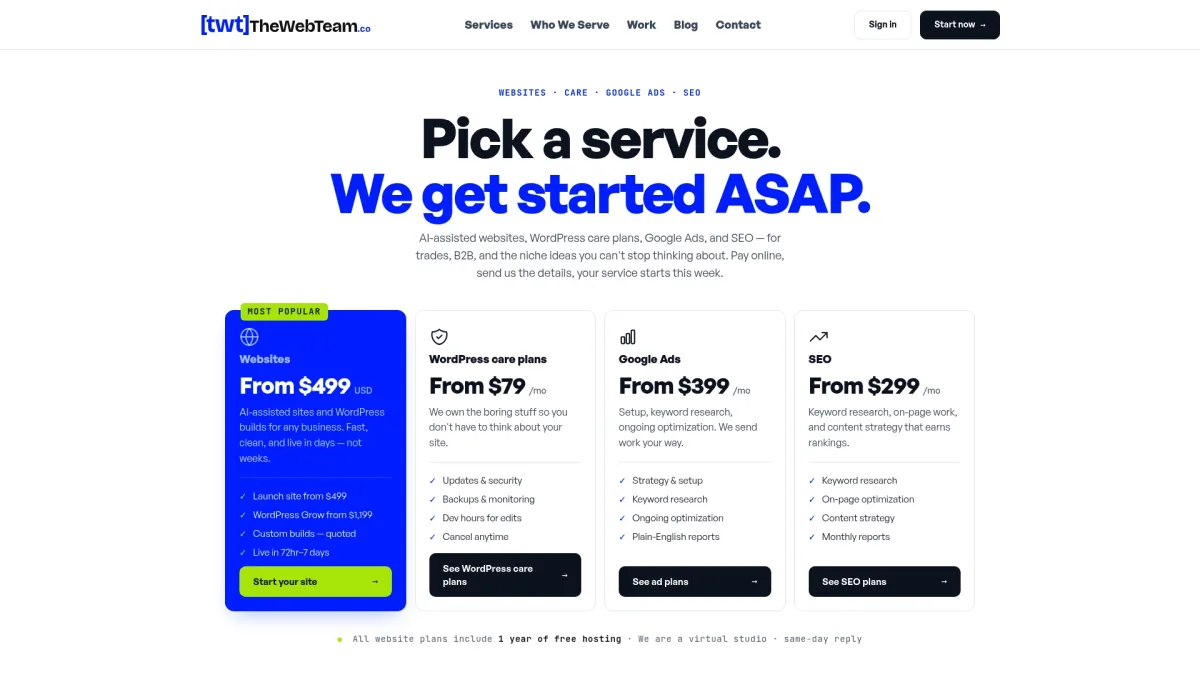
For niche businesses in trades, B2B, and industrial sectors, Thewebteam offers rapid build packages, content hub setup, WordPress care plans, and optional Google Ads management for paid validation and lead generation. The services and pricing page covers the full range of packages, and the portfolio shows what a finished niche build looks like in practice. If you are ready to launch a niche site that actually earns rankings and leads, book a strategy session and get a clear plan within the week.