
Internal linking is the practice of connecting one page on your website to another through clickable hyperlinks, and it directly improves SEO by strengthening crawl paths, distributing PageRank, and signaling topical relevance to search engines. Understanding how internal linking improves SEO gives website owners and digital marketers a concrete lever to pull without waiting for external backlinks. Google's Reasonable Surfer Model weights editorial body links more heavily than footer or navigation links, meaning placement matters as much as volume. In 2026, with AI-powered search engines increasingly citing well-structured content clusters, a deliberate internal linking strategy is no longer optional.
How do internal links influence crawlability and indexation?
Search engines discover pages by following links. When your internal link structure is weak, crawlers miss pages entirely, and those pages never rank. Crawl budget is the number of pages Google will crawl on your site within a given timeframe. Wasting it on redundant or low-value pages means your best content gets ignored.
Click depth is the number of clicks required to reach a page from your homepage. Pages buried more than 3 clicks deep receive significantly less crawl frequency and ranking authority. Pages deeper than 4 clicks are effectively invisible to Google's crawler. Keeping your most important content within 2 clicks of the homepage is the single fastest structural fix most sites can make.
Orphan pages compound the problem. These are pages with no internal links pointing to them. Orphan pages rank an average of 11 positions worse than properly linked pages. Fixing them can recover more than 6 ranking positions on average. Many sites have 20–40% of their pages orphaned, which represents a significant, untapped opportunity.
Pro Tip: Run a crawl audit using Screaming Frog or Sitebulb monthly. Filter for pages with zero inbound internal links. Those are your orphans, and fixing them is the highest-return task on your SEO list.
Key crawlability improvements to target:
- Keep priority pages within 2 clicks of the homepage
- Link to new content from existing high-authority pages immediately after publishing
- Fix or redirect broken internal links within 48 hours of detection
- Remove links pointing to redirect chains, since each hop dilutes authority
Controlled tests show that optimized internal linking improves crawl coverage within 30 days and produces visible ranking gains within 60–90 days. That is a fast return compared to most SEO tactics.
What role does internal linking play in distributing link authority?
PageRank flows through links. Every page on your site has a certain amount of authority, and internal links pass a share of that authority to the pages they point to. The more outbound links a page has, the smaller the share each destination receives. This is why footer links with 50 or more destinations dilute authority rather than concentrate it.
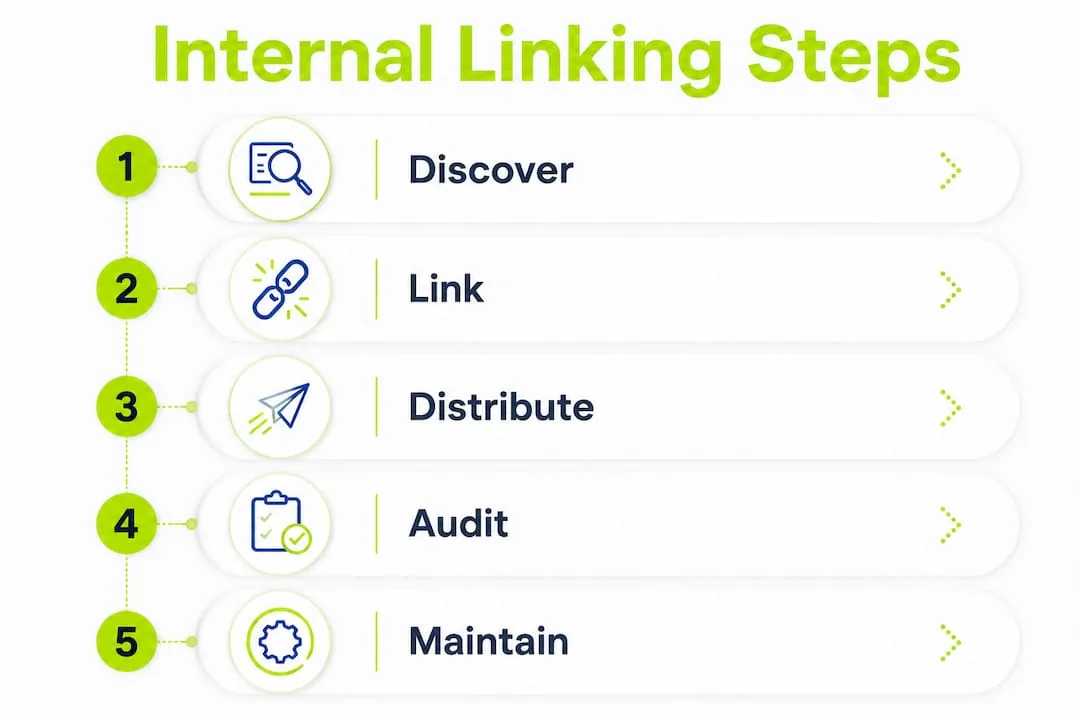
Sites with lean navigation footers have 18% higher domain authority than sites with 30–50 footer links. That gap is significant. Trimming your footer to essential links only is a structural change that pays dividends across your entire site.
The most effective way to move authority is through contextual, editorial body links. At least 70% of your internal links should appear within body text, not in sidebars, footers, or navigation menus. A link embedded in a relevant paragraph carries more SEO weight than the same link buried in a footer list.
Adding 3 to 5 contextual internal links from high-authority pages improves rankings by 1 to 3 positions in 73% of cases. That is a measurable, repeatable result. The implication is clear: identify your highest-authority pages and use them as launching pads for the content you most want to rank.
| Link placement | SEO weight | Best use case |
|---|---|---|
| Editorial body link | Highest | Passing authority to target pages |
| Navigation link | Medium | Site-wide discoverability |
| Sidebar link | Low to medium | Related content suggestions |
| Footer link | Lowest | Legal pages, essential navigation only |

Pro Tip: Use Google Search Console to identify your top-performing pages by clicks and impressions. Those are your authority pages. Add 3 to 5 contextual links from each one to the pages you want to rank higher.
What are the best internal linking strategies for 2026?
The pillar page and topic cluster model is the most effective internal linking architecture available. A pillar page covers a broad topic comprehensively. Cluster pages cover specific subtopics in depth. Every cluster page links back to the pillar, and the pillar links out to each cluster. This bidirectional structure signals topical authority to Google and to AI search engines simultaneously.
Sites applying topic clusters saw pillar page traffic grow 41% over 6 months. That growth comes from the compounding effect of authority flowing through the cluster. Each new cluster page you publish strengthens the entire group. A solid site architecture makes this model far easier to implement and maintain.
Anchor text strategy matters more than most marketers realize. The recommended distribution is:
- Exact match anchors (5–10%): Use sparingly. Exact match anchors like "internal linking strategies" signal relevance but trigger over-optimization penalties when overused.
- Partial match anchors (30–40%): Phrases that include the target keyword alongside other words. These carry strong relevance signals without the risk.
- Semantic or branded anchors (50–60%): Natural language phrases, brand names, and topic-related terms. Anchor text variety strongly correlates with higher Google clicks and better page performance.
AI-powered search engines in 2026 cite well-linked content clusters 4 times more frequently than isolated pages. To capture AI citations, keep your most important pages within 2 clicks of the homepage and write content in extractable, self-contained passages. This aligns with how AI systems pull answers from structured content.
Regular audits keep the structure healthy. Schedule them quarterly at minimum. During each audit, check for orphan pages, broken links, anchor text cannibalization, and pages with too many or too few inbound internal links. A technical SEO checklist built around these criteria gives your team a repeatable process.
What common internal linking mistakes should website owners avoid?
Generic anchor text is the most widespread mistake. Anchors like "click here," "read more," or "learn more" tell Google nothing about the destination page. They waste the relevance signal that a descriptive anchor would deliver. Every internal link anchor should describe what the reader will find on the other side.
- Vague anchors: Replace "click here" with the topic of the destination page
- Footer link overload: Cap footer links at 10 to 15 essential destinations
- Orphan pages: Any page with zero inbound internal links needs at least 2 to 3 pointing to it
- Topically irrelevant links: Linking a plumbing services page to a blog post about marketing strategy passes no useful signal
- Anchor text cannibalization: Using the same anchor text for two different pages confuses Google about which page to rank for that term
Anchor text cannibalization occurs when multiple pages share the same internal anchor text. Google cannot determine which page you want to rank, so it often ranks neither well. Assign each target page a unique primary anchor and use it consistently.
Pro Tip: Build a simple spreadsheet mapping each key page to its primary anchor text. Share it with every content contributor. Consistency across your team prevents cannibalization before it starts.
Broken internal links are another silent ranking killer. When a link points to a deleted or moved page, crawlers hit a dead end and authority stops flowing. Audit for broken links every time you delete or restructure content.
How can you measure and maintain internal linking for long-term SEO?
Measurement turns internal linking from a one-time task into a compounding asset. Start by tracking inbound internal link counts for your 20 most important pages. Any priority page with fewer than 5 inbound internal links is underserved and needs attention.
Incremental improvements over 8–12 weeks produce sustainable traffic gains of 14.2% over 12 months. Rapid, full-site restructuring risks temporary ranking drops. A steady cadence of fixes is safer and more effective than a single large overhaul.
A practical maintenance process looks like this:
- Monthly crawl audit: Use Screaming Frog or Sitebulb to identify orphan pages, broken links, and redirect chains.
- Quarterly anchor text review: Check your anchor text spreadsheet against live pages. Update any anchors pointing to redirected or deleted URLs.
- New content protocol: Every time you publish a new page, immediately link to it from 2 to 3 existing high-authority pages. New content linked quickly from authority pages indexes and ranks faster than content left to attract links naturally.
- Priority page check: Review inbound link counts for your top 20 pages. Add links from relevant posts if any page drops below your minimum threshold.
- Performance tracking: Use Google Search Console to monitor ranking changes for pages you have recently linked to. Expect visible movement within 60–90 days.
Internal linking acts as a multiplier on existing content authority. It cannot rescue thin or low-quality content, but it significantly boosts discoverability and ranking when applied to solid pages. Pair your linking work with a strong long-form content strategy to get the full compounding effect.
Key Takeaways
Internal linking is the most controllable on-site SEO lever you have, and consistent execution compounds into measurable ranking gains over 60–90 days.
| Point | Details |
|---|---|
| Crawl depth matters | Keep priority pages within 2 clicks of the homepage to maximize crawl frequency and authority. |
| Fix orphan pages first | Pages with no inbound internal links rank 11 positions worse on average; fixing them is high-ROI. |
| Body links carry the most weight | At least 70% of internal links should appear in editorial body text, not footers or sidebars. |
| Use varied anchor text | Aim for 50–60% semantic anchors, 30–40% partial match, and only 5–10% exact match. |
| Audit incrementally | Steady improvements over 8–12 weeks outperform rapid restructuring and avoid ranking volatility. |
What I have learned from years of watching internal linking work (and fail)
Most website owners treat internal linking as a checkbox. They add a few links when they publish a post, and then they forget about it. That approach leaves most of the value on the table.
The sites I have seen grow consistently are the ones that treat internal linking as a living system. They map their content into clusters, assign authority deliberately, and audit on a schedule. They also link new content to existing pages within hours of publishing, not weeks later. That single habit accelerates indexing more reliably than any other tactic I have tested.
The 2026 shift toward AI-powered search makes this discipline even more important. AI systems favor well-structured clusters because they can extract clean, authoritative answers from them. A site with strong internal linking is not just easier for Google to crawl. It is easier for AI to cite. That is a meaningful competitive edge that most marketers are still ignoring.
My honest advice: do not wait until your site is "ready" for a full audit. Start with your top 10 pages today. Find the ones with fewer than 5 inbound internal links and fix them this week. The ranking movement you see in 60 days will tell you everything you need to know about whether to scale the process.
— Jonathon
How Thewebteam can strengthen your site's internal linking and SEO
Building a strong internal link structure requires more than good intentions. It requires a site architecture designed to support it from the ground up.
Thewebteam builds WordPress websites for trades, B2B businesses, and niche industries with SEO-friendly architecture built in from day one. That means logical page hierarchies, clean URL structures, and content layouts that make contextual linking natural rather than forced. If your current site makes internal linking difficult, the structure itself is the problem. Thewebteam's web design and SEO services cover everything from initial site builds to ongoing WordPress maintenance and SEO audits. You can also review past projects to see how site architecture decisions translate into real ranking results for clients in competitive industries.