
Effective B2B service page optimization is the practice of structuring, writing, and technically configuring service pages so they rank for buyer-intent queries and convert qualified leads. B2B buyers search differently from consumers, and organic SEO channels outperform many paid channels in both conversion quality and cost efficiency. To optimise B2B service pages for SEO, you need content that satisfies Google crawlers, AI answer engines, and human decision-makers at the same time. This guide covers every layer of that process, from intent mapping to schema markup to CTA placement.
How does B2B search intent differ, and why must you optimise service pages accordingly?
B2B buyers conduct longer, more research-driven searches than consumers, and their queries span three distinct intent types: informational, navigational, and transactional. Each type demands a different content response on your service pages.
Informational intent covers queries like "what does a managed IT service include" or "how does B2B SEO work." Buyers at this stage are building a shortlist and evaluating categories. Your service page needs a clear definition block in the first 100 words to capture this traffic.

Navigational intent appears when a buyer already knows your brand and searches for a specific page. These visitors convert at higher rates, so your page titles and URL structure must match your brand name and service category exactly.
Transactional intent signals readiness to act. Queries like "B2B SEO agency pricing" or "hire WordPress developer for B2B site" indicate a buyer close to a decision. These pages need pricing signals, proof points, and a direct call to action.
Why B2B buyers search differently comes down to three structural factors:
- Longer sales cycles. A B2B purchase often involves 6–12 stakeholders. Content must address multiple roles, not just one buyer persona.
- Research depth. B2B buyers read case studies, compare credentials, and verify claims before contacting a vendor. Thin pages lose them fast.
- Risk aversion. The cost of a wrong vendor decision is high. Pages that reduce perceived risk through guarantees, credentials, and outcome statements win more inquiries.
Mapping search intent to service pages prevents content dilution and thin pages, which directly improves ranking potential. A service page targeting transactional intent should not double as a blog post. Keep the purposes separate.
What role does outcome-focused content play in B2B service page SEO?
Service pages optimized solely around vendor capabilities lose buyer trust. Framing content around benefits and measurable outcomes is the single most effective shift you can make to improve both rankings and conversions.
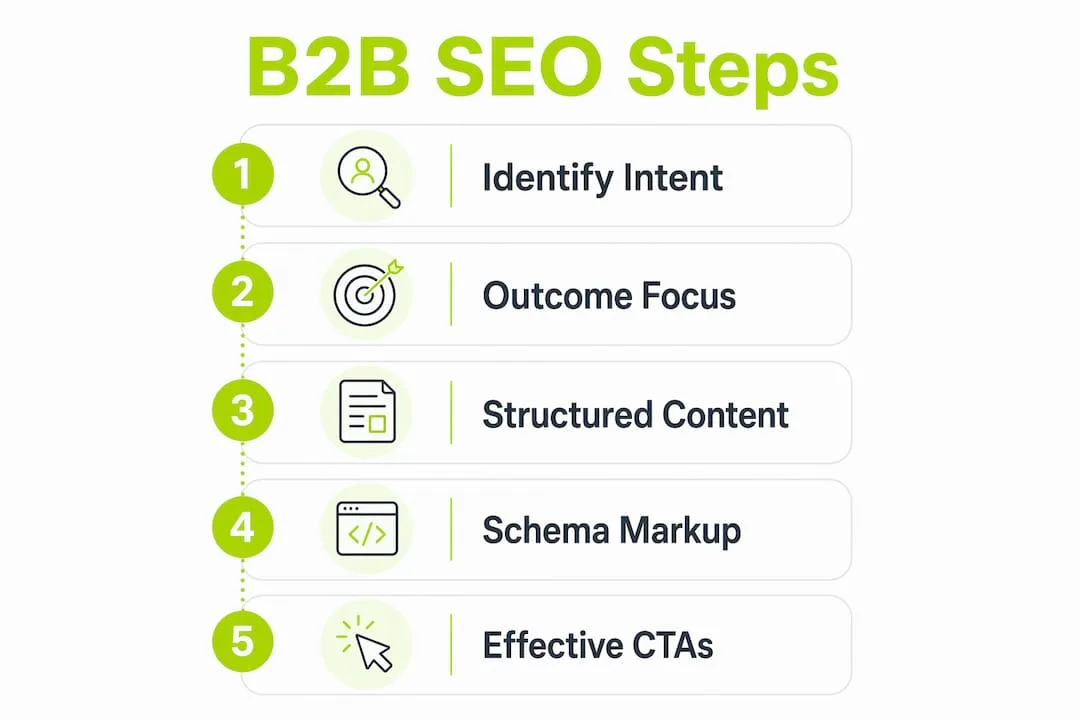
The most reliable structure for a high-converting service description is the three-sentence frame: state the problem the buyer faces, describe how you deliver the solution, then name the expected outcome. This format works because it mirrors how buyers think, not how vendors talk. A buyer searching for "B2B lead generation website" does not want to read about your team's passion for design. They want to know what changes after they hire you.
The first 300 words of your service page carry disproportionate weight. Google and AI engines parse the opening paragraph extensively, so entity clarity here directly boosts rankings and AI citations. Name your service, your intended buyer, your location if relevant, and your credentials within that opening block.
Social proof belongs inside the service description, not just at the bottom of the page. Specific numbers, named industries, and verifiable outcomes carry more weight than generic testimonials. Thewebteam, for example, publishes case studies directly within service sections to give buyers proof at the moment of evaluation.
Here is what outcome-focused content includes at the service block level:
- A clear problem statement that mirrors the buyer's search query
- A delivery description that names the process, timeline, or method
- A measurable outcome (reduced cost, faster launch, higher ranking)
- One or two proof points: a client result, a credential, or a named standard
- A context-specific CTA aligned to that service block
Pro Tip: Write your service description as if the buyer has never heard of your company. If the page only makes sense to someone who already knows you, rewrite it.
How to structure service pages for modern SEO: technical and content best practices
Page architecture determines whether Google and AI engines can parse your content correctly. Optimized page titles and H1s that tightly match buyer intent improve crawlability and ranking relevance. Avoid generic titles like "Our Services." Use exact service phrases plus qualifiers, such as "B2B WordPress Web Design for Industrial Companies."
Follow this structure for each service page:
- H1: Primary keyword plus buyer qualifier (matches the page's transactional or informational intent)
- Opening paragraph: Service definition, intended buyer, credentials, location (first 300 words)
- H2 blocks: Each answers a buyer question. Examples: "What does this service include?", "How long does it take?", "What does it cost?"
- Social proof block: Case study excerpt or client result with a specific metric
- FAQ section: 3–5 questions with standalone answers (100–200 words each)
- CTA block: Inline with the service description, not just at the footer
Structured headings aligned to buyer questions with 100–200 words under each improve Google snippet eligibility and AI answer inclusion. Each H2 answer must stand alone. If a reader only sees that section, they should still get a complete answer.
Schema markup for FAQ and HowTo content increases the chance of AI-powered search engines extracting and displaying those answers. Implement FAQ schema on every service page that contains a question-and-answer block. HowTo schema applies when your service description walks through a process.
| Technical element | SEO impact |
|---|---|
| Intent-matched H1 | Signals page relevance to Google and AI crawlers |
| FAQ schema markup | Increases rich snippet and voice assistant eligibility |
| Internal links to blog posts | Distributes authority and deepens topical coverage |
| Mobile-first design | Required for Google's mobile-first indexing |
| Fast page load (Core Web Vitals) | Direct ranking factor and engagement signal |
Mobile-first design and fast page load times remain foundational for B2B website SEO. Google's Core Web Vitals and mobile-first indexing prioritize these factors for ranking and engagement. A slow page loses buyers before they read a single word.
Pro Tip: Use Thewebteam's technical SEO checklist to audit your service pages against every ranking factor before publishing.
What are effective CTA strategies on B2B service pages?
Generic footer CTAs underperform because they appear after the buyer's attention has already dropped. Each service block needs its own context-specific CTA placed inline or immediately after the section. This aligns the call to action with the buyer's readiness at that exact moment in the page.
Effective B2B CTA copy names the next step explicitly. "Talk to us about your WordPress site" outperforms "Contact us" because it confirms the buyer is in the right place. "Get a quote for B2B SEO" outperforms "Learn more" because it signals a concrete outcome. Context-specific CTAs that clarify the next step dramatically lower visitor hesitation and raise conversion rates.
Risk-reversals belong next to CTAs, not buried in a terms page. A short phrase like "No lock-in contracts" or "Free initial consultation" removes the final objection at the moment of decision. Thewebteam includes transparent pricing and no-hidden-cost statements directly adjacent to its service CTAs for exactly this reason.
- Place one CTA per service block, not one CTA per page
- Write CTA copy that names the service and the next step
- Add a risk-reversal phrase within two lines of the CTA button
- Test CTA placement above and below the social proof block
- Track CTA click rate separately from page conversion rate to isolate what works
Pro Tip: If your CTA says "Get in touch," replace it with the specific action the buyer takes next. Vague CTAs signal a vague process, and B2B buyers notice.
How to maintain B2B service pages for sustained SEO results
Service pages decay. Pricing changes, clients move on, and search trends shift. Biannual updates to pricing, client references, and FAQs demonstrate freshness and signal ongoing upkeep to search engines. A page last updated two years ago loses credibility with both buyers and crawlers.
Follow this maintenance cycle every six months:
- Review pricing and availability. Outdated pricing creates friction and erodes trust faster than any other content error.
- Refresh case studies and testimonials. Replace older proof points with recent results. Specific metrics age better than general praise.
- Update FAQ answers. Buyer questions evolve. Add new questions that reflect current search trends in your industry.
- Audit internal links. Add links to new blog posts and deeper service pages. Remove links to pages that no longer exist.
- Revalidate schema markup. Updating schema markup every six months signals page freshness to Google and AI engines and maintains ranking position.
- Check Core Web Vitals scores. Page speed and layout stability shift as plugins and images accumulate. Re-test after every major content update.
Track three metrics to measure the health of each service page: organic traffic volume, lead quality (measured by sales team feedback), and conversion rate from page visit to inquiry. Organic traffic alone is a vanity metric. A page that attracts 500 visitors and converts zero leads needs a content fix, not more traffic.
For deeper guidance on building content authority around your service pages, Thewebteam's long-form content strategy guide covers how supporting articles feed authority back to core service pages.
Key Takeaways
Effective B2B service page SEO requires intent-matched content, entity-rich opening paragraphs, structured headings with schema markup, context-specific CTAs, and biannual content maintenance to sustain rankings and lead quality.
| Point | Details |
|---|---|
| Match content to buyer intent | Separate informational, navigational, and transactional pages to prevent content dilution. |
| Lead with outcomes, not capabilities | Use the problem-delivery-outcome frame in every service block to reduce buyer risk. |
| Structure pages for AI parsing | Apply FAQ and HowTo schema so AI engines can extract and cite your answers. |
| Place CTAs inline, not just at the footer | Context-specific CTAs aligned to each service block convert at higher rates. |
| Update pages every six months | Refresh pricing, case studies, schema, and internal links to signal freshness to Google. |
What I've learned about balancing AI SEO and human buyers on B2B service pages
The biggest mistake I see B2B marketers make is writing for one audience. They either write for Google crawlers and produce dry, keyword-stuffed pages, or they write for buyers and produce beautifully worded pages that never rank. The pages that actually generate leads do both.
Generative Engine Optimization (GEO) and Answer Engine Optimization (AEO) are not future trends. They are current ranking factors in 2026. Content must satisfy Google crawlers, AI answer engines, voice assistants, and human buyers simultaneously. That sounds complex, but it reduces to one discipline: write factually dense, clearly structured content that answers real buyer questions.
The clients I've seen improve lead generation fastest are the ones who rewrote their service descriptions using the three-sentence outcome frame and then added inline CTAs. The change was not technical. It was a shift in whose perspective the page was written from. Vendor-centric pages describe what you do. Buyer-centric pages describe what changes for the buyer.
One more thing: iteration beats perfection. A service page published with 80% of the right elements and updated quarterly will outperform a "perfect" page published once and left alone. Build the habit of treating your service pages as live documents, not finished products.
— Jonathon
How Thewebteam can help with your B2B service page SEO
B2B service pages need more than good copy. They need fast load times, clean WordPress architecture, proper schema implementation, and a content structure that satisfies both buyers and AI search engines.
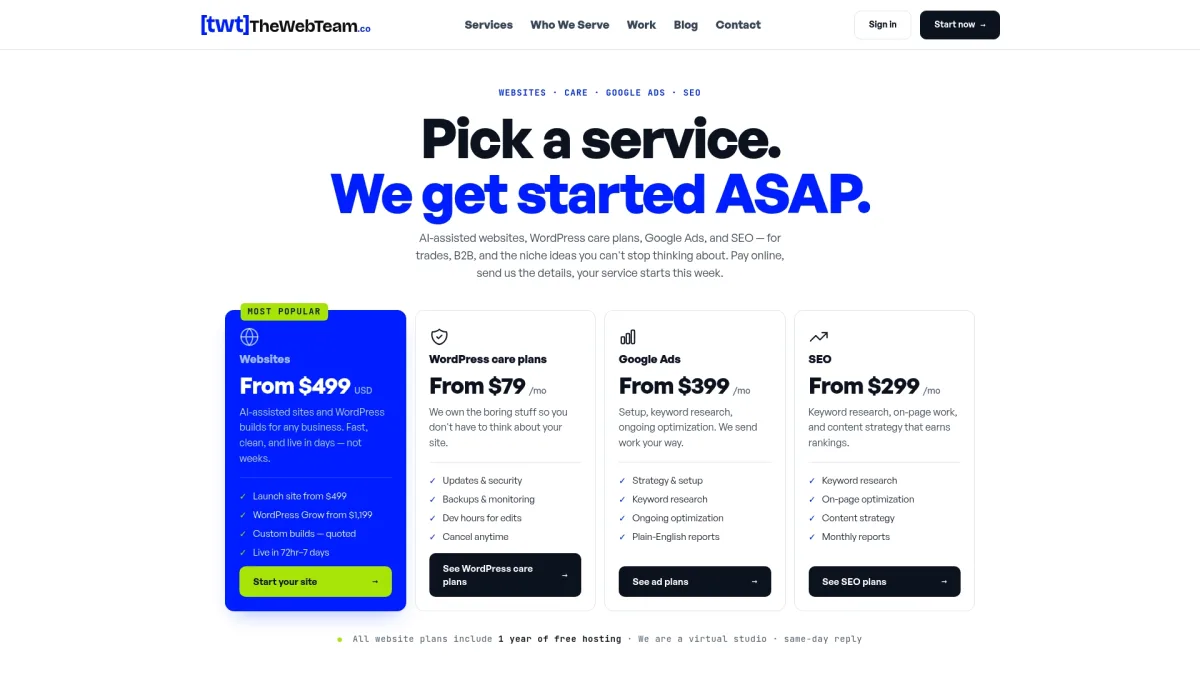
Thewebteam builds and maintains WordPress websites for B2B businesses, trades, and niche industries, with SEO built into every page from day one. Clients launch within days, not weeks, with transparent pricing and no hidden costs. You can review real results in the web design portfolio or explore the full range of services and pricing to find the right fit for your business. If your service pages are not generating the leads they should, that is the right place to start.