
Local search rankings determine which businesses appear in Google's local results by measuring how relevant, nearby, and prominent a business is to the searcher's query and location. Google's local algorithm, formalized since 2014, evaluates every local query through three core pillars: relevance, distance, and prominence. These pillars do not operate in isolation. They combine with six distinct signal groups, including Google Business Profile signals, review signals, and on-page SEO, to produce the final ranking. Understanding how local search rankings work gives business owners a clear map for where to invest their time and budget.
What are the primary components that influence local ranking in 2026?
Google's local ranking relies on six primary signal groups, with Google Business Profile (GBP) signals accounting for roughly 32–36% of total ranking influence. That single factor outweighs every other signal category combined. A business with an incomplete or unverified GBP profile starts every local search at a structural disadvantage.
The six signal groups break down as follows:
- Google Business Profile signals (32–36%): Category selection, business description, photo count, post frequency, and attribute completeness all feed this bucket.
- Review signals (15–20%): Volume, recency, velocity, and sentiment each contribute. Review impact grew from 16% in 2023 to 20% in 2026, making this the fastest-rising signal category.
- On-page and website signals (15–19%): Localized content, schema markup, and NAP (name, address, phone number) consistency across the site.
- Link signals (8–12%): Backlinks from locally relevant and authoritative domains.
- Behavioral signals (6–10%): Click-through rates, direction requests, and click-to-call actions.
- Citation signals (6–7%): Consistent business listings across directories like Yelp, Bing Places, and Apple Maps.
| Signal Group | Approximate Weight | Core Pillar It Feeds |
|---|---|---|
| Google Business Profile | 32–36% | Relevance, Prominence |
| Review signals | 15–20% | Prominence |
| On-page and website | 15–19% | Relevance |
| Link signals | 8–12% | Prominence |
| Behavioral signals | 6–10% | Relevance, Prominence |
| Citation signals | 6–7% | Prominence |
These weights are not fixed forever. Google adjusts them as user behavior shifts. The trend since 2023 shows behavioral and review signals gaining ground at the expense of pure citation volume.
How do relevance, distance, and prominence affect your ranking?
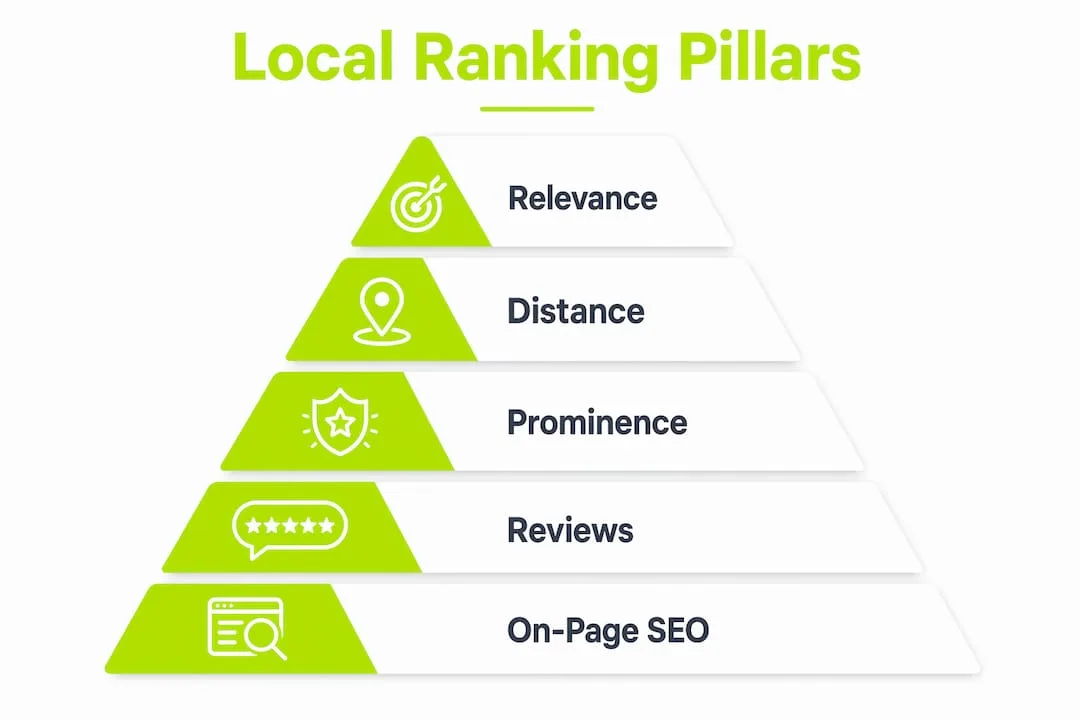
Google's local algorithm evaluates every query through relevance, distance, and prominence. Each pillar does a different job, and each requires a different response from business owners.

Relevance
Relevance measures how well a business profile matches what the searcher is looking for. A plumber whose GBP profile lists "emergency plumbing," "water heater repair," and "drain cleaning" as services will rank for those specific queries. A plumber whose profile says only "plumbing services" will not. The same logic applies to the business website. Pages that use localized language, answer specific service questions, and include structured data (schema markup) signal relevance more clearly to Google.
Keyword alignment between the GBP profile and the website matters. If the profile says "HVAC contractor" but the website only mentions "heating and cooling," Google sees a mismatch. Consistency across both properties strengthens the relevance signal.
Distance
Distance acts as a filter before relevance and prominence even enter the equation. Proximity functions as a hard eligibility threshold for convenience-based services. A coffee shop two miles away from the searcher will not outrank one three blocks away, regardless of how many reviews it has. Business owners cannot control their physical location, but they can define their service area accurately in GBP to capture searches from surrounding neighborhoods.
For service-area businesses (plumbers, electricians, landscapers), setting a precise service area in GBP is the primary lever for distance eligibility. Leaving this field blank removes the business from a large portion of relevant local queries.
Prominence
Prominence reflects how well-known and trusted a business is, both online and offline. Google measures prominence through review volume and quality, backlinks from local news sites and industry directories, brand mentions across the web, and citation consistency. A business with 200 reviews, a local newspaper feature, and listings on 30 directories signals more prominence than a competitor with 10 reviews and three citations.
Pro Tip: Keyword stuffing in business names triggers automatic policy enforcement and can result in profile suspension. Write your business name exactly as it appears on your storefront or legal registration.
What role do reviews play in local search rankings?
Reviews are the fastest-growing ranking signal in Google's local algorithm. Businesses with over 100 reviews rank 3.2x higher in the Map Pack than businesses with fewer reviews. That correlation is strong enough that review acquisition should be treated as a core business process, not an afterthought.
Google does not just count reviews. It analyzes four dimensions of review quality:
- Volume: More reviews signal a more active and trusted business.
- Recency: A business that received 50 reviews last month outperforms one with 200 reviews from three years ago.
- Velocity: A steady stream of new reviews signals ongoing customer engagement.
- Sentiment: Google's natural language processing reads review text. Phrases like "fast response" or "fixed the leak same day" reinforce specific service keywords.
Eighty-seven percent of consumers read online reviews before visiting a local business. That means your review profile is often the first real impression a potential customer forms, before they ever visit your website or call your number.
The practical implication is clear. Asking every satisfied customer for a review is not optional for businesses that want local visibility. The request should come immediately after service delivery, when the experience is fresh. Responding to every review, positive or negative, also signals active management to Google and builds trust with prospective customers.
Avoid any tactic that manufactures fake reviews or offers incentives for positive reviews. Google's detection systems flag unnatural review spikes, and the penalty is a ranking drop or profile removal.
How do on-page SEO, citations, and behavioral signals influence local rankings?
On-page and citation signals together carry roughly one-third of local ranking weight. That makes your website and your directory listings two of the most controllable factors in the entire algorithm.
On-page SEO for local search focuses on three areas:
- Localized content: Service pages that name the city, neighborhood, or region you serve rank for location-specific queries. A general "roofing services" page does not compete with a page titled "Roof Repair in Austin, TX."
- Schema markup: LocalBusiness schema tells Google your address, hours, phone number, and service categories in a structured format it can read directly. This reduces ambiguity and strengthens relevance signals.
- NAP consistency: Your business name, address, and phone number must match exactly across your website, GBP profile, and every directory listing. Even minor differences (abbreviating "Street" as "St." on one listing but not another) create entity confusion for Google.
Pro Tip: Run a citation audit at least twice a year. Tools like Moz Local or BrightLocal surface inconsistencies across dozens of directories in one report. Fixing those inconsistencies is one of the highest-return tasks in local SEO.
Behavioral signals contribute approximately 7% to local ranking and are growing. When users click your listing, request directions, or tap "call," Google interprets those actions as proof that your business matches what searchers want. A business with a high click-through rate from local results gets a positive feedback loop: more clicks reinforce ranking, which generates more clicks.
Improving behavioral signals means improving the quality of your GBP listing itself. High-quality photos, accurate hours, a compelling business description, and recent posts all increase the likelihood that a searcher clicks your listing over a competitor's. The technical SEO elements of your website also matter here. A slow-loading page after a GBP click sends a negative engagement signal back to Google.
A fully optimized Google Business Profile is 2.7x more likely to be deemed reputable by Google. That single statistic justifies treating GBP maintenance as a weekly task, not a one-time setup.
Key Takeaways
Local search rankings are determined by the combined weight of Google Business Profile signals, review quality, on-page SEO, behavioral engagement, backlinks, and citation consistency, with GBP signals carrying the largest share at 32–36%.
| Point | Details |
|---|---|
| GBP signals dominate | Google Business Profile signals carry 32–36% of ranking weight. Complete every field. |
| Reviews are growing fast | Review impact rose from 16% in 2023 to 20% in 2026. Treat review acquisition as a core process. |
| Distance is a filter, not a factor | Proximity determines eligibility first. Set your service area accurately in GBP. |
| On-page and citations matter | NAP consistency and schema markup together account for roughly one-third of ranking weight. |
| Behavioral signals reward quality listings | Click-through rates and call actions contribute 7% and grow when your GBP listing is complete and accurate. |
What I've learned after years of watching local rankings shift
Most business owners treat their Google Business Profile like a phone book listing: fill it in once and forget it. That is the single most common mistake I see, and it costs businesses real revenue.
The businesses that consistently hold Map Pack positions treat GBP as a living document. They add photos weekly, post updates about seasonal services, respond to every review within 24 hours, and update their hours the moment they change. Google rewards activity. A dormant profile signals a dormant business.
The other mistake I see constantly is chasing citations at the expense of reviews. Citations matter, but their weight has been declining relative to reviews for three straight years. If I had to choose between spending an hour submitting to 10 more directories or spending that same hour following up with five recent customers to request a review, I would choose the reviews every time. The ranking impact is faster and more durable.
For businesses in trades and B2B, the B2B local SEO strategies that work in 2026 are built on the same foundation: a complete GBP profile, a steady review pipeline, and a website that loads fast and speaks directly to local service needs. There is no shortcut that replaces those three things.
— Jonathon
How Thewebteam helps businesses rank in local search
Local search visibility depends on your website and your GBP profile working together. Thewebteam builds fast, well-structured websites for trades, B2B businesses, and niche industries, with local SEO built into the foundation from day one.
Every website Thewebteam delivers includes proper schema markup, NAP-consistent contact pages, and localized service pages designed to rank. The team also handles ongoing website maintenance and SEO, so your site stays technically sound as Google's algorithm evolves. If you want to see what that looks like in practice, the client portfolio shows real results across industries. Thewebteam treats web development as a job with measurable outcomes, not a creative exercise.