
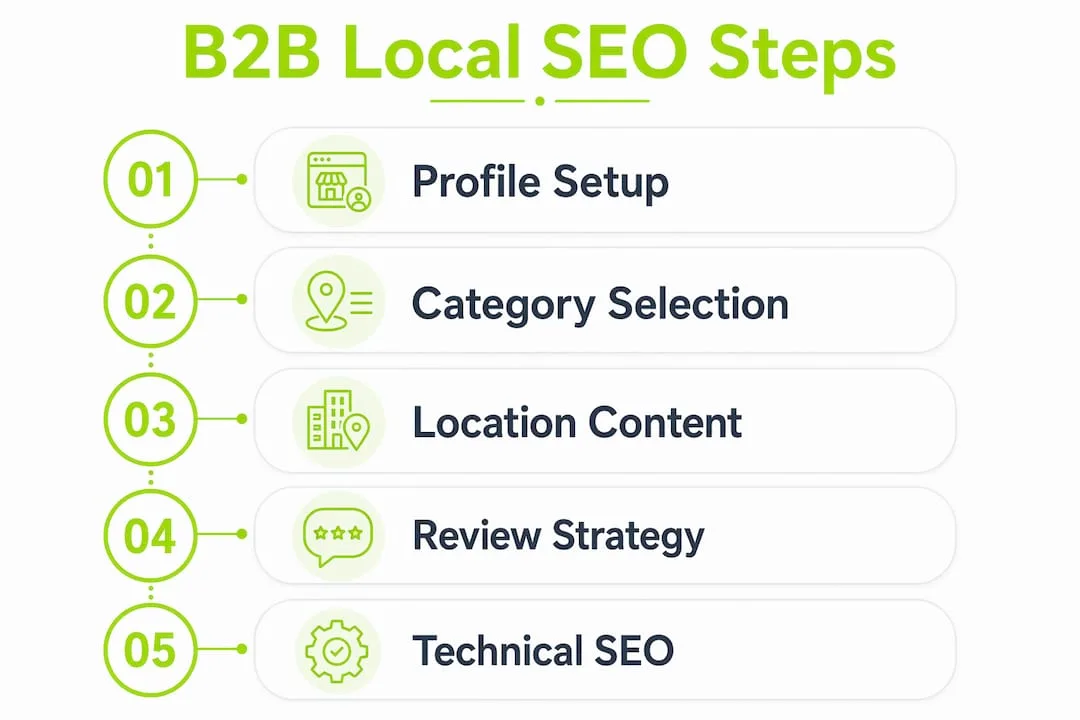
B2B local SEO for offices is the practice of optimizing your office locations' presence in local search results to attract regional business clients through Google Maps, local packs, and location-based queries. The five primary local ranking factors in 2026 account for over 50% of total ranking weight, led by Google Business Profile category match at 14% and proximity at 12%. Businesses that apply these factors consistently see a 156% average increase in Google Maps visibility and an 89% increase in direction requests within 90 days. Local search optimization is not a one-time project. It compounds over time, meaning the offices that invest steadily pull further ahead of competitors with every passing month.
Which Google Business Profile steps matter most for B2B offices?
Google Business Profile (GBP) is the single most influential asset in office local search optimization. Getting it right is not complicated, but most B2B offices leave critical fields incomplete or choose the wrong primary category.

Category selection and profile completeness
Your primary GBP category must match the core service your office delivers. A commercial real estate firm should not default to "Real Estate Agency" if "Commercial Real Estate Agency" exists as a category. Secondary categories add context. A consulting firm might list "Business Management Consultant" as primary and "Financial Consultant" as secondary. GBP completeness accounts for 9% of local pack ranking weight in 2026. That is a significant share of ranking power sitting unused when offices skip fields like business hours, service areas, or attributes.
Business description and photos
Your business description should include the city or neighborhood name, the specific services you offer at that location, and one or two phrases that match how buyers search. Keep it under 750 characters and front-load the most important information. Photos matter more than most B2B companies expect. Offices with current exterior photos, team photos, and interior shots receive more engagement than those with no images or stock photography. Upload at least 10 photos when you first set up the profile, then add new ones monthly.
Key GBP actions for B2B offices:
- Select the most specific primary category available for your service type
- Complete every profile field, including services, products, and attributes
- Write a description that includes your city name and core service keywords
- Upload at least 10 photos covering exterior, interior, and team
- Maintain consistent NAP (name, address, phone) across all citations and directories
Pro Tip: Set a monthly calendar reminder to post a GBP update. Google treats active profiles as more relevant than dormant ones, and regular posts cost nothing.
How can location-specific content improve your B2B office's local SEO?
Location pages are the backbone of local SEO for corporate offices with multiple sites. A single generic "Contact Us" page does not tell Google which city you serve or which buyers you want to reach. Dedicated location pages fix that.
What makes a location page genuinely useful?
A strong location page goes beyond your address and phone number. It includes neighborhood-specific details that only someone familiar with the area would write. For example, a staffing firm's Chicago office page might reference the River North business district, note that it serves companies in the Loop, and mention local hiring regulations specific to Cook County. That level of specificity signals genuine local relevance to both Google and the business buyers reading the page.
Local schema markup and genuinely unique content prevent duplication penalties and increase relevance for each office location. Use LocalBusiness schema with areaServed and geo coordinates for every location page. This structured data helps Google understand exactly where your office operates and which searches it should appear for.
Avoid copying the same paragraph across multiple location pages and swapping only the city name. That approach triggers thin content penalties and rarely ranks. Each page needs its own unique content block of at least 300 words specific to that location.
| Location page element | Why it matters |
|---|---|
| Unique local content block | Prevents thin content penalties and signals genuine relevance |
| LocalBusiness schema markup | Helps Google map your office to specific geographic searches |
| Local keyword integration | Aligns page with buyer intent searches in that city or region |
| Neighborhood and district references | Adds specificity that generic pages cannot replicate |
| Location-specific FAQs | Captures long-tail local queries and improves dwell time |
Keyword targeting for B2B should focus on buyer intent rather than search volume alone. A phrase like "commercial HVAC contractor downtown Denver" has lower volume than "HVAC contractor Denver" but attracts buyers much closer to a purchasing decision.
What review strategies drive local SEO for B2B offices?
Reviews are not just social proof. They are a direct ranking signal. Review velocity and sentiment account for 10% of local pack ranking weight combined, making them one of the most controllable factors in your local SEO program.
The recommended target is 5–10 new reviews per week per location. That pace keeps your profile active and signals to Google that your business is consistently serving clients. A single burst of 50 reviews followed by months of silence does not produce the same ranking effect as a steady weekly flow.
Here is a process that works for B2B offices:
- Identify your review touchpoints. Map every moment in the client relationship where satisfaction is highest: project completion, contract renewal, quarterly reviews.
- Send a direct review request within 24 hours of that moment. Timing matters. Clients who just had a positive experience are far more likely to leave a review than those contacted weeks later.
- Use a short, direct message. Include the direct link to your GBP review form. Do not ask clients to search for you. Remove every possible step between them and the review box.
- Respond to every review within 48 hours. Maintain at least an 80% response rate. Responses to negative reviews are especially visible to prospective clients researching your office.
- Encourage specific, location-referenced content. Ask clients to mention the office they worked with and the service they received. Reviews that include location names and service keywords carry more local SEO weight than generic praise.
Pro Tip: Add a review request to your email signature for client-facing staff. A passive, always-on prompt generates reviews without any extra effort from your team.
Which technical SEO tactics support local search for B2B office sites?
Technical SEO is the foundation that makes every other local effort work. Poor site architecture creates crawl inefficiencies and splits SEO authority across duplicate or thin pages. The fix starts with URL structure.
Each office location should have its own URL following a logical hierarchy. The pattern /offices/new-york/ or /locations/chicago/ tells Google exactly how your site is organized and which pages represent which offices. Avoid burying location pages under generic paths like /contact/ or /about/.
On-page local SEO signals account for 8% of local rankings weight and complement GBP optimization directly. That means your meta titles, H1 headings, and first paragraph on each location page need to include the city name and primary service keyword.
Key technical actions for B2B office sites:
- Use a clear URL hierarchy:
/services/[city]/or/offices/[city]/ - Write unique meta titles and descriptions for each location page, including city name and service
- Implement LocalBusiness schema with
areaServed,geo, andaddressfields on every location page - Avoid duplicate content by writing unique body copy for each office location
- Check that Google Search Console shows no crawl errors on location pages
- Use hreflang tags if your offices serve markets in different languages
| Technical element | Common mistake | Correct approach |
|---|---|---|
| URL structure | /contact/?location=nyc |
/offices/new-york/ |
| Meta title | "Contact Us | Company Name" |
| Schema markup | No schema on location pages | LocalBusiness schema with geo coordinates |
| Duplicate content | Same copy across all location pages | Unique 300+ word content block per location |
How do you track and improve your B2B office local SEO results?
Measurement separates offices that improve from those that stagnate. Local SEO compounds over time, and the performance gap between consistent and sporadic efforts widens notably after 90 days. You need to know which signals are moving before that gap opens.
Track these KPIs monthly for each office location:
- Google Maps visibility. GBP Insights shows how often your profile appeared in local pack results. Watch for trends, not just absolute numbers.
- Direction requests. An increase in direction requests is a strong signal that your local presence is converting searchers into physical visitors.
- Location page traffic. Google Search Console shows which location pages receive impressions and clicks. Pages with high impressions but low clicks need better meta titles.
- Local ranking positions. Use a local rank tracker to check your position for target keywords in each city. Rankings can vary by neighborhood, so test from multiple locations.
- Review count and rating trends. Track weekly review volume per location. A drop in review velocity often predicts a ranking decline 4–6 weeks later.
Common mistakes that stall progress include inconsistent NAP data across directories, ignoring reviews for weeks at a time, and publishing thin location pages with fewer than 200 words of unique content. Each of these is fixable in a single afternoon.
Pro Tip: Set a 90-day review date in your calendar when you launch a new location page or GBP profile. Most meaningful ranking changes appear in that window, and reviewing the data at that point gives you enough signal to make informed adjustments.
Key Takeaways
B2B local SEO for offices produces the strongest results when Google Business Profile optimization, location-specific content, consistent reviews, and clean technical structure work together as a single compounding system.
| Point | Details |
|---|---|
| GBP category match is critical | Selecting the most specific primary category drives 14% of local pack ranking weight. |
| Location pages need unique content | Generic pages with swapped city names trigger thin content penalties and rarely rank. |
| Review velocity beats review volume | Aim for 5–10 new reviews per week per location, not one large burst. |
| URL structure signals office relevance | Use /offices/[city]/ hierarchies so Google maps each page to the right location. |
| Results compound after 90 days | Consistent small actions outperform sporadic large efforts over any 90-day window. |
Why most B2B offices treat local SEO as an afterthought (and pay for it)
I have worked with B2B companies across trades, professional services, and niche industries, and the pattern is almost always the same. Local SEO gets assigned to whoever has spare time, which means it gets done inconsistently or not at all. The GBP profile gets set up once and never touched again. Location pages go live with placeholder copy. Reviews pile up unanswered.
The offices that pull ahead are not doing anything exotic. They pick one person to own local SEO for each location. That person sends review requests every week, responds to every review, and updates the GBP profile monthly. They treat it like a dedicated channel with a recurring schedule, not a project with a finish line.
The compounding effect is real and it is measurable. I have seen offices go from invisible in local pack results to ranking in the top three within a single quarter, purely by fixing GBP completeness, building out location pages, and generating reviews consistently. The technical work matters too, but it is table stakes. The ongoing behavioral habits are what separate offices that rank from those that wonder why they do not.
If you are managing multiple office locations, assign ownership early. The cost of inconsistency is not just lower rankings. It is lost leads that went to a competitor whose GBP profile was simply more complete than yours.
— Jonathon
How Thewebteam supports your office local SEO program
B2B offices that want faster results without building an in-house SEO team have a clear path forward with Thewebteam.
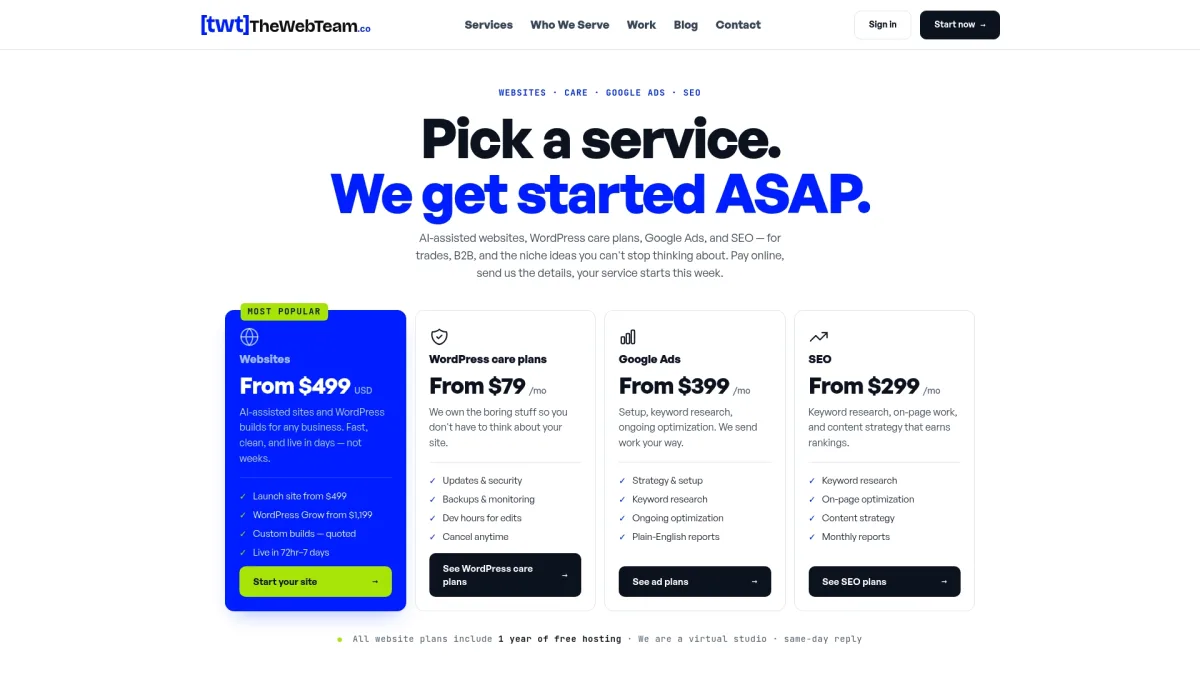
Thewebteam builds and manages WordPress websites, ongoing SEO care plans, and Google Ads campaigns specifically for B2B businesses and niche industries. Every engagement includes site structure built for local search, location pages written with genuine local content, and GBP optimization as part of the standard workflow. Clients launch within days, not weeks, and get continuous support as their local SEO program matures. If your offices need a digital marketing partner that treats local search as a core deliverable rather than an add-on, Thewebteam is built for exactly that.